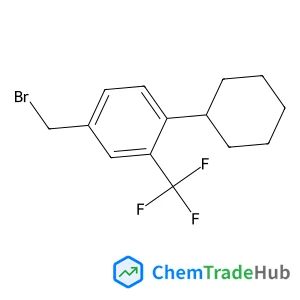
4-(Bromomethyl)-1-cyclohexyl-2-(trifluoromethyl)benzene
CAS Number:
800381-60-6
Molecular Formula:
C14H16BrF3
Michele Guizzardi, Silvio Bonfadini, Ilka Kriegel, Luigino Criante
Indium tin oxide (ITO) is a heavily doped semiconductor with a plasmonic response in the near infrared region. When exposed to light, the distribution of conduction band electron induces a change in the real and imaginary parts of the dielectric permittivity. The coupling of the electromagnetic waves with the electrons in the conduction band of metallic nanostructures with ultrashort light pulses results in a nonlinear plasmonic response. Such optical modulation occurring on ultrafast time scales, e.g. picosecond response times, can be exploited and used to create integrated optical components with terahertz modulation speed. Here, we present a photophysical study on a one dimensional ITO grating, realized using a femtosecond micromachining process, a very industrially accessible technology. The geometries, dimensions and pitch of the various gratings analyzed are obtained by means of direct ablation in a controlled atmosphere of a homogeneous thin layer of ITO deposited on a glass substrate. The pitch has been selected in order to obtain a higher order of the photonic band gap in the visible spectral region. Femtosecond micromachining technology guarantees precision, repeatability and extreme manufacturing flexibility. By means of ultrafast pump–probe spectroscopy, we characterize both the plasmon and inter-band temporal dynamics. We observe a large optical nonlinearity of the ITO grating in the visible range, where the photonic band gap occurs, when pumped at the surface plasmon resonance in the near infrared (1500 nm) region. All together, we show the possibility of all-optical signal modulation with heavily doped semiconductors in their transparency window with a picosecond response time through the formation of ITO grating structures.
DOI: 10.1039/B908378B
Yun Chen, Hui Li, Shuanglian Cai
DOI: 10.1039/B908853A
Tibor Hianik, Igor Grman, Ivana Karpisova
DOI: 10.1039/B910981A
Therese Buskas, Pamela Thompson, Geert-Jan Boons
DOI: 10.1039/B908664C
Ekaterina V. Skorb, Dmitry V. Sviridov, Helmuth Möhwald, Dmitry G. Shchukin
DOI: 10.1039/B914257F
A. M. Coto-García, M. T. Fernández-Argüelles, J. M. Costa-Fernández, A. Sanz-Medel
DOI: 10.1039/B909469E
Lei Zhang, Christian Chmelik, Adri N. C. van Laak, Jörg Kärger, Petra E. de Jongh, Krijn P. de Jong
DOI: 10.1039/B914391B
Boon Ping Ting, Jie Zhang, Majad Khan, Yi Yan Yang, Jackie Y. Ying
DOI: 10.1039/B910730D
When handling lithium chloride hydrate (1:1:1) (CAS: 16712-20-2), it is importan...
4-(4H-1,2,4-Triazol-4-yl)piperidine is generally considered safe for use in phar...
Waste containing 1,3-Thiazole-2-carboxamide (CAS: 16733-85-0) should be collecte...
5-(Difluoromethyl)-2-fluorobenzonitrile (CAS: 934175-58-3) is subject to regulat...
Methyl 3-acetamido-2-thiophenecarboxylate can be synthesized by the reaction of ...
4-Isoquinolinecarbonitrile is a chemical compound with the CAS number 34846-65-6...
Store Methyl 1H-1,2,3-triazole-4-carboxylate (CAS: 877309-59-6) in a cool, dry p...
6-Bromo[1,3]thiazolo[5,4-b]pyridin-2-amine (CAS: 1160791-13-8) is subject to the...
(2S,3S)-2-Ammonio-3-(3,4-dihydroxyphenyl)-3-hydroxypropanoate (CAS: 23651-95-8) ...
7-Bromo-3-methyl-3,4-dihydroquinazolin-4-one is a solid with a crystalline form....

Physical Chemistry Chemical Physics (PCCP) is an international journal co-owned by 19 physical chemistry and physics societies from around the world. This journal publishes original, cutting-edge research in physical chemistry, chemical physics and biophysical chemistry. To be suitable for publication in PCCP, articles must include significant innovation and/or insight into physical chemistry; this is the most important criterion that reviewers and Editors will judge against when evaluating submissions. The journal has a broad scope and welcomes contributions spanning experiment, theory, computation and data science. Topical coverage includes spectroscopy, dynamics, kinetics, statistical mechanics, thermodynamics, electrochemistry, catalysis, surface science, quantum mechanics, quantum computing and machine learning. Interdisciplinary research areas such as polymers and soft matter, materials, nanoscience, energy, surfaces/interfaces, and biophysical chemistry are welcomed if they demonstrate significant innovation and/or insight into physical chemistry. Joined experimental/theoretical studies are particularly appreciated when complementary and based on up-to-date approaches.
![(R)-N-[(S)-1-[2-(Diphenylphosphino)phenyl]ethyl]-2-methylpropane-2-sulfinamide structure](https://static.chemtradehub.com/structs/159/1595319-98-4-33e7.webp "(R)-N-[(S)-1-[2-(Diphenylphosphino)phenyl]ethyl]-2-methylpropane-2-sulfinamide structure")