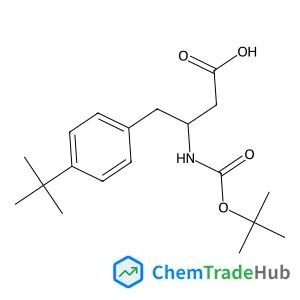
(S)-3-((tert-Butoxycarbonyl)amino)-4-(4-(tert-butyl)phenyl)butanoic acid
CAS Number:
403661-85-8
Molecular Formula:
C19H29NO4
Zheng Yao, Zhiqiang Lai, Chengchi Chen, Suting Xiao, Peihui Yang
Plant cell walls (CWs) with complex macromolecular structures can surround and protect cells from a variety of harsh environmental conditions such as pathogens, herbivores, and trace metals. Here, a novel strategy for in situ imaging of plant cell walls was developed to evaluate heavy metal pollution via thiolated full-color emissive carbon-dots (F-CDs) targeting Pb(II)-adsorbed onion cell walls. The thiolated F-CDs with excellent optical properties from red light to blue light were synthesized through a facile electrochemical approach using new precursors of luminol and L-tryptophan and further modified with L-cysteine. Based on a strong covalent interaction of Pb(II) and thiolated F-CDs, we achieved in situ fluorescence imaging for the Pb(II) adsorbed on CWs, which showed enhanced red, blue and green multi-color fluorescence (FL) on CWs with increased Pb(II)-ion content. In contrast, multi-color fluorescence on cytoplasm diminished, attributed to F-CDs targeting and accumulating on the cytoskeleton which thus limited F-CD diffusion into protoplasm. Therefore, in situ fluorescent images for CWs can demonstrate heavy metal contamination degrees in plant cells. This facile and undamaging protocol will be beneficial for investigating heavy metal migration into the protoplast and fast evaluation of food quality and safety.
Natasha W. Pettinger, Jennifer M. Empey, Sascha Fröbel, Bern Kohler
DOI: 10.1039/C9CP06579B
Albin Antony, Poornesh P., I. V. Kityk, K. Ozga, J. Jedryka, G. Myronchuk, Suresh D. Kulkarni, Ganesh Sanjeev, Vikash Chandra Petwal, Vijay Pal Verma, Jishnu Dwivedi
DOI: 10.1039/C9CP06323D
Sayoni Mitra, Chinh H. Duong, Mark A. Johnson
DOI: 10.1039/D0CP90054K
Zhendong Li, Jingxiao Bao
DOI: 10.1039/C9CP05635A
Nguyen-Thi Van-Oanh
DOI: 10.1039/C9CP05095G
Wei-Chih Liao, Atsuko Ogawa, Kazuhiko Sato, Christophe Copéret
DOI: 10.1039/C9CP05208A
Olivier J. J. Ronsin, DongJu Jang, Hans-Joachim Egelhaaf
DOI: 10.1039/D0CP00214C
Jaspreet Singh, Pooja Jamdagni, Mukesh Jakhar, Ashok Kumar
DOI: 10.1039/D0CP00511H
Susana Blanco, Juan Carlos López, Assimo Maris
DOI: 10.1039/D0CP00086H
Ellen C. Wrobel, Lucas S. de Lara, Taiza A. S. do Carmo, Patrícia Castellen, Márcio Lazzarotto, Sérgio R. de Lázaro, Alexandre Camilo, Jr, Luciano Caseli, Rolf Schmidt, Christine E. DeWolf, Karen Wohnrath
DOI: 10.1039/D0CP00432D
N-(4-Methoxybenzyl)-2-pyridinamine (CAS: 52818-63-0) is increasingly being used ...
When handling Ethyl 4-(2-chlorophenyl)-1,3-thiazole-2-carboxylate, appropriate p...
Diethyldiselane (CAS: 628-39-7) is classified under the Globally Harmonized Syst...
The market for oxocopper (CAS: 12053-18-8) is primarily driven by its use in cat...
The market for 5-{[(2-Methyl-2-propanyl)oxy]carbonyl}-5-azaspiro[2.4]heptane-7-c...
2-(1-Pyrrolidinyl)-4-pyridinamine is a chemical compound with the CAS number 359...
2-(3-Pyridinyl)-1-azabicyclo[2.2.2]octane (CAS: 91556-75-1) is a crystalline sol...
(S)-Alpha-allyl-proline hydrochloride is usually synthesized via a Wittig reacti...
3-Methyl-1,2-oxazole-5-carboxylic acid (CAS: 4857-42-5) is an organic compound w...
Lys-SMCC-DM1 is synthesized via a multi-step process involving the coupling of S...

Analyst publishes analytical and bioanalytical research that reports premier fundamental discoveries and inventions, and the applications of those discoveries, unconfined by traditional discipline barriers.
![2-[(5Z,8Z,11Z,14Z)-5,8,11,14-Icosatetraen-1-yloxy]-1,3-propanediol structure](https://static.chemtradehub.com/structs/222/222723-55-9-0348.webp "2-[(5Z,8Z,11Z,14Z)-5,8,11,14-Icosatetraen-1-yloxy]-1,3-propanediol structure")