












![6-Bromo-3-ethyl-3H-imidazo[4,5-b]pyridine structure](https://static.chemtradehub.com/structs/103/1033202-59-3-2a8f.webp "6-Bromo-3-ethyl-3H-imidazo[4,5-b]pyridine structure")
Fluorescence lifetime-based pH sensing by platinum nanoclusters
Literature Information
Publication Date
2019-04-26
DOI
10.1039/C9AN00061E
Impact Factor
4.616
Authors
Lihua Jin, Lulu Shi, Wenjuan Shi, Zheng Meng, Li Shang, Yehua Shen
View Original
Abstract
In this work, we report for the first time the application of ultrasmall Pt nanoclusters (Pt NCs) as a fluorescence-lifetime-based pH sensor. The fluorescence properties of our prepared Pt NCs show strong pH dependence, due to the change of the surface states of Pt NCs under alkaline/acidic conditions. Interestingly, both the fluorescence intensity and the fluorescence lifetime of Pt NCs exhibit a good linear relationship in the physiologically relevant pH range of 6.02–7.54. Our Pt NC-based pH sensor possesses many important features as an attractive sensor, including high anti-jamming capability, excellent stability and good reversibility. Moreover, the use of fluorescence lifetime as the optical readout signal rather than the intensity makes the present pH sensor more reliable in practical applications because the fluorescence lifetime is invariant to the probe concentration or changes in excitation conditions. Application of the Pt NC-based system for pH detection in real water samples and simulated intracellular environment samples has also been successfully demonstrated.
Related Literature
A new non-diffusional gas bubble production route in used nuclear fuel: implications for fission gas release, cladding corrosion, and next generation fuel design
Jon M. Schwantes, Jacob L. Bair, Edgar C. Buck, Ram Devanathan, Sean H. Kessler, Timothy G. Lach, Jason M. Lonergan, Bruce K. McNamara, Camille J. Palmer, Richard A. Clark
2020-01-28
Paper
DOI: 10.1039/C9CP05363H
Formation of N2 bubbles along grain boundaries in (ZnO)1−x(GaN)x: nanoscale STEM-EELS studies
Calliope Bazioti, Vegard S. Olsen, Andrej Y. Kuznetsov, Lasse Vines, Øystein Prytz
2020-01-31
Communication
DOI: 10.1039/C9CP06025A
Triplet fusion upconversion using sterically protected 9,10-diphenylanthracene as the emitter
Can Gao, Bolong Zhang, Christopher R. Hall, Li Li, Yeqin Chen, Yi Zeng, Trevor A. Smith, Wallace W. H. Wong
2020-02-26
Paper
DOI: 10.1039/C9CP06311K
Growth and auto-oxidation of Pd on single-layer AgOx/Ag(111)
Vikram Mehar, Christopher R. O’Connor, Mustafa Karatok, Robert J. Madix, Jason F. Weaver
2020-02-25
Paper
DOI: 10.1039/C9CP06973A
Xe⋯chalcogen aerogen bond. Effect of substituents and size of chalcogen atom
Ruijing Wang, Haojie Liu, Qingzhong Li, Steve Scheiner
2020-02-03
Paper
DOI: 10.1039/C9CP06648A
The challenging playground of astrochemistry: an integrated rotational spectroscopy – quantum chemistry strategy
Cristina Puzzarini, Vincenzo Barone
2020-03-05
Perspective
DOI: 10.1039/D0CP00561D
Correction: Calculation of vibrationally resolved absorption and fluorescence spectra of the rylenes
Jonas Greiner, Dage Sundholm
2020-02-07
Correction
DOI: 10.1039/D0CP90033H
Energy landscape of Au13: a global view of structure transformation
Xiao-Tian Li, Shao-Gang Xu
2020-01-27
Paper
DOI: 10.1039/C9CP06463J
You might also like
Compound Q&A
What is the market or research trend for N-(4-Methoxybenzyl)-2-pyridinamine (CAS: 52818-63-0)?
N-(4-Methoxybenzyl)-2-pyridinamine (CAS: 52818-63-0) is increasingly being used ...
52818-63-0N-(4-Methoxybenzyl)-...
Compound Q&A
What precautions should be taken when handling Ethyl 4-(2-chlorophenyl)-1,3-thiazole-2-carboxylate (CAS: 1050507-06-6)?
When handling Ethyl 4-(2-chlorophenyl)-1,3-thiazole-2-carboxylate, appropriate p...
1050507-06-6Ethyl 4-(2-chlorophe...
Compound Q&A
What regulatory guidelines apply to diethyldiselane (CAS: 628-39-7)?
Diethyldiselane (CAS: 628-39-7) is classified under the Globally Harmonized Syst...
628-39-7Diethyldiselane
Compound Q&A
What is the market or research trend for oxocopper (CAS: 12053-18-8)?
The market for oxocopper (CAS: 12053-18-8) is primarily driven by its use in cat...
12053-18-8oxocopper; oxo-(oxoc...
Compound Q&A
What is the market or research trend for 5-{[(2-Methyl-2-propanyl)oxy]carbonyl}-5-azaspiro[2.4]heptane-7-carboxylic acid?
The market for 5-{[(2-Methyl-2-propanyl)oxy]carbonyl}-5-azaspiro[2.4]heptane-7-c...
1268519-54-55-{[(2-Methyl-2-prop...
Compound Q&A
What is 2-(1-Pyrrolidinyl)-4-pyridinamine (CAS: 35981-63-6)?
2-(1-Pyrrolidinyl)-4-pyridinamine is a chemical compound with the CAS number 359...
35981-63-62-(1-Pyrrolidinyl)-4...
Compound Q&A
What are the physical and chemical properties of 2-(3-Pyridinyl)-1-azabicyclo[2.2.2]octane (CAS: 91556-75-1)?
2-(3-Pyridinyl)-1-azabicyclo[2.2.2]octane (CAS: 91556-75-1) is a crystalline sol...
91556-75-12-(3-Pyridinyl)-1-az...
Compound Q&A
How is (S)-Alpha-allyl-proline hydrochloride (CAS: 129704-91-2) typically synthesized?
(S)-Alpha-allyl-proline hydrochloride is usually synthesized via a Wittig reacti...
129704-91-2(S)-Alpha-allyl-prol...
Compound Q&A
What is 3-Methyl-1,2-oxazole-5-carboxylic acid (CAS: 4857-42-5)?
3-Methyl-1,2-oxazole-5-carboxylic acid (CAS: 4857-42-5) is an organic compound w...
4857-42-53-Methyl-1,2-oxazole...
Compound Q&A
How is Lys-SMCC-DM1 (CAS: 1281816-04-3) typically synthesized?
Lys-SMCC-DM1 is synthesized via a multi-step process involving the coupling of S...
1281816-04-3Lys-SMCC-DM1
Source Journal
Analyst

CiteScore:
7.8
Self-citation Rate:
5.6%
Articles per Year:
653
Analyst publishes analytical and bioanalytical research that reports premier fundamental discoveries and inventions, and the applications of those discoveries, unconfined by traditional discipline barriers.
Recommended Compounds
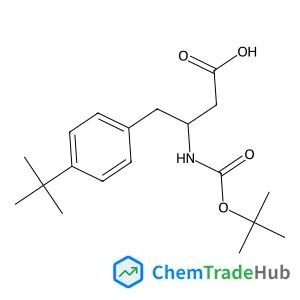
(S)-3-((tert-Butoxycarbonyl)amino)-4-(4-(tert-butyl)phenyl)butanoic acid
CAS Number:
403661-85-8
Molecular Formula:
C19H29NO4
Recommended Suppliers




Disclaimer
This page provides academic journal information for reference and research purposes only. We are not affiliated with any journal publishers and do not handle publication submissions. For publication-related inquiries, please contact the respective journal publishers directly.
If you notice any inaccuracies in the information displayed, please contact us at support@chemtradehub.com. We will promptly review and address your concerns.