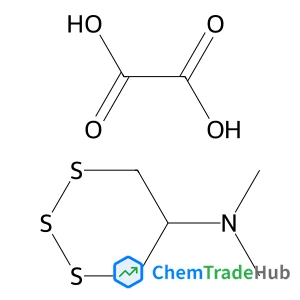
Oxalic acid compound with cyclohexylsulfamothioic O-acid (11)
CAS Number:
31895-22-4
Molecular Formula:
C7H13NO4S3
Chaeeun Lee, Hyemi Lee, Seungwon Lee, Hae-Geun Jeon, Kyu-Sung Jeong
Indolocarbazole-Pyridine (IP) hybrid foldamers have been known to adopt a helical conformation with an internal tubular cavity wherein water molecules are tightly packed via the formation of multiple cooperative hydrogen bonds. In order to develop IP foldamer-based receptors for ions and molecules other than water molecules, we herein prepare two modified IP foldamers 2 and 3 that contain a pyrrole and an inverted pyridine in the middle of the strands, respectively, instead of the original pyridine unit. Such site-specific modification significantly disrupts the hydrogen-bonding network between the entrapped water molecules and the interior of the cavity, thus allowing for binding two dihydrogenphosphate ions as a cyclic dimer inside the cavity as demonstrated by 1H NMR spectroscopy and X-ray crystal structure analysis. The crystal structures of the two complexes (H2PO4−)2 ⊂ 2 and (H2PO4−)2 ⊂ 3 are very similar to each other, with twelve hydrogen bonds between the bound dihydrogenphosphate dimer and the interior functional groups, indolocarbazole NH protons, pyridine nitrogen atoms and terminal OH protons in the helical tubular cavity.
Tobias Schwabe, Stefan Grimme
DOI: 10.1039/B704725H
Thomas F. Miller, III, David C. Clary
DOI: 10.1039/B314644H
Timur V. Tscherbul, Alexei A. Buchachenko, Mikhail E. Akopyan, Sergey A. Poretsky, Anatoly M. Pravilov, Thomas A. Stephenson
DOI: 10.1039/B402655A
W. D. Geppert, R. Thomas, F. Hellberg, A. Ehlerding, F. Österdahl, M. af Ugglas, M. Larsson
DOI: 10.1039/B403461A
H. Wang, H. Zhang, W. Rettig, A. I. Tolmachev, M. Glasbeek
DOI: 10.1039/B402229G
Zheng Su, Yunjie Xu
DOI: 10.1039/B504191K
Christopher W. Outhwaite
DOI: 10.1039/B316098J
A. Lund, E. Sagstuen
DOI: 10.1039/B400730A
H. R. Schober
DOI: 10.1039/B403557G
Stefania Cinelli, Alessio De Francesco, Giuseppe Onori, Alessandro Paciaroni
DOI: 10.1039/B402003K
Waste containing (6-Bromo-2-naphthyl)oxy](dimethyl)(2-methyl-2-propanyl)silane (...
7-Fluoro-4-isoquinolinecarboxylic acid can be synthesized via a multi-step proce...
2,3,5,6-Tetrabromothieno[3,2-b]thiophene is a crystalline compound with a high m...
1-[4-(Benzylamino)-7,8-dihydro-5H-pyrano[4,3-d]pyrimidin-2-yl]-2-methyl-1H-indol...
The market for imidazo[5,1-d]-1,2,3,5-tetrazine-8-carboxylic acid, 3,4-dihydro-3...
3-(Triisopropylsilyl)propiolaldehyde is a synthetic organic compound with the CA...
6-Nitro-2H-1,4-benzoxazin-3(4H)-one (CAS: 81721-87-1) is subject to various regu...
Waste containing (3-Fluorophenyl)(4-{[(2-methyl-2-propanyl)oxy]carbonyl}-1-piper...
N,N'-4,4'-Biphenyldiyldiisonicotinamide is a white crystalline solid with a mole...
6-Bromo-8-fluoro-2-quinazolinol is primarily used in the pharmaceutical industry...

Organic Chemistry Frontiers publishes high-quality research from across organic chemistry. Emphases are placed on studies that make significant contributions to the field of organic chemistry by reporting either new or significantly improved protocols or methodologies. Topics include, but are not limited to the following: Organic synthesis Development of synthetic methodologies Catalysis Natural products Functional organic materials Supramolecular and macromolecular chemistry Physical and computational organic chemistry
![2,2'-{2,2-Propanediylbis[(2,6-dibromo-4,1-phenylene)oxy]}diethanol structure](https://static.chemtradehub.com/structs/416/4162-45-2-b3d6.webp "2,2'-{2,2-Propanediylbis[(2,6-dibromo-4,1-phenylene)oxy]}diethanol structure")
![2,9-Dichloro-5,12-dihydroquinolino[2,3-b]acridine-7,14-dione structure](https://static.chemtradehub.com/structs/308/3089-17-6-750b.webp "2,9-Dichloro-5,12-dihydroquinolino[2,3-b]acridine-7,14-dione structure")
![10-(1-Azabicyclo[2.2.2]oct-3-ylmethyl)-10H-phenothiazine structure](https://static.chemtradehub.com/structs/292/29216-28-2-1d81.webp "10-(1-Azabicyclo[2.2.2]oct-3-ylmethyl)-10H-phenothiazine structure")