


Solvent-tuned chemoselective carboazidation and diazidation of alkenes via iron catalysis
Literature Information
Publication Date
2018-12-27
DOI
10.1039/C8QO01142G
Impact Factor
5.281
Authors
Lei Xu, Jian Chen, Lingling Chu
View Original
Abstract
We have described Fe-catalyzed chemoselective oxidative carboazidation and diazidation of alkenes by employing CH2Cl2 as the chloromethyl source and TMSN3 as the azido source. For the synthesis, we have taken the advantage of solvent-controlled generation of C-based and N-based radicals, allowing the construction of molecularly diverse azido compounds from readily available starting materials through a simple operation.
Recommended Journals

Science Progress

Organic Preparations and Procedures International

Pharmacological Reviews

Journal of Physics and Chemistry of Solids

Pure and Applied Chemistry

Russian Chemical Reviews

Israel Journal of Chemistry

Nature

Proceedings of the National Academy of Sciences of the United States of America

European Journal of Wood and Wood Products
Related Literature
Rapid detection of drug metabolites in latent fingermarks
Pompi Hazarika, Sue M. Jickells, David A. Russell
2008-11-25
Paper
DOI: 10.1039/B816273E
Correlated theoretical, spectroscopic and X-ray crystallographic studies of a non-covalent molecularly imprinted polymerisation system
John O'Mahony, Bjorn C. G. Karlsson, Boris Mizaikoff, Ian A. Nicholls
2007-08-16
Paper
DOI: 10.1039/B706258C
Upconverting phosphors in a dual-parameter LRET-based hybridization assay
Terhi Rantanen, Marja-Leena Järvenpää, Johanna Vuojola, Riikka Arppe, Katri Kuningas, Tero Soukka
2009-06-15
Paper
DOI: 10.1039/B901299K
Detection of secondary biomarker of met-eGH as a strategy to screen for somatotropin misuse in horseracing
Emeline Chu-Van, Gaud Pinel, Patrice Garcia, Marie-Agnès Popot, Geneviève André-Fontaine, Yves Bonnaire, Bruno Le Bizec
2007-12-21
Paper
DOI: 10.1039/B713712E
Peptide microarrays for carbohydrate recognition
Kathryn W. Boltz, Maria J. Gonzalez-Moa, Phillip Stafford, Sergei A. Svarovsky
2009-02-11
Communication
DOI: 10.1039/B823156G
Detection of lectin–glycan interaction using high resolution surface plasmon resonance
Kyle J. Foley, Erica S. Forzani, Lokesh Joshi, Nongjian Tao
2008-03-12
Communication
DOI: 10.1039/B719321A
Determination of enzyme kinetics and glutathione conjugates of chlortetracycline and chloroacetanilides using liquid chromatography–mass spectrometry
Michael Farkas, James O. Berry, Diana S. Aga
2007-05-29
Paper
DOI: 10.1039/B700561J
You might also like
Compound Q&A
Is 2-(2-chloroacetamido)-3-phenylpropanoic acid (CAS: 7765-11-9) safe?
2-(2-Chloroacetamido)-3-phenylpropanoic acid (CAS: 7765-11-9) is generally consi...
7765-11-92-(2-chloroacetamido...
Compound Q&A
Is 2-(Benzyloxy)-5-bromobenzoic acid (CAS: 62176-31-2) safe?
2-(Benzyloxy)-5-bromobenzoic acid can be handled safely if appropriate precautio...
62176-31-22-(Benzyloxy)-5-brom...
Compound Q&A
What is (4-Methyl-1,2,5-oxadiazol-3-yl)methanamine hydrochloride (CAS: 1159825-48-5)?
(4-Methyl-1,2,5-oxadiazol-3-yl)methanamine hydrochloride is a chemical compound ...
1159825-48-5(4-Methyl-1,2,5-oxad...
Compound Q&A
What is 2-(5-Hexylthiophen-2-yl)-4,4,5,5-tetramethyl-1,3,2-dioxaborolane (CAS: 917985-54-7)?
2-(5-Hexylthiophen-2-yl)-4,4,5,5-tetramethyl-1,3,2-dioxaborolane (CAS: 917985-54...
917985-54-72-(5-Hexylthiophen-2...
Compound Q&A
Are there alternatives to 4-(8-Methyl-9H-1,3-dioxolo[4,5-h][2,3]benzodiazepin-5-yl)benzenamine (CAS: 102771-26-6) in synthesis?
While 4-(8-Methyl-9H-1,3-dioxolo[4,5-h][2,3]benzodiazepin-5-yl)benzenamine (CAS:...
102771-26-64-(8-Methyl-9H-1,3-d...
Compound Q&A
What is the market or research trend for tert-butyl 3-hydroxy-4,5,7,8-tetrahydro-2H-pyrazolo[3,4-d]azepine-6-carboxylate (CAS: 851376-80-2)?
The market for tert-butyl 3-hydroxy-4,5,7,8-tetrahydro-2H-pyrazolo[3,4-d]azepine...
851376-80-2tert-butyl 3-hydroxy...
Compound Q&A
How should waste containing 3,5-Diamino-1H-pyrazole-4-carbonitrile (CAS: 6844-58-2) be handled?
Waste containing 3,5-Diamino-1H-pyrazole-4-carbonitrile (CAS: 6844-58-2) should ...
6844-58-23,5-Diamino-1H-pyraz...
Compound Q&A
How is (6-Fluoro-3-pyridinyl)boronic acid (CAS: 351019-18-6) typically synthesized?
(6-Fluoro-3-pyridinyl)boronic acid can be synthesized through the reaction of 6-...
351019-18-6(6-Fluoro-3-pyridiny...
Compound Q&A
What industries use Dibenzyl carbonimidoylbiscarbamate (CAS: 10065-79-9)?
Dibenzyl carbonimidoylbiscarbamate (CAS: 10065-79-9) finds applications in vario...
10065-79-9Dibenzyl carbonimido...
Compound Q&A
What is the market or research trend for (beta,beta,2,3,4,5,6-~2~H_7_)Phenylalanine (CAS: 74228-83-4)?
The market for (beta,beta,2,3,4,5,6-~2~H_7_)Phenylalanine (CAS: 74228-83-4) is g...
74228-83-4(beta,beta,2,3,4,5,6...
Source Journal
Organic Chemistry Frontiers

CiteScore:
7.8
Self-citation Rate:
8.7%
Articles per Year:
724
Organic Chemistry Frontiers publishes high-quality research from across organic chemistry. Emphases are placed on studies that make significant contributions to the field of organic chemistry by reporting either new or significantly improved protocols or methodologies. Topics include, but are not limited to the following: Organic synthesis Development of synthetic methodologies Catalysis Natural products Functional organic materials Supramolecular and macromolecular chemistry Physical and computational organic chemistry
Recommended Compounds
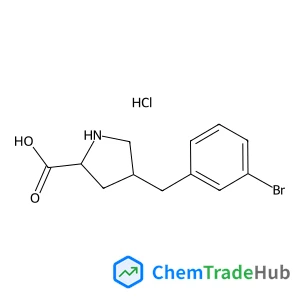
(2S,4R)-4-(3-Bromobenzyl)pyrrolidine-2-carboxylic acid hydrochloride
CAS Number:
1049734-10-2
Molecular Formula:
C12H15BrClNO2

Recommended Suppliers






Disclaimer
This page provides academic journal information for reference and research purposes only. We are not affiliated with any journal publishers and do not handle publication submissions. For publication-related inquiries, please contact the respective journal publishers directly.
If you notice any inaccuracies in the information displayed, please contact us at support@chemtradehub.com. We will promptly review and address your concerns.