












![(1S)-1,5-Anhydro-2-O-alpha-L-arabinopyranosyl-1-[5-hydroxy-7-({6-O-[3-(4-hydroxy-3-methoxyphenyl)propanoyl]-beta-D-glucopyranosyl}oxy)-2-(4-hydroxyphenyl)-4-oxo-4H-chromen-6-yl]-D-glucitol structure](https://static.chemtradehub.com/structs/225/2252345-81-4-bcff.webp "(1S)-1,5-Anhydro-2-O-alpha-L-arabinopyranosyl-1-[5-hydroxy-7-({6-O-[3-(4-hydroxy-3-methoxyphenyl)propanoyl]-beta-D-glucopyranosyl}oxy)-2-(4-hydroxyphenyl)-4-oxo-4H-chromen-6-yl]-D-glucitol structure")
Correlated theoretical, spectroscopic and X-ray crystallographic studies of a non-covalent molecularly imprinted polymerisation system
Literature Information
Publication Date
2007-08-16
DOI
10.1039/B706258C
Impact Factor
4.616
Authors
John O'Mahony, Bjorn C. G. Karlsson, Boris Mizaikoff, Ian A. Nicholls
View Original
Abstract
The correlation of the recognition properties of a molecularly imprinted polymer (MIP) with the recognition events in pre-polymerisation mixtures is of central importance to our understanding of the molecular imprinting technique. Using the NSAID naproxen as a model template, we have applied parallel theoretical (molecular dynamics) and practical (1H-NMR, X-ray crystallography, HPLC, radioligand binding) methods to examine the nature of template-functional monomer complexation. An effective imprint is achieved, despite the presence of only one site on the template which provides for the formation of effective electrostatic interactions with the functional monomer used, 4-vinylpyridine. This is attributed to the creation of a well-defined receptor site for the acidic terminus of the molecule and complementary van der Waals interactions, as described in preliminary simulations of the pre-polymerisation system, and as confirmed for the resultant MIP by HPLC data. Qualitative agreement is also observed between simulation and proton NMR data examining monomer self-association in the presence and absence of the template. On the basis of the data obtained, the role of a cross-linker appears to be more significant for this system than previously anticipated.
Related Literature
Structural characteristics of hydrated protons in the conductive channels: effects of confinement and fluorination studied by molecular dynamics simulation
Ning Zhang, Yuechun Song, Xuehua Ruan, Xiaoming Yan, Zhao Liu, Zhuanglin Shen, Xuemei Wu
2016-07-05
Paper
DOI: 10.1039/C6CP03012B
Quantum phase transitions in Sn bilayer based interfacial systems by an external strain
Li Chen, Qiandong Zhuang, Yeqing Chen, Changmin Shi, Dongchao Wang
2016-08-03
Paper
DOI: 10.1039/C6CP04534K
Elucidating dominant pathways of the nano-particle self-assembly process
Xiangze Zeng, Bin Li, Qin Qiao, Lizhe Zhu, Zhong-Yuan Lu
2016-05-13
Paper
DOI: 10.1039/C6CP01808D
Studies of cytochrome c-551 unfolding using fluorescence correlation spectroscopy and other biophysical techniques
Pallabi Sil, Simanta Sarani Paul, Eva Di Silvio, Carlo Travaglini-Allocatelli, Krishnananda Chattopadhyay
2016-08-10
Paper
DOI: 10.1039/C6CP04819F
A comparison of adsorbed and grafted fibronectin coatings under static and dynamic conditions
Sergio Díaz-Rodríguez, Ranna Tolouei, Pascale Chevallier, Emmanuel Pauthe, Diego Mantovani
2016-08-08
Paper
DOI: 10.1039/C6CP04527H
Tautomerization lowers the activation barriers for N-glycosidic bond cleavage of protonated uridine and 2′-deoxyuridine
R. R. Wu, M. T. Rodgers
2016-08-04
Paper
DOI: 10.1039/C6CP03620A
Microscopic mechanistic study on the multiferroic of R2CoMnO6/La2CoMnO6 (R = Ce, Pr, Nd, Pm, Sm, Gd, Tb, Dy, Ho, Er, Tm) by chemical and hydrostatic pressures: a first-principles calculation
Xiaojuan Liu, Xianfeng Hao, Jian Meng, Hongjie Zhang
2016-07-22
Paper
DOI: 10.1039/C6CP03145E
From bulk to plasmonic nanoparticle surfaces: the behavior of two potent therapeutic peptides, octreotide and pasireotide
Belén Hernández, Eduardo López-Tobar, Santiago Sanchez-Cortes, Yves-Marie Coïc, Bruno Baron, Alexandre Chenal, Fernando Pflüger, Régis Cohen, Mahmoud Ghomi
2016-08-03
Paper
DOI: 10.1039/C6CP04421B
Tribotronic control of friction in oil-based lubricants with ionic liquid additives
P. K. Cooper, H. Li, G. B. Webber, R. Atkin
2016-08-03
Paper
DOI: 10.1039/C6CP04405K
You might also like
Compound Q&A
Is 2-(2-chloroacetamido)-3-phenylpropanoic acid (CAS: 7765-11-9) safe?
2-(2-Chloroacetamido)-3-phenylpropanoic acid (CAS: 7765-11-9) is generally consi...
7765-11-92-(2-chloroacetamido...
Compound Q&A
Is 2-(Benzyloxy)-5-bromobenzoic acid (CAS: 62176-31-2) safe?
2-(Benzyloxy)-5-bromobenzoic acid can be handled safely if appropriate precautio...
62176-31-22-(Benzyloxy)-5-brom...
Compound Q&A
What is (4-Methyl-1,2,5-oxadiazol-3-yl)methanamine hydrochloride (CAS: 1159825-48-5)?
(4-Methyl-1,2,5-oxadiazol-3-yl)methanamine hydrochloride is a chemical compound ...
1159825-48-5(4-Methyl-1,2,5-oxad...
Compound Q&A
What is 2-(5-Hexylthiophen-2-yl)-4,4,5,5-tetramethyl-1,3,2-dioxaborolane (CAS: 917985-54-7)?
2-(5-Hexylthiophen-2-yl)-4,4,5,5-tetramethyl-1,3,2-dioxaborolane (CAS: 917985-54...
917985-54-72-(5-Hexylthiophen-2...
Compound Q&A
Are there alternatives to 4-(8-Methyl-9H-1,3-dioxolo[4,5-h][2,3]benzodiazepin-5-yl)benzenamine (CAS: 102771-26-6) in synthesis?
While 4-(8-Methyl-9H-1,3-dioxolo[4,5-h][2,3]benzodiazepin-5-yl)benzenamine (CAS:...
102771-26-64-(8-Methyl-9H-1,3-d...
Compound Q&A
What is the market or research trend for tert-butyl 3-hydroxy-4,5,7,8-tetrahydro-2H-pyrazolo[3,4-d]azepine-6-carboxylate (CAS: 851376-80-2)?
The market for tert-butyl 3-hydroxy-4,5,7,8-tetrahydro-2H-pyrazolo[3,4-d]azepine...
851376-80-2tert-butyl 3-hydroxy...
Compound Q&A
How should waste containing 3,5-Diamino-1H-pyrazole-4-carbonitrile (CAS: 6844-58-2) be handled?
Waste containing 3,5-Diamino-1H-pyrazole-4-carbonitrile (CAS: 6844-58-2) should ...
6844-58-23,5-Diamino-1H-pyraz...
Compound Q&A
How is (6-Fluoro-3-pyridinyl)boronic acid (CAS: 351019-18-6) typically synthesized?
(6-Fluoro-3-pyridinyl)boronic acid can be synthesized through the reaction of 6-...
351019-18-6(6-Fluoro-3-pyridiny...
Compound Q&A
What industries use Dibenzyl carbonimidoylbiscarbamate (CAS: 10065-79-9)?
Dibenzyl carbonimidoylbiscarbamate (CAS: 10065-79-9) finds applications in vario...
10065-79-9Dibenzyl carbonimido...
Compound Q&A
What is the market or research trend for (beta,beta,2,3,4,5,6-~2~H_7_)Phenylalanine (CAS: 74228-83-4)?
The market for (beta,beta,2,3,4,5,6-~2~H_7_)Phenylalanine (CAS: 74228-83-4) is g...
74228-83-4(beta,beta,2,3,4,5,6...
Source Journal
Analyst

CiteScore:
7.8
Self-citation Rate:
5.6%
Articles per Year:
653
Analyst publishes analytical and bioanalytical research that reports premier fundamental discoveries and inventions, and the applications of those discoveries, unconfined by traditional discipline barriers.
Recommended Compounds
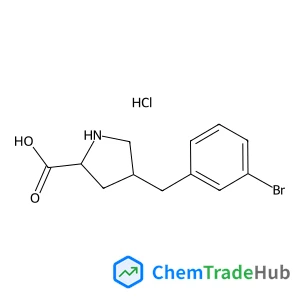
(2S,4R)-4-(3-Bromobenzyl)pyrrolidine-2-carboxylic acid hydrochloride
CAS Number:
1049734-10-2
Molecular Formula:
C12H15BrClNO2
![Heptadecanoic Acid 3-[2-[4-(6-Fluoro-1,2-benzisoxazol-3-yl)-1-piperidinyl]ethyl]-6,7,8,9-tetrahydro-2-methyl-4-oxo-4H-pyrido[1,2-a]pyrimidin-9-yl Ester structure](https://static.chemtradehub.com/structs/140/1404053-62-8-9da4.webp "Heptadecanoic Acid 3-[2-[4-(6-Fluoro-1,2-benzisoxazol-3-yl)-1-piperidinyl]ethyl]-6,7,8,9-tetrahydro-2-methyl-4-oxo-4H-pyrido[1,2-a]pyrimidin-9-yl Ester structure")
Heptadecanoic Acid 3-[2-[4-(6-Fluoro-1,2-benzisoxazol-3-yl)-1-piperidinyl]ethyl]-6,7,8,9-tetrahydro-2-methyl-4-oxo-4H-pyrido[1,2-a]pyrimidin-9-yl Ester
CAS Number:
1404053-62-8
Molecular Formula:
C40H59FN4O4
![3,7-Di(1,1':3',1''-terphenyl-5'-yl)-10,11,12,13-tetrahydrodiindeno[7,1-de:1',7'-fg][1,3,2]dioxaphosphocin-5-ol 5-oxide structure](https://static.chemtradehub.com/structs/135/1352810-38-8-3f10.webp "3,7-Di(1,1':3',1''-terphenyl-5'-yl)-10,11,12,13-tetrahydrodiindeno[7,1-de:1',7'-fg][1,3,2]dioxaphosphocin-5-ol 5-oxide structure")
3,7-Di(1,1':3',1''-terphenyl-5'-yl)-10,11,12,13-tetrahydrodiindeno[7,1-de:1',7'-fg][1,3,2]dioxaphosphocin-5-ol 5-oxide
CAS Number:
1352810-38-8
Molecular Formula:
C53H39O4P
Recommended Suppliers






Disclaimer
This page provides academic journal information for reference and research purposes only. We are not affiliated with any journal publishers and do not handle publication submissions. For publication-related inquiries, please contact the respective journal publishers directly.
If you notice any inaccuracies in the information displayed, please contact us at support@chemtradehub.com. We will promptly review and address your concerns.