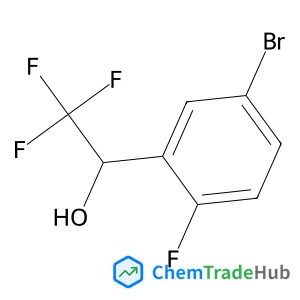
1-(5-Bromo-2-fluorophenyl)-2,2,2-trifluoroethanol
CAS Number:
1039827-16-1
Molecular Formula:
C8H5BrF4O
Michael Farkas, James O. Berry, Diana S. Aga
Glutathione S-transferases (GSTs) isolated from chlortetracycline (CTC)-treated maize catalyzed the conjugation of glutathione (GSH) with CTC, producing stable conjugates that were structurally characterized using liquid chromatography–ion-trap mass spectrometry (LC–IT-MS). Enzyme-mediated dechlorination of CTC resulted during GSH conjugation as revealed by the mass spectra of the CTC–GSH conjugate, which was characterized by the loss of the chlorine isotopic signature, and shorter chromatographic retention time relative to the chlorinated parent compound. Several fragmentation patterns in the mass spectrum of the CTC–GSH conjugate can be used to verify the identity of the enzyme reaction products. The expected molecular ion [M + H]+ of the CTC–GSH conjugate (m/z 751) with chlorine removal was not observed in the positive electrospray ionization. Instead, a base peak of m/z 677, corresponding to the loss of glycine (MW = 75 Da), was observed. When m/z 677 was subjected to further fragmentation, characteristic peaks corresponding to the loss of glutamic acid (m/z = 129) and water (m/z 18) were observed in the MS/MS spectrum. The catalytic activity of the CTC-induced GST towards dechlorination of chloroacetanilide herbicides (alachlor, metolachlor and propachlor), which are known to be detoxified in plants via the glutathione pathway, was also evaluated in vitro. Glutathione conjugates of chloroacetanilides also showed the losses of m/z 129 and m/z 18 that are characteristic of GSH conjugates when characterized by LC–IT-MS. Interestingly, the sensitivity of LC–IT-MS made it possible, for the first time, to detect chloroacetanilides that are conjugated with two GSH molecules, in addition to the known single GSH conjugates. This research demonstrates a more sensitive and specific method of measuring enzyme reaction products using LC–IT-MS.
X. S. Liu, H. J. Chen, M. J. Chao, E. J. Liang
DOI: 10.1039/C5CP00045A
Gong Chen, Xian Kong, Jingying Zhu, Diannan Lu, Zheng Liu
DOI: 10.1039/C5CP00418G
Graham E. Morse, Agnès Rivaton, Thomas Chassé, Christine Taviot-Gueho, Nicolas Blouin, Owen R. Lozman, Steven Tierney
DOI: 10.1039/C5CP01158B
Aleš Vítek, René Kalus
DOI: 10.1039/C4CP04909H
Ana R. Santos, Rebecca K. Blundell, Peter Licence
DOI: 10.1039/C5CP01069A
Qian Zhang, Jia-Jia Chen, Xue-Yin Wang, Cheng Yang, Ming-Sen Zheng, Quan-Feng Dong
DOI: 10.1039/C5CP00799B
Piotr A. Guńka, Zygmunt Gontarz, Janusz Zachara
DOI: 10.1039/C4CP05656F
Huan Lin, Dan Liu, Jinlin Long, Zizhong Zhang, Huaqiang Zhuang, Yi Zheng, Xuxu Wang
DOI: 10.1039/C5CP00720H
Kuiwen Zhao, Huiying Wu
DOI: 10.1039/C4CP06054G
Serena Esposito, Barbara Bonelli, Marco Armandi, Edoardo Garrone, Guido Saracco
DOI: 10.1039/C5CP00191A
2-(2-Chloroacetamido)-3-phenylpropanoic acid (CAS: 7765-11-9) is generally consi...
2-(Benzyloxy)-5-bromobenzoic acid can be handled safely if appropriate precautio...
(4-Methyl-1,2,5-oxadiazol-3-yl)methanamine hydrochloride is a chemical compound ...
2-(5-Hexylthiophen-2-yl)-4,4,5,5-tetramethyl-1,3,2-dioxaborolane (CAS: 917985-54...
While 4-(8-Methyl-9H-1,3-dioxolo[4,5-h][2,3]benzodiazepin-5-yl)benzenamine (CAS:...
The market for tert-butyl 3-hydroxy-4,5,7,8-tetrahydro-2H-pyrazolo[3,4-d]azepine...
Waste containing 3,5-Diamino-1H-pyrazole-4-carbonitrile (CAS: 6844-58-2) should ...
(6-Fluoro-3-pyridinyl)boronic acid can be synthesized through the reaction of 6-...
Dibenzyl carbonimidoylbiscarbamate (CAS: 10065-79-9) finds applications in vario...
The market for (beta,beta,2,3,4,5,6-~2~H_7_)Phenylalanine (CAS: 74228-83-4) is g...

Analyst publishes analytical and bioanalytical research that reports premier fundamental discoveries and inventions, and the applications of those discoveries, unconfined by traditional discipline barriers.
![Heptadecanoic Acid 3-[2-[4-(6-Fluoro-1,2-benzisoxazol-3-yl)-1-piperidinyl]ethyl]-6,7,8,9-tetrahydro-2-methyl-4-oxo-4H-pyrido[1,2-a]pyrimidin-9-yl Ester structure](https://static.chemtradehub.com/structs/140/1404053-62-8-9da4.webp "Heptadecanoic Acid 3-[2-[4-(6-Fluoro-1,2-benzisoxazol-3-yl)-1-piperidinyl]ethyl]-6,7,8,9-tetrahydro-2-methyl-4-oxo-4H-pyrido[1,2-a]pyrimidin-9-yl Ester structure")
![{3-[Bis(4-hydroxyphenyl)methyl]-1-[2-(dimethylamino)ethyl]-1H-indol-2-yl}[4-(2-chlorophenyl)-1-piperazinyl]methanone structure](https://static.chemtradehub.com/structs/170/170365-25-0-e4d7.webp "{3-[Bis(4-hydroxyphenyl)methyl]-1-[2-(dimethylamino)ethyl]-1H-indol-2-yl}[4-(2-chlorophenyl)-1-piperazinyl]methanone structure")