


In vivo programming of tumor mitochondria-specific doxorubicin delivery by a cationic glycolipid polymer for enhanced antitumor activity
Literature Information
Publication Date
2018-12-06
DOI
10.1039/C8PY01504J
Impact Factor
5.582
Authors
Yanan Tan, Xiqin Yang, Suhuan Dai, Keke Lian, Lijuan Wen, Yun Zhu, Tingting Meng, Xuan Liu, Hong Yuan
View Original
Abstract
The selective delivery of DOX into tumor mitochondria in vitro and in vivo, which can be achieved with the aid of a skeletal polymer with positively charged and lipophilic character, may significantly promote its antitumor efficiency as well as eliminate its severe cardiotoxicity. In this study, we developed a polycationic glycolipid polymer (CSOSA) as a skeletal nanomaterial, which was further modified with lipophilic (4-carboxybutyl) triphenylphosphonium bromide (CTPP) cations to form the mitochondria-targeted polymer C-P-CSOSA. In vitro, C-P-CSOSA polymer micelles were internalized more by tumor cells than normal cells and exhibited rapid lysosomal escape capability due to their strong proton buffering ability. When loaded with DOX, the C-P-CSOSA/DOX micelles could selectively target mitochondria in tumor cells and remarkably activate the mitochondrial apoptosis signaling pathway. Importantly, the C-P-CSOSA polymer exhibited significant mitochondrial co-localization in vivo. Moreover, C-P-CSOSA/DOX demonstrated the highest tumor-inhibition rate (75.0%), when compared with CSOSA/DOX (44.8%) and DOX·HCl (55.0%). Meaningfully, C-P-CSOSA/DOX did not cause obvious organ damage and exhibited the longest survival time, indicating the low toxicity of this polymer. This study opens up new avenues for the future clinical translation of mitochondrial-targeted drug delivery systems.
Recommended Journals

Colloid Journal

Journal of Asian Natural Products Research

Chinese Journal of Chemistry

Polycyclic Aromatic Compounds

Bioorganic & Medicinal Chemistry

Medicinal Chemistry Research

Journal of Chemical Sciences

Journal of the Indian Institute of Science

Herald of the Russian Academy of Sciences

Electroanalysis
Related Literature
Potential energy surfaces for ground and excited electronic states of the CF3I molecule and their relevance to its A-band photodissociation
Aleksey B. Alekseyev, Heinz-Peter Liebermann, Robert J. Buenker
2013-02-15
Paper
DOI: 10.1039/C3CP44237C
Modeling environment effects on spectroscopies through QM/classical models
Benedetta Mennucci
2013-01-08
Perspective
DOI: 10.1039/C3CP44417A
Interpretation of experimental hydrogen-bond enthalpies and entropies from COSMO polarisation charge densities
Jens Reinisch, Frank Eckert, Jérôme Graton, Jean-Yves Le Questel
2013-03-22
Paper
DOI: 10.1039/C3CP44611E
Fast phase formation of double-filled p-type skutterudites by ball-milling and hot-pressing
Qing Jie, Hengzhi Wang, Weishu Liu, Hui Wang, Gang Chen, Zhifeng Ren
2013-02-11
Paper
DOI: 10.1039/C3CP50327E
The reaction force constant as an indicator of synchronicity/nonsynchronicity in [4+2] cycloaddition processes
Diana Yepes, Oscar Donoso-Tauda, Patricia Pérez, Pablo Jaque
2013-01-18
Paper
DOI: 10.1039/C3CP44197K
Examination of the chemical behavior of the quercetin radical cation towards some bases
Zoran Marković, Dragan Amić, Dejan Milenković, Jasmina M. Dimitrić-Marković, Svetlana Marković
2013-03-22
Paper
DOI: 10.1039/C3CP44605K
Photoinduced energy and charge transfer in a p-phenylene-linked dyad of boron dipyrromethene and monostyryl boron dipyrromethene
Roel Menting, Jian-Yong Liu, Ying-Si Huang, Dennis K. P. Ng, Beate Röder
2013-03-15
Paper
DOI: 10.1039/C3CP50576F
Photoelectrical properties and the electronic structure of Tl1−xIn1−xSnxSe2 (x = 0, 0.1, 0.2, 0.25) single crystalline alloys
G. E. Davydyuk, H. Kamarudin, G. L. Myronchuk, S. P. Danylchuk, A. O. Fedorchuk, L. V. Piskach, M. Yu. Mozolyuk, O. V. Parasyuk
2013-03-12
Paper
DOI: 10.1039/C3CP50836F
High permeability and salt rejection reverse osmosis by a zeolite nano-membrane
Yilun Liu
2013-02-12
Paper
DOI: 10.1039/C3CP43854F
You might also like
Compound Q&A
What precautions should be taken when handling 4-(2-Furylmethyl)thiomorpholine 1,1-dioxide (CAS: 79206-94-3)?
When handling 4-(2-Furylmethyl)thiomorpholine 1,1-dioxide (CAS: 79206-94-3), it ...
79206-94-34-(2-Furylmethyl)thi...
Compound Q&A
What precautions should be taken when handling 4-Chloro-N-[2-(4-morpholinyl)ethyl]benzamide (CAS: 71320-77-9)?
When handling 4-Chloro-N-[2-(4-morpholinyl)ethyl]benzamide (CAS: 71320-77-9), it...
71320-77-94-Chloro-N-[2-(4-mor...
Compound Q&A
How should waste containing 2-[2-(2-Methoxyethoxy)ethoxy]ethyl 4-methylbenzenesulfonate (CAS: 62921-74-8) be handled?
Waste containing this compound (CAS: 62921-74-8) should be handled according to ...
62921-74-82-[2-(2-Methoxyethox...
Compound Q&A
How should waste containing (S)-Methyl 2-amino-3-cyclohexylpropanoate be handled?
Waste containing (S)-Methyl 2-amino-3-cyclohexylpropanoate should be collected i...
40056-18-6(S)-Methyl 2-amino-3...
Compound Q&A
How is 5-({4-[(2S,4R)-4-Hydroxy-2-methyltetrahydro-2H-pyran-4-yl]-2-thienyl}sulfanyl)-1-methyl-1,3-dihydro-2H-indol-2-one (CAS: 166882-70-8) typically synthesized?
This compound can be synthesized using a multi-step process involving the conjug...
166882-70-85-({4-[(2S,4R)-4-Hyd...
Compound Q&A
Are there alternatives to (2E)-3-(3,4-Dichlorophenyl)acrylic acid (CAS: 7312-27-8) in synthesis?
There are several alternatives to (2E)-3-(3,4-Dichlorophenyl)acrylic acid in syn...
7312-27-8(2E)-3-(3,4-Dichloro...
Compound Q&A
How should Ethyl 6-(2-nitrophenyl)imidazo[2,1-b][1,3]thiazole-3-carboxylate (CAS: 925437-84-9) be stored?
Ethyl 6-(2-nitrophenyl)imidazo[2,1-b][1,3]thiazole-3-carboxylate (CAS: 925437-84...
925437-84-9Ethyl 6-(2-nitrophen...
Compound Q&A
How should waste containing 2-(1,3-Thiazol-2-yl)ethanamine (CAS: 18453-07-1) be handled?
Waste containing 2-(1,3-Thiazol-2-yl)ethanamine (CAS: 18453-07-1) should be coll...
18453-07-12-(1,3-Thiazol-2-yl)...
Compound Q&A
How is Methyl 5-iodo-2-methylbenzoate (CAS: 103440-54-6) typically synthesized?
Methyl 5-iodo-2-methylbenzoate can be synthesized through the iodination of meth...
103440-54-6Methyl 5-iodo-2-meth...
Compound Q&A
How is 5-Chloro[1,2,4]triazolo[1,5-a]pyridine (CAS: 1427399-34-5) typically synthesized?
5-Chloro[1,2,4]triazolo[1,5-a]pyridine is commonly synthesized via the condensat...
1427399-34-55-Chloro[1,2,4]triaz...
Source Journal
Polymer Chemistry

CiteScore:
8.6
Self-citation Rate:
7.3%
Articles per Year:
457
Polymer Chemistry welcomes submissions in all areas of polymer science that have a strong focus on macromolecular chemistry. Manuscripts may cover a broad range of fields, yet no direct application focus is required.
Recommended Compounds
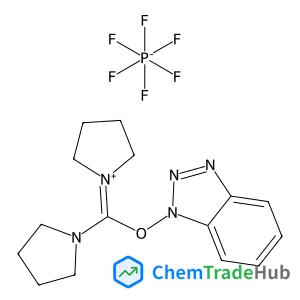
(1H-Benzotriazol-1-yloxy)(di-1-pyrrolidinyl)methylium hexafluorophosphate
CAS Number:
105379-24-6
Molecular Formula:
C15H21F6N5OP
Recommended Suppliers





Disclaimer
This page provides academic journal information for reference and research purposes only. We are not affiliated with any journal publishers and do not handle publication submissions. For publication-related inquiries, please contact the respective journal publishers directly.
If you notice any inaccuracies in the information displayed, please contact us at support@chemtradehub.com. We will promptly review and address your concerns.