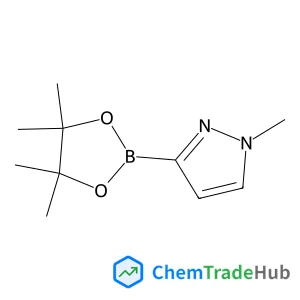
1-Methyl-3-(4,4,5,5-tetramethyl-1,3,2-dioxaborolan-2-yl)-1H-pyrazole
CAS Number:
1020174-04-2
Molecular Formula:
C10H17BN2O2
Wen-Hua Chen, Junko Aimi, Yi-Shen Huang, Sathesh Venkatesan, Yeo-Wan Chiang, Shih-Hung Huang, Shiao-Wei Kuo, Tao Chen
In this study we prepared a novel triblock copolymer (tBCP) through ring-opening polymerization (ROP) with ε-caprolactone (ε-CL) and two specific atom transfer radical polymerizations (ATRPs), with n-butyl acrylate (nBA) and methyl methacrylate (MMA), respectively (herein, a supplemental activator and reducing agent and halogen-exchange ATRPs were employed). These chain-extending polymerizations were chosen to achieve controlled/living polymerization. This strategy afforded a well-defined ABC-type PCL-b-PnBA-b-PMMA tBCP (Mn, GPC = 56 600; PDI = 1.18) comprising two external miscible blocks with an epoxy monomer and a middle soft block. After curing with the diglycidyl ether of bisphenol-A and 4,4′-methylenedianiline, the miscibility of the resulting epoxy thermoset (ET)/tBCP composites was examined using Fourier transform infrared spectroscopy, differential scanning calorimetry, and thermogravimetric analysis. On further examining the ET/tBCP microstructures using transmission electron microscopy and small-angle X-ray scattering, we observed transitions with a long range order—from lamellar to core/shell cylinder to short core/shell cylinder morphologies—upon increasing the amount of ET. The domain sizes obtained after the curing reaction were in the range of approximately 30–60 nm.
ZhenHua Zeng, Mårten E. Björketun, Sune Ebbesen, Mogens B. Mogensen, Jan Rossmeisl
DOI: 10.1039/C3CP51099A
Magali Duvail, Jean-François Dufrêche, Lise Arleth, Thomas Zemb
DOI: 10.1039/C3CP43981J
Matija Zlatar, Maja Gruden-Pavlović, Mireia Güell
DOI: 10.1039/C2CP43735J
Joseph W. DePalma, Andrew J. Horan, Wiley A. Hall IV, Murray V. Johnston
DOI: 10.1039/C3CP44586K
Guilherme Oliveira Siqueira, Tulio Matencio, Herculano Vieira da Silva, Yara Gonçalves de Souza, José Domingos Ardisson, Geraldo Magela de Lima, Arilza de Oliveira Porto
DOI: 10.1039/C3CP50549A
Christoph Kölbl, Beate Stempfle
DOI: 10.1039/C3CP44693J
Pierre Terech, Minhao Yan, Manuel Maréchal, Guy Royal, Jose Galvez, Sabareesh K. P. Velu
DOI: 10.1039/C3CP50671A
Qian Gou, Gang Feng, Luca Evangelisti, Alberto Lesarri, Emilio J. Cocinero, Walther Caminati
DOI: 10.1039/C3CP50306B
Martin Thomas, Martin Brehm, Reinhold Fligg, Peter Vöhringer, Barbara Kirchner
DOI: 10.1039/C3CP44302G
When handling 4-(2-Furylmethyl)thiomorpholine 1,1-dioxide (CAS: 79206-94-3), it ...
When handling 4-Chloro-N-[2-(4-morpholinyl)ethyl]benzamide (CAS: 71320-77-9), it...
Waste containing this compound (CAS: 62921-74-8) should be handled according to ...
Waste containing (S)-Methyl 2-amino-3-cyclohexylpropanoate should be collected i...
This compound can be synthesized using a multi-step process involving the conjug...
There are several alternatives to (2E)-3-(3,4-Dichlorophenyl)acrylic acid in syn...
Ethyl 6-(2-nitrophenyl)imidazo[2,1-b][1,3]thiazole-3-carboxylate (CAS: 925437-84...
Waste containing 2-(1,3-Thiazol-2-yl)ethanamine (CAS: 18453-07-1) should be coll...
Methyl 5-iodo-2-methylbenzoate can be synthesized through the iodination of meth...
5-Chloro[1,2,4]triazolo[1,5-a]pyridine is commonly synthesized via the condensat...

Polymer Chemistry welcomes submissions in all areas of polymer science that have a strong focus on macromolecular chemistry. Manuscripts may cover a broad range of fields, yet no direct application focus is required.