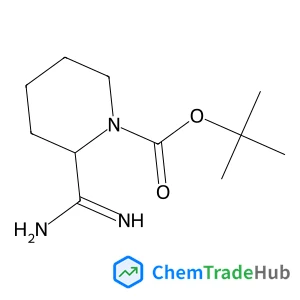
2-Methyl-2-propanyl 2-carbamimidoyl-1-piperidinecarboxylate
CAS Number:
1258640-98-0
Molecular Formula:
C11H21N3O2
Keisuke Tanaka, Yoichi Miyamoto, Takumi Okuda, Tatsuro Kasai, Kentaro Onodera, Masahiro Oka, Yoshihiro Yoneda
Correction for ‘Development of oligonucleotide-based antagonists of Ebola virus protein 24 inhibiting its interaction with karyopherin alpha 1′ by Keisuke Tanaka et al., Org. Biomol. Chem., 2018, 16, 4456–4463.
Genki Sakata, Minoru Mizuhata
DOI: 10.1039/C7AN00067G
Anthony Dicken, Daniel Spence, Keith Rogers, Danae Prokopiou, Paul Evans
DOI: 10.1039/C8AN01537F
Shuai-Liang Yang, Jiu-Nan Lu, Sai-Jun Zhang
DOI: 10.1039/C8AN00701B
M. R. Johnston, J. R. Gascooke, A. V. Ellis, S. C. Leterme
DOI: 10.1039/C8AN00948A
Anthony J. Lucio, Scott K. Shaw
DOI: 10.1039/C8AN01085D
Yayun Chen, Xiaoxue Hu, Caihui Rao, Zheyao Li, Lu Chen, Chao Fu, Chuanxiang Liu
DOI: 10.1039/C8AN00718G
Krisda Sudprasert, Ratthasart Amarit, Armote Somboonkaew, Boonsong Sutapun, Apirom Vongsakulyanon, Wuttigrai Seedacoon, Pimpun Kitpoka, Mongkol Kunakorn
DOI: 10.1039/C7AN00027H
Yu Jiang, Zhiying Su, Jian Zhang, Meijiao Cai, Lili Wu
DOI: 10.1039/C8AN01436A
Oliver Jonas, Jeon Woong Kang, Surya P. Singh, Alex Lammers, Freddy T. Nguyen, Ramachandra R. Dasari, Peter T. C. So, Robert Langer
DOI: 10.1039/C8AN00913A
N-(4-Methoxybenzyl)-2-pyridinamine (CAS: 52818-63-0) is increasingly being used ...
When handling Ethyl 4-(2-chlorophenyl)-1,3-thiazole-2-carboxylate, appropriate p...
Diethyldiselane (CAS: 628-39-7) is classified under the Globally Harmonized Syst...
The market for oxocopper (CAS: 12053-18-8) is primarily driven by its use in cat...
The market for 5-{[(2-Methyl-2-propanyl)oxy]carbonyl}-5-azaspiro[2.4]heptane-7-c...
2-(1-Pyrrolidinyl)-4-pyridinamine is a chemical compound with the CAS number 359...
2-(3-Pyridinyl)-1-azabicyclo[2.2.2]octane (CAS: 91556-75-1) is a crystalline sol...
(S)-Alpha-allyl-proline hydrochloride is usually synthesized via a Wittig reacti...
3-Methyl-1,2-oxazole-5-carboxylic acid (CAS: 4857-42-5) is an organic compound w...
Lys-SMCC-DM1 is synthesized via a multi-step process involving the coupling of S...

Organic & Biomolecular Chemistry (OBC) publishes original and high impact research and reviews in organic chemistry. We welcome research that shows new or significantly improved protocols or methodologies in total synthesis, synthetic methodology or physical and theoretical organic chemistry as well as research that shows a significant advance in the organic chemistry or molecular design aspects of chemical biology, catalysis, supramolecular and macromolecular chemistry, theoretical chemistry, mechanism-oriented physical organic chemistry, medicinal chemistry or natural products. Articles published in the journal should report new work which makes a highly-significant impact in the field. Routine and incremental work is generally not suitable for publication in the journal. More details about key areas of our scope are below. In all cases authors should include in their article clear rationale for why their research has been carried out.
![1-[6-(1H-Imidazol-1-yl)-3-pyridinyl]methanamine structure](https://static.chemtradehub.com/structs/914/914637-08-4-8825.webp "1-[6-(1H-Imidazol-1-yl)-3-pyridinyl]methanamine structure")
![1-(1-Benzyl-1,2,3,6-tetrahydropyridin-4-yl)-1H-benzo[d]imidazol-2(3H)-one structure](https://static.chemtradehub.com/structs/603/60373-71-9-7dfb.webp "1-(1-Benzyl-1,2,3,6-tetrahydropyridin-4-yl)-1H-benzo[d]imidazol-2(3H)-one structure")