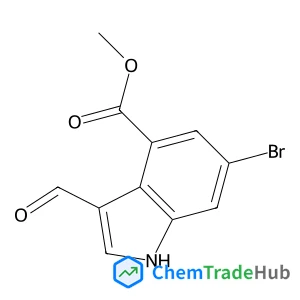
methyl 6-bromo-3-formyl-1H-indole-4-carboxylate
CAS Number:
1353636-63-1
Molecular Formula:
C11H8BrNO3
The first page of this article is displayed as the abstract.
C. Callegari
DOI: 10.1039/C2CP22749E
Bhooshan C. Popere, Andrea M. Della Pelle, Ambata Poe, S. Thayumanavan
DOI: 10.1039/C2CP23422J
Oleg Opanasyuk, Therese Mikaelsson, Linus Ryderfors, Emad Mukhtar, Lennart B.-Å. Johansson
DOI: 10.1039/C2CP23177H
Stefaan Vandendriessche, Ventsislav K. Valev, Thierry Verbiest
DOI: 10.1039/C2CP23311H
Dan Bai, Andrew C. Benniston, Jerry Hagon, Helge Lemmetyinen, Nikolai V. Tkachenko, William Clegg, Ross W. Harrington
DOI: 10.1039/C2CP23868C
Jón Bergmann Maronsson, Hannes Jónsson, Tejs Vegge
DOI: 10.1039/C2CP23421A
Richard M. Forck, Christoph C. Pradzynski, Sabine Wolff, Thomas Zeuch
DOI: 10.1039/C2CP23301K
Guofa Dong, Meihua Huang, Lunhui Guan
DOI: 10.1039/C2CP23718K
(3.beta.)-3-Hydroxy-N,N-dimethyl-chol-5-en-24-amide (CAS: 79066-03-8) is primari...
5-(Aminomethyl)-2-methoxyphenol (CAS: 89702-89-6) is classified under GHS as a s...
Thieno[2,3-c]pyridin-7(6H)-one (CAS: 28981-13-7) is a heterocyclic organic compo...
1-[(6-Methoxy-3-pyridinyl)methyl]-4-piperidinamine dihydrochloride is generally ...
[(2E)-3-Phenyl-2-propen-1-yl]phosphonic acid (CAS: 146404-58-2) is regulated und...
6-Bromo-7-methoxyquinoline (CAS: 1620515-86-7) falls under the scope of the Glob...
This compound is primarily used in the pharmaceutical industry for the developme...
1-Ethyl-7-[2-methyl-6-(4H-1,2,4-triazol-3-yl)-3-pyridinyl]-3,5-dihydropyrazino[2...
Alternative reagents such as 2-[(dimethylamino)methyl]phenylboronic acid or rela...
3-(Piperidin-4-yloxy)pyridine (CAS: 310881-48-2) is an organic compound with the...

Organic & Biomolecular Chemistry (OBC) publishes original and high impact research and reviews in organic chemistry. We welcome research that shows new or significantly improved protocols or methodologies in total synthesis, synthetic methodology or physical and theoretical organic chemistry as well as research that shows a significant advance in the organic chemistry or molecular design aspects of chemical biology, catalysis, supramolecular and macromolecular chemistry, theoretical chemistry, mechanism-oriented physical organic chemistry, medicinal chemistry or natural products. Articles published in the journal should report new work which makes a highly-significant impact in the field. Routine and incremental work is generally not suitable for publication in the journal. More details about key areas of our scope are below. In all cases authors should include in their article clear rationale for why their research has been carried out.