













A method for finding the ridge between saddle points applied to rare event rate estimates
Literature Information
Publication Date
2011-12-22
DOI
10.1039/C2CP23421A
Impact Factor
3.676
Authors
Jón Bergmann Maronsson, Hannes Jónsson, Tejs Vegge
View Original
Abstract
A method is presented for finding the ridge between first order saddle points on a multidimensional surface. For atomic scale systems, such saddle points on the energy surface correspond to atomic rearrangement mechanisms. Information about the ridge can be used to test the validity of the harmonic approximation to transition state theory, in particular to verify that second order saddle points—maxima along the ridge—are high enough compared to the first order saddle points. New minima along the ridge can also be identified during the path optimisation, thereby revealing additional transition mechanisms. The method is based on a string of discretisation points along a path between the first order saddle points and using an iterative optimisation which requires only the force acting on the atoms. At each iteration during the optimisation, the force is inverted along an unstable eigenmode perpendicular to the path. The method is applied to Al adatom diffusion on the Al(100) surface to find the ridge between 2-, 3- and 4-atom concerted displacements and hop mechanisms. A correction to the harmonic approximation of transition state theory was estimated by direct evaluation of the configuration integral along the ridge.
Related Literature
Aromatic polyesters from biosuccinic acid
Gabriel N. Short, Ha T. H. Nguyen, Patricia I. Scheurle, Stephen A. Miller
2018-07-20
Communication
DOI: 10.1039/C8PY00862K
Swelling properties of thermoresponsive/hydrophilic co-networks with functional crosslinked domain structures
Shohei Ida, Hironobu Kitanaka, Tatsuya Ishikawa, Shokyoku Kanaoka, Yoshitsugu Hirokawa
2018-01-03
Paper
DOI: 10.1039/C7PY01793F
Synthesis of PEVE-b-P(CTFE-alt-EVE) block copolymers by sequential cationic and radical RAFT polymerization
Marc Guerre, Mineto Uchiyama, Gérald Lopez, Bruno Améduri, Masami Kamigaito, Vincent Ladmiral
2017-12-08
Paper
DOI: 10.1039/C7PY01924F
Anti-fatigue adhesive and tough hydrogels regulated by adenine and uracil
Xin Liu, Qin Zhang, Yanchao Qiao, Lijie Duan, Guanghui Gao
2018-08-01
Paper
DOI: 10.1039/C8PY00868J
Ferromagnetic iron oxide–cellulose nanocomposites prepared by ultrasonication
Razvan Rotaru, Marcela Savin, Nita Tudorachi, Cristian Peptu, Petrisor Samoila, Liviu Sacarescu, Valeria Harabagiu
2017-10-27
Paper
DOI: 10.1039/C7PY01587A
Inhibition of lysozyme's polymerization activity using a polymer structural mimic
D. L. Morris, T. C. Leeper, C. J. Ziegler
2018-05-29
Communication
DOI: 10.1039/C8PY00545A
You might also like
Compound Q&A
What are the main uses of (3.beta.)-3-Hydroxy-N,N-dimethyl-chol-5-en-24-amide (CAS: 79066-03-8)?
(3.beta.)-3-Hydroxy-N,N-dimethyl-chol-5-en-24-amide (CAS: 79066-03-8) is primari...
79066-03-8(3.beta.)-3-Hydroxy-...
Compound Q&A
What regulatory guidelines apply to 5-(aminomethyl)-2-methoxyphenol (CAS: 89702-89-6)?
5-(Aminomethyl)-2-methoxyphenol (CAS: 89702-89-6) is classified under GHS as a s...
89702-89-65-(aminomethyl)-2-me...
Compound Q&A
What is Thieno[2,3-c]pyridin-7(6H)-one (CAS: 28981-13-7)?
Thieno[2,3-c]pyridin-7(6H)-one (CAS: 28981-13-7) is a heterocyclic organic compo...
28981-13-7Thieno[2,3-c]pyridin...
Compound Q&A
Is 1-[(6-Methoxy-3-pyridinyl)methyl]-4-piperidinamine dihydrochloride (CAS: 1185311-28-7) safe?
1-[(6-Methoxy-3-pyridinyl)methyl]-4-piperidinamine dihydrochloride is generally ...
1185311-28-71-[(6-Methoxy-3-pyri...
Compound Q&A
What regulatory guidelines apply to [(2E)-3-Phenyl-2-propen-1-yl]phosphonic acid (CAS: 146404-58-2)?
[(2E)-3-Phenyl-2-propen-1-yl]phosphonic acid (CAS: 146404-58-2) is regulated und...
146404-58-2[(2E)-3-Phenyl-2-pro...
Compound Q&A
What regulatory guidelines apply to 6-Bromo-7-methoxyquinoline (CAS: 1620515-86-7)?
6-Bromo-7-methoxyquinoline (CAS: 1620515-86-7) falls under the scope of the Glob...
1620515-86-76-Bromo-7-methoxyqui...
Compound Q&A
What industries use (2R)-1-(1-Benzofuran-2-yl)-N-propyl-2-pentanamine (CAS: 260550-89-8)?
This compound is primarily used in the pharmaceutical industry for the developme...
260550-89-8(2R)-1-(1-Benzofuran...
Compound Q&A
What are the main uses of 1-Ethyl-7-[2-methyl-6-(4H-1,2,4-triazol-3-yl)-3-pyridinyl]-3,5-dihydropyrazino[2,3-b]pyrazin-2(1H)-one (CAS: 1228013-15-7)?
1-Ethyl-7-[2-methyl-6-(4H-1,2,4-triazol-3-yl)-3-pyridinyl]-3,5-dihydropyrazino[2...
1228013-15-71-Ethyl-7-[2-methyl-...
Compound Q&A
Are there alternatives to {5-(Acryloylamino)-2-[(dimethylamino)methyl]phenyl}boronic acid (CAS: 1217500-78-1) in synthesis?
Alternative reagents such as 2-[(dimethylamino)methyl]phenylboronic acid or rela...
1217500-78-1{5-(Acryloylamino)-2...
Compound Q&A
What is 3-(Piperidin-4-yloxy)pyridine (CAS: 310881-48-2)?
3-(Piperidin-4-yloxy)pyridine (CAS: 310881-48-2) is an organic compound with the...
310881-48-23-(Piperidin-4-yloxy...
Source Journal
Physical Chemistry Chemical Physics

CiteScore:
5.5
Self-citation Rate:
10.3%
Articles per Year:
3036
Physical Chemistry Chemical Physics (PCCP) is an international journal co-owned by 19 physical chemistry and physics societies from around the world. This journal publishes original, cutting-edge research in physical chemistry, chemical physics and biophysical chemistry. To be suitable for publication in PCCP, articles must include significant innovation and/or insight into physical chemistry; this is the most important criterion that reviewers and Editors will judge against when evaluating submissions. The journal has a broad scope and welcomes contributions spanning experiment, theory, computation and data science. Topical coverage includes spectroscopy, dynamics, kinetics, statistical mechanics, thermodynamics, electrochemistry, catalysis, surface science, quantum mechanics, quantum computing and machine learning. Interdisciplinary research areas such as polymers and soft matter, materials, nanoscience, energy, surfaces/interfaces, and biophysical chemistry are welcomed if they demonstrate significant innovation and/or insight into physical chemistry. Joined experimental/theoretical studies are particularly appreciated when complementary and based on up-to-date approaches.
Recommended Compounds
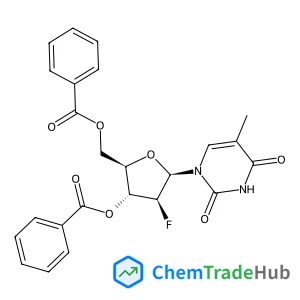
1-(3',5'-Di-O-benzoyl-2'-deoxy-2'-fluoro-b-D-arabinofuranosyl)thymine
CAS Number:
97614-47-6
Molecular Formula:
C24H21FN2O7
Recommended Suppliers




Disclaimer
This page provides academic journal information for reference and research purposes only. We are not affiliated with any journal publishers and do not handle publication submissions. For publication-related inquiries, please contact the respective journal publishers directly.
If you notice any inaccuracies in the information displayed, please contact us at support@chemtradehub.com. We will promptly review and address your concerns.