












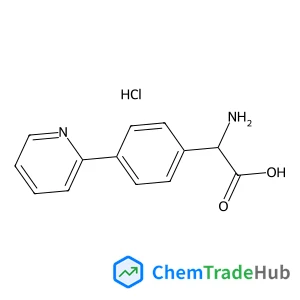
2-Amino-2-(4-(pyridin-2-YL)phenyl)acetic acid hydrochloride
CAS Number:
1135818-89-1
Molecular Formula:
C13H13ClN2O2
Richard M. Forck, Christoph C. Pradzynski, Sabine Wolff, Thomas Zeuch
Size resolved IR action spectra of neutral sodium doped methanol clusters have been measured using IR excitation modulated photoionisation mass spectroscopy. The Na(CH3OH)n clusters were generated in a supersonic He seeded expansion of methanol by subsequent Na doping in a pick-up cell. A combined analysis of IR action spectra, IP evolutions and harmonic predictions of IR spectra (using density functional theory) of the most stable structures revealed that for n = 4, 5 structures with an exterior Na atom showing high ionisation potentials (IPs) of ∼4 eV dominate, while for n = 6, 7 clusters with lower IPs (∼3.2 eV) featuring fully solvated Na atoms and solvated electrons emerge and dominate the IR action spectra. For n = 4 simulations of photoionisation spectra using an ab initio MD approach confirm the dominance of exterior structures and explain the previously reported appearance IP of 3.48 eV by small fractions of clusters with partly solvated Na atoms. Only for this cluster size a shift in the isomer composition with cluster temperature has been observed, which may be related to kinetic stabilisation of less Na solvated clusters at low temperatures. Features of slow fragmentation dynamics of cationic Na+(CH3OH)6 clusters have been observed for the photoionisation near the adiabatic limit. This finding points to the relevance of previously proposed non-vertical photoionisation dynamics of this system.
Sara Marina, Daniele Mantione, Kasina ManojKumar, Vijayakrishna Kari, Agnieszka Tercjak, Ana Sanchez-Sanchez
DOI: 10.1039/C8PY00680F
Weiqiang Fu, Lichao Dong, Jianbing Shi, Bin Tong, Zhengxu Cai, Junge Zhi, Yuping Dong
DOI: 10.1039/C8PY00819A
Shi Wang, Xu Liu, Ailian Wang, Zhinan Wang, Jie Chen, Qinghui Zeng, Xuefei Wang, Liaoyun Zhang
DOI: 10.1039/C8PY00951A
Yangchun Tao, Siwei Liu, Yi Zhang, Zhenguo Chi, Jiarui Xu
DOI: 10.1039/C7PY02108A
Marcus H. Reis, Cullen L. G. Davidson, IV, Frank A. Leibfarth
DOI: 10.1039/C7PY01938F
Hao Guo, Xiaoyu Huang
DOI: 10.1039/C7PY01407D
Bo Zhao, Mahalia A. C. Serrano, Jingjing Gao, Jiaming Zhuang
DOI: 10.1039/C7PY01947E
(3.beta.)-3-Hydroxy-N,N-dimethyl-chol-5-en-24-amide (CAS: 79066-03-8) is primari...
5-(Aminomethyl)-2-methoxyphenol (CAS: 89702-89-6) is classified under GHS as a s...
Thieno[2,3-c]pyridin-7(6H)-one (CAS: 28981-13-7) is a heterocyclic organic compo...
1-[(6-Methoxy-3-pyridinyl)methyl]-4-piperidinamine dihydrochloride is generally ...
[(2E)-3-Phenyl-2-propen-1-yl]phosphonic acid (CAS: 146404-58-2) is regulated und...
6-Bromo-7-methoxyquinoline (CAS: 1620515-86-7) falls under the scope of the Glob...
This compound is primarily used in the pharmaceutical industry for the developme...
1-Ethyl-7-[2-methyl-6-(4H-1,2,4-triazol-3-yl)-3-pyridinyl]-3,5-dihydropyrazino[2...
Alternative reagents such as 2-[(dimethylamino)methyl]phenylboronic acid or rela...
3-(Piperidin-4-yloxy)pyridine (CAS: 310881-48-2) is an organic compound with the...

Physical Chemistry Chemical Physics (PCCP) is an international journal co-owned by 19 physical chemistry and physics societies from around the world. This journal publishes original, cutting-edge research in physical chemistry, chemical physics and biophysical chemistry. To be suitable for publication in PCCP, articles must include significant innovation and/or insight into physical chemistry; this is the most important criterion that reviewers and Editors will judge against when evaluating submissions. The journal has a broad scope and welcomes contributions spanning experiment, theory, computation and data science. Topical coverage includes spectroscopy, dynamics, kinetics, statistical mechanics, thermodynamics, electrochemistry, catalysis, surface science, quantum mechanics, quantum computing and machine learning. Interdisciplinary research areas such as polymers and soft matter, materials, nanoscience, energy, surfaces/interfaces, and biophysical chemistry are welcomed if they demonstrate significant innovation and/or insight into physical chemistry. Joined experimental/theoretical studies are particularly appreciated when complementary and based on up-to-date approaches.
amine structure](https://static.chemtradehub.com/structs/629/62924-61-2-0728.webp "[(2-chlorophenyl)methyl](ethyl)amine structure")




