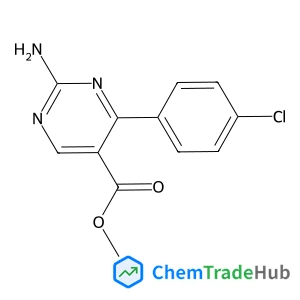
Methyl 2-amino-4-(4-chlorophenyl)-5-pyrimidinecarboxylate
CAS Number:
1133115-56-6
Molecular Formula:
C12H10ClN3O2
Anna M. Kulakova
In this work, we disclose a mechanism of competing chemical reactions of protein assembly for a bacterial phytochrome using modern methods of molecular modeling. The recently designed variant of a near-infrared fluorescent protein miRFP670 shows novel and unexpected features of covalent binding of the biliverdin chromophore to cysteine residues in the phytochrome domains GAF and PAS. Upon protein assembly, biliverdin reacts either with a cysteine from GAF, or with two cysteines, one from GAF and one from PAS. We characterize computationally a model structure of the noncovalently bound biliverdin molecule inside the protein cleft of miRFP670 and model reactions of the covalent binding. Both cysteines, Cys20 (PAS) and Cys253 (GAF), are located close to the electrophile C32 atom of biliverdin and can act as nucleophiles. The nucleophilic attack of Cys253 from the GAF domain results in a single C–S bond formation with an activation energy of 16 kcal mol−1. Another pathway, leading to the biliverdin adduct with two C–S bonds, is characterized by lower energy barriers, less than 11 kcal mol−1. Competition between these reaction pathways explains the experimentally obtained mixture of both adducts. On the basis of our first simulations of covalent BV binding to the phytochrome domains, we propose an approach of a direct experimental validation of the reaction mechanisms using IR vibrational spectroscopy.
Wu-Jun Liu, Ke Tian, Hong Jiang, Han-Qing Yu
DOI: 10.1039/C4GC00599F
Virginia P. Silva Nykänen, Outi Härkönen, Antti Nykänen, Panu Hiekkataipale, Janne Ruokolainen, Olli Ikkala
DOI: 10.1039/C4GC00794H
Patrick Wagner, Maud Bollenbach, Christelle Doebelin, Frédéric Bihel, Jean-Jacques Bourguignon, Martine Schmitt
DOI: 10.1039/C4GC00853G
Samuel E. Evans, John Z. Staniforth, Richard J. Darton, R. Mark Ormerod
DOI: 10.1039/C4GC00782D
Guangzheng Gao, Muzaffer A. Karaaslan, John F. Kadla, Frank Ko
DOI: 10.1039/C4GC00757C
Sadu Nageswara Rao, Darapaneni Chandra Mohan, Subbarayappa Adimurthy
DOI: 10.1039/C4GC01402B
C. Pirez, A. F. Lee, J. C. Manayil, C. M. A. Parlett, K. Wilson
DOI: 10.1039/C4GC01139B
Lin He, Helfried Neumann, Matthias Beller
DOI: 10.1039/C4GC00801D
Beatrice Bechi, Susanne Herter, Shane McKenna, Christopher Riley, Silke Leimkühler, Nicholas J. Turner, Andrew J. Carnell
DOI: 10.1039/C4GC01321B
2-Methylbenzene-1,4-diamine dihydrochloride (CAS: 615-45-2) should be stored in ...
(1S,4S)-2,5-Diazabicyclo[2.2.1]heptane dihydrobromide is generally considered sa...
(6-Chloropyridazin-3-YL)methanamine finds applications in the pharmaceutical ind...
2-Fluoro-3-methylphenol is primarily used in the synthesis of pharmaceuticals, p...
When handling 3-Methoxy-4-nitrobenzonitrile, it is important to wear appropriate...
When handling 1,3-Oxazolo[4,5-b]pyridine-2(3H)-thione (CAS: 211949-57-4), it is ...
4-Ethynylbenzamide (CAS: 90347-86-7) falls under various regulatory guidelines i...
3-(2-Ethylphenyl)-2-thioxo-4-imidazolidinone is primarily used as an intermediat...
(2-Fluoro-6-methoxyphenyl)acetic acid, also known as 4-fluoro-3-methoxybenzoic a...
Market trends for 2-[4-(Hydroxymethyl)phenoxy]ethanol (CAS: 102196-18-9) indicat...

Organic & Biomolecular Chemistry (OBC) publishes original and high impact research and reviews in organic chemistry. We welcome research that shows new or significantly improved protocols or methodologies in total synthesis, synthetic methodology or physical and theoretical organic chemistry as well as research that shows a significant advance in the organic chemistry or molecular design aspects of chemical biology, catalysis, supramolecular and macromolecular chemistry, theoretical chemistry, mechanism-oriented physical organic chemistry, medicinal chemistry or natural products. Articles published in the journal should report new work which makes a highly-significant impact in the field. Routine and incremental work is generally not suitable for publication in the journal. More details about key areas of our scope are below. In all cases authors should include in their article clear rationale for why their research has been carried out.
![5-Bromo-3-isopropyl-1H-pyrrolo[2,3-b]pyridine structure](https://static.chemtradehub.com/structs/125/1256819-54-1-8620.webp "5-Bromo-3-isopropyl-1H-pyrrolo[2,3-b]pyridine structure")