












A nickel doped perovskite catalyst for reforming methane rich biogas with minimal carbon deposition
Literature Information
Publication Date
2014-07-31
DOI
10.1039/C4GC00782D
Impact Factor
10.182
Authors
Samuel E. Evans, John Z. Staniforth, Richard J. Darton, R. Mark Ormerod
View Original
Abstract
A novel nickel-doped strontium zirconate perovskite catalyst for biogas reforming has been synthesised using a green, low temperature hydrothermal synthesis. The catalyst has been shown to be very efficient towards the conversion of methane-rich biogas at relatively low temperatures with high selectivity towards synthesis gas formation and extremely good resistance to carbon deposition in carbon-rich reaction mixtures. The catalyst displays very low carbon deposition which does not increase over time, and as a result shows excellent stability. The use of a catalyst produced by a low temperature hydrothermal route provides a potentially very attractive and sustainable source of useful chemicals from biogas that otherwise might be vented wastefully and detrimentally into the atmosphere.
Related Literature
The leapfrog principle for boron fullerenes: a theoretical study of structure and stability of B112
Jules Tshishimbi Muya, G. Gopakumar, Minh Tho Nguyen, Arnout Ceulemans
2011-03-18
Paper
DOI: 10.1039/C0CP02130J
Collective plasmon modes excited on a silver nanoparticle 2D crystalline sheet
Yasuhiro Ikezoe, Daiki Obara, Koichi Okamoto
2011-03-21
Paper
DOI: 10.1039/C0CP02953J
Polyoxometalate-stabilized Pt nanoparticles and their electrocatalytic activities
Thomas Hsu-Yao, Kevin P. Browne, Nicole Honesty, YuYe J. Tong
2011-03-14
Paper
DOI: 10.1039/C0CP02805C
The C–Cl⋯π interactions inside supramolecular nanotubes of hexaethynylhexamethoxy[6]pericyclyne
Roman I. Zubatyuk, Viktoriya V. Dyakonenko
2011-03-14
Paper
DOI: 10.1039/C0CP02666B
In situRaman spectroscopy of H2 interaction with WO3 films
J. Z. Ou, M. H. Yaacob, H. D. Zheng, J. L. Campbell, K. Latham, J. du. Plessis, W. Wlodarski, K. Kalantar-zadeh
2011-03-09
Paper
DOI: 10.1039/C0CP02050H
Catalysis by metal–organic frameworks: fundamentals and opportunities
Marco Ranocchiari
2011-01-14
Perspective
DOI: 10.1039/C0CP02394A
The isomeric effect on the adjacent Si dimer didechlorination of trans and iso-dichloroethylene on Si(100)-2×1
Qiuju Zhang, Bo Li, Qinghong Yuan, Baihai Li, Zhifeng Liu, Liang Chen
2011-03-14
Paper
DOI: 10.1039/C0CP01506G
Defect chemistry, redox kinetics, and chemical diffusion of lithium deficient lithium niobate
Jianmin Shi, Holger Fritze, Günter Borchardt, Klaus-Dieter Becker
2011-02-23
Paper
DOI: 10.1039/C0CP02703K
You might also like
Compound Q&A
How should 2-Methylbenzene-1,4-diamine dihydrochloride (CAS: 615-45-2) be stored?
2-Methylbenzene-1,4-diamine dihydrochloride (CAS: 615-45-2) should be stored in ...
615-45-22-Methylbenzene-1,4-...
Compound Q&A
Is (1S,4S)-2,5-Diazabicyclo[2.2.1]heptane dihydrobromide (CAS: 132747-20-7) safe?
(1S,4S)-2,5-Diazabicyclo[2.2.1]heptane dihydrobromide is generally considered sa...
132747-20-7(1S,4S)-2,5-Diazabic...
Compound Q&A
What industries use (6-Chloropyridazin-3-YL)methanamine (CAS: 871826-15-2)?
(6-Chloropyridazin-3-YL)methanamine finds applications in the pharmaceutical ind...
871826-15-2(6-Chloropyridazin-3...
Compound Q&A
What are the main uses of 2-Fluoro-3-methylphenol (CAS: 77772-72-6)?
2-Fluoro-3-methylphenol is primarily used in the synthesis of pharmaceuticals, p...
77772-72-62-Fluoro-3-methylphe...
Compound Q&A
What precautions should be taken when handling 3-Methoxy-4-nitrobenzonitrile (CAS: 177476-75-4)?
When handling 3-Methoxy-4-nitrobenzonitrile, it is important to wear appropriate...
177476-75-43-Methoxy-4-nitroben...
Compound Q&A
What precautions should be taken when handling 1,3-Oxazolo[4,5-b]pyridine-2(3H)-thione (CAS: 211949-57-4)?
When handling 1,3-Oxazolo[4,5-b]pyridine-2(3H)-thione (CAS: 211949-57-4), it is ...
211949-57-4[1,3]Oxazolo[4,5-b]p...
Compound Q&A
What regulatory guidelines apply to 4-Ethynylbenzamide (CAS: 90347-86-7)?
4-Ethynylbenzamide (CAS: 90347-86-7) falls under various regulatory guidelines i...
90347-86-74-Ethynylbenzamide
Compound Q&A
What are the main uses of 3-(2-Ethylphenyl)-2-thioxo-4-imidazolidinone (CAS: 186822-57-1)?
3-(2-Ethylphenyl)-2-thioxo-4-imidazolidinone is primarily used as an intermediat...
186822-57-13-(2-Ethylphenyl)-2-...
Compound Q&A
What is (2-Fluoro-6-methoxyphenyl)acetic acid (CAS: 500912-19-6)?
(2-Fluoro-6-methoxyphenyl)acetic acid, also known as 4-fluoro-3-methoxybenzoic a...
500912-19-6(2-Fluoro-6-methoxyp...
Compound Q&A
What is the market or research trend for 2-[4-(Hydroxymethyl)phenoxy]ethanol (CAS: 102196-18-9)?
Market trends for 2-[4-(Hydroxymethyl)phenoxy]ethanol (CAS: 102196-18-9) indicat...
102196-18-92-[4-(Hydroxymethyl)...
Source Journal
Green Chemistry

CiteScore:
16.1
Self-citation Rate:
7.5%
Articles per Year:
944
Green Chemistry provides a unique forum for the publication of innovative research on the development of alternative green and sustainable technologies. The scope of Green Chemistry is based on, but not limited to, the definition proposed by Anastas and Warner (Green Chemistry: Theory and Practice, P T Anastas and J C Warner, Oxford University Press, Oxford, 1998). Green chemistry is the utilisation of a set of principles that reduces or eliminates the use or generation of hazardous substances in the design, manufacture and application of chemical products. Green Chemistry is at the frontiers of this continuously-evolving interdisciplinary science and publishes research that attempts to reduce the environmental impact of the chemical enterprise by developing a technology base that is inherently non-toxic to living things and the environment. Submissions on all aspects of research relating to the endeavour are welcome. The journal publishes original and significant cutting-edge research that is likely to be of wide general appeal. To be published, work must present a significant advance in green chemistry. Papers must contain a comparison with existing methods and demonstrate advantages over those methods before publication can be considered. For more information please see this Editorial. Coverage includes the following, but is not limited to: Design (e.g. biomimicry, design for degradation/recycling/reduced toxicity…) Reagents & Feedstocks (e.g. renewables, CO2, solvents, auxiliary agents, waste utilization…) Synthesis (e.g. organic, inorganic, synthetic biology…) Catalysis (e.g. homogeneous, heterogeneous, enzyme, whole cell…) Process (e.g. process design, intensification, separations, recycling, efficiency…) Energy (e.g. renewable energy, fuels, photovoltaics, fuel cells, energy storage, energy carriers…) Applications (e.g. electronics, dyes, consumer products, coatings, pharmaceuticals, preservatives, building materials, chemicals for industry/agriculture/mining…) Impact (e.g. safety, metrics, LCA, sustainability, (eco)toxicology…) Green chemistry is, by definition, a continuously-evolving frontier. Therefore, the inclusion of a particular material or technology does not, of itself, guarantee that a paper is suitable for the journal. To be suitable, the novel advance should have the potential for reduced environmental impact relative to the state of the art. Green Chemistry does not normally deal with research associated with 'end-of-pipe' or remediation issues.
Recommended Compounds
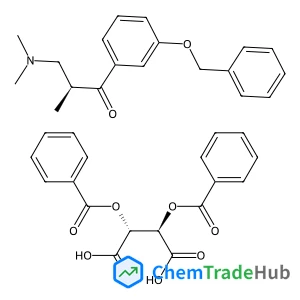
(S)-1-(3-(Benzyloxy)phenyl)-3-(dimethylamino)-2-methylpropan-1-one (2r,3r)-2,3-bis(benzoyloxy)succinate
CAS Number:
1004315-81-4
Molecular Formula:
C37H37NO10
Recommended Suppliers




Disclaimer
This page provides academic journal information for reference and research purposes only. We are not affiliated with any journal publishers and do not handle publication submissions. For publication-related inquiries, please contact the respective journal publishers directly.
If you notice any inaccuracies in the information displayed, please contact us at support@chemtradehub.com. We will promptly review and address your concerns.