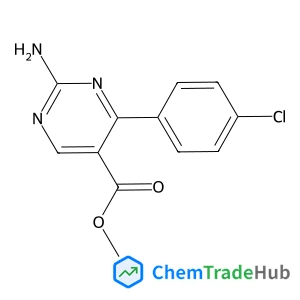
Methyl 2-amino-4-(4-chlorophenyl)-5-pyrimidinecarboxylate
CAS Number:
1133115-56-6
Molecular Formula:
C12H10ClN3O2
Ning Wang, Jiahui Xu, Jeehiun K. Lee
N-Heterocyclic carbenes (NHCs) are versatile species that figure prominently as catalysts. Despite their widespread use in organocatalysis, studies of the relationship between the basicity of NHCs and their catalytic ability are limited. Herein we review work on both the examination of NHC basicity as well as its impact on organocatalysis. The review is divided into three main parts: an overview of NHC basicity studies, both in solution and in the gas phase; the role of basicity in Umpolung-type catalysis; and the relationship between NHC basicity and its growing role as a Brønsted base catalyst. This review is not an exhaustive catalog of all NHC catalysis, but rather focuses on work that specifically examines and discusses the effect of NHC basicity on catalyst function.
Jihong Lan, Zhuqi Chen, Jinchi Lin, Guochuan Yin
DOI: 10.1039/C4GC90039A
Douglas R. Greer, Thalita P. Basso, Ana B. Ibanez, Stefan Bauer, Jeffrey M. Skerker, A. Evren Ozcam, Dacia Leon, Chaeyoung Shin, Adam P. Arkin
DOI: 10.1039/C4GC00756E
Kyujin Kim, Inhyuk Kim, Yunjung Oh, Daehee Lee, Kyoohee Woo, Sunho Jeong, Jooho Moon
DOI: 10.1039/C4GC00896K
L. Jean-Gérard, R. Auvergne, D. Benazet, S. Caillol, B. Andrioletti
DOI: 10.1039/C4GC01032A
Samuel E. Evans, John Z. Staniforth, Richard J. Darton, R. Mark Ormerod
DOI: 10.1039/C4GC00782D
Tobias Stemmler, Felix A. Westerhaus, Annette-Enrica Surkus, Marga-Martina Pohl, Kathrin Junge, Matthias Beller
DOI: 10.1039/C4GC00536H
Zhen-Zhen Yang, Yanfei Zhao, Guipeng Ji, Hongye Zhang, Bo Yu, Xiang Gao, Zhimin Liu
DOI: 10.1039/C4GC00730A
Xincheng Wang, Yanlei Song, Chongpin Huang, Fengbing Liang, Biaohua Chen
DOI: 10.1039/C4GC00811A
Paula M. Uberman, Natalia J. S. Costa, Rafaela C. Carmona, Alcindo A. Dos Santos, Liane M. Rossi
DOI: 10.1039/C4GC00669K
Peter A. Bayliss, Eduardo Pérez, Sihai Yang, Chiu C. Tang, Martyn Poliakoff, Martin Schröder
DOI: 10.1039/C4GC00313F
2-Methylbenzene-1,4-diamine dihydrochloride (CAS: 615-45-2) should be stored in ...
(1S,4S)-2,5-Diazabicyclo[2.2.1]heptane dihydrobromide is generally considered sa...
(6-Chloropyridazin-3-YL)methanamine finds applications in the pharmaceutical ind...
2-Fluoro-3-methylphenol is primarily used in the synthesis of pharmaceuticals, p...
When handling 3-Methoxy-4-nitrobenzonitrile, it is important to wear appropriate...
When handling 1,3-Oxazolo[4,5-b]pyridine-2(3H)-thione (CAS: 211949-57-4), it is ...
4-Ethynylbenzamide (CAS: 90347-86-7) falls under various regulatory guidelines i...
3-(2-Ethylphenyl)-2-thioxo-4-imidazolidinone is primarily used as an intermediat...
(2-Fluoro-6-methoxyphenyl)acetic acid, also known as 4-fluoro-3-methoxybenzoic a...
Market trends for 2-[4-(Hydroxymethyl)phenoxy]ethanol (CAS: 102196-18-9) indicat...

Organic & Biomolecular Chemistry (OBC) publishes original and high impact research and reviews in organic chemistry. We welcome research that shows new or significantly improved protocols or methodologies in total synthesis, synthetic methodology or physical and theoretical organic chemistry as well as research that shows a significant advance in the organic chemistry or molecular design aspects of chemical biology, catalysis, supramolecular and macromolecular chemistry, theoretical chemistry, mechanism-oriented physical organic chemistry, medicinal chemistry or natural products. Articles published in the journal should report new work which makes a highly-significant impact in the field. Routine and incremental work is generally not suitable for publication in the journal. More details about key areas of our scope are below. In all cases authors should include in their article clear rationale for why their research has been carried out.