












Fermentation of hydrolysate detoxified by pervaporation through block copolymer membranes
Literature Information
Publication Date
2014-07-11
DOI
10.1039/C4GC00756E
Impact Factor
10.182
Authors
Douglas R. Greer, Thalita P. Basso, Ana B. Ibanez, Stefan Bauer, Jeffrey M. Skerker, A. Evren Ozcam, Dacia Leon, Chaeyoung Shin, Adam P. Arkin
View Original
Abstract
The large-scale use of lignocellulosic hydrolysate as a fermentation broth has been impeded due to its high concentration of organic inhibitors to fermentation. In this study, pervaporation with polystyrene-block-polydimethylsiloxane-block-polystyrene (SDS) block copolymer membranes was shown to be an effective method for separating volatile inhibitors from dilute acid pretreated hydrolysate, thus detoxifying hydrolysate for subsequent fermentation. We report the separation of inhibitors from hydrolysate thermodynamically and quantitatively by detailing their concentrations in the hydrolysate before and after detoxification by pervaporation. Specifically, we report >99% removal of furfural and 27% removal of acetic acid with this method. Additionally, we quantitatively report that the membrane is selective for organic inhibitor compounds over water, despite water's smaller molecular size. Because its inhibitors were removed but its sugars left intact, pervaporation-detoxified hydrolysate was suitable for fermentation. In our fermentation experiments, Saccharomyces cerevisiae strain SA-1 consumed the glucose in pervaporation-detoxified hydrolysate, producing ethanol. In contrast, under the same conditions, a control hydrolysate was unsuitable for fermentation; no ethanol was produced and no glucose was consumed. This work demonstrates progress toward economical lignocellulosic hydrolysate fermentation.
Related Literature
Predictive power of long-range corrected functionals on the spectroscopic properties of tetrapyrrole derivatives for photodynamic therapy
Emma S. E. Eriksson, Leif A. Eriksson
2011-03-15
Paper
DOI: 10.1039/C0CP02792H
Fuel-specific influences on the composition of reaction intermediates in premixed flames of three C5H10O2 ester isomers
Bin Yang, Charles K. Westbrook, Terrill A. Cool, Nils Hansen, Katharina Kohse-Höinghaus
2011-03-15
Paper
DOI: 10.1039/C0CP02065F
Isomerization of spirobenzopyrans bearing electron-donating and electron-withdrawing groups in acidic aqueous solutions
Taku Satoh, Kimio Sumaru, Toshiyuki Takagi, Katsuki Takai, Toshiyuki Kanamori
2011-03-11
Paper
DOI: 10.1039/C0CP01989E
Capping polymer-enhanced electrocatalytic activity on Pt nanoparticles: a combined electrochemical and in situIR spectroelectrochemical study
Ceren Susut, Shi-Gang Sun, YuYe J. Tong
2011-03-22
Paper
DOI: 10.1039/C1CP20164F
High-resolution FTIR spectroscopy of the ν8 and Coriolis perturbation allowed ν12 bands of ketenimine‡
Michael K. Bane, Christopher D. Thompson, Evan G. Robertson, Dominique R. T. Appadoo, Don McNaughton
2010-11-29
Paper
DOI: 10.1039/C0CP01816C
Unexpected optical response of single ZnO nanowires probed using controllable electrical contacts
Y. J. Zeng, M. Menghini, D. Y. Li, S. S. Lin, Z. Z. Ye, J. Hadermann, T. Moorkens, J. W. Seo, J.-P. Locquet, C. Van Haesendonck
2011-03-14
Paper
DOI: 10.1039/C1CP00012H
Pattern formation in the Belousov–Zhabotinsky-PAMAM dendrimer system
Diana I. Roncaglia, Jorge Carballido-Landeira, Alberto P. Muñuzuri
2011-03-22
Paper
DOI: 10.1039/C0CP02656E
Iodineoxidation by hydrogen peroxide and Bray–Liebhafsky oscillating reaction: effect of the temperature
Guy Schmitz
2011-03-14
Paper
DOI: 10.1039/C1CP00006C
Coupling microscopic and mesoscopic scales to simulate chemical equilibrium between a nanometric carboncluster and detonation products fluid
Emeric Bourasseau, Jean-Bernard Maillet
2011-03-11
Paper
DOI: 10.1039/C0CP02622K
Chemical evolution of biomolecule building blocks. Can thermodynamics explain the accumulation of glycine in the prebiotic ocean?
Milán Szőri, Balázs Jójárt, Kornél Szőri, Béla Viskolcz
2011-03-22
Paper
DOI: 10.1039/C0CP02687E
You might also like
Compound Q&A
How should 2-Methylbenzene-1,4-diamine dihydrochloride (CAS: 615-45-2) be stored?
2-Methylbenzene-1,4-diamine dihydrochloride (CAS: 615-45-2) should be stored in ...
615-45-22-Methylbenzene-1,4-...
Compound Q&A
Is (1S,4S)-2,5-Diazabicyclo[2.2.1]heptane dihydrobromide (CAS: 132747-20-7) safe?
(1S,4S)-2,5-Diazabicyclo[2.2.1]heptane dihydrobromide is generally considered sa...
132747-20-7(1S,4S)-2,5-Diazabic...
Compound Q&A
What industries use (6-Chloropyridazin-3-YL)methanamine (CAS: 871826-15-2)?
(6-Chloropyridazin-3-YL)methanamine finds applications in the pharmaceutical ind...
871826-15-2(6-Chloropyridazin-3...
Compound Q&A
What are the main uses of 2-Fluoro-3-methylphenol (CAS: 77772-72-6)?
2-Fluoro-3-methylphenol is primarily used in the synthesis of pharmaceuticals, p...
77772-72-62-Fluoro-3-methylphe...
Compound Q&A
What precautions should be taken when handling 3-Methoxy-4-nitrobenzonitrile (CAS: 177476-75-4)?
When handling 3-Methoxy-4-nitrobenzonitrile, it is important to wear appropriate...
177476-75-43-Methoxy-4-nitroben...
Compound Q&A
What precautions should be taken when handling 1,3-Oxazolo[4,5-b]pyridine-2(3H)-thione (CAS: 211949-57-4)?
When handling 1,3-Oxazolo[4,5-b]pyridine-2(3H)-thione (CAS: 211949-57-4), it is ...
211949-57-4[1,3]Oxazolo[4,5-b]p...
Compound Q&A
What regulatory guidelines apply to 4-Ethynylbenzamide (CAS: 90347-86-7)?
4-Ethynylbenzamide (CAS: 90347-86-7) falls under various regulatory guidelines i...
90347-86-74-Ethynylbenzamide
Compound Q&A
What are the main uses of 3-(2-Ethylphenyl)-2-thioxo-4-imidazolidinone (CAS: 186822-57-1)?
3-(2-Ethylphenyl)-2-thioxo-4-imidazolidinone is primarily used as an intermediat...
186822-57-13-(2-Ethylphenyl)-2-...
Compound Q&A
What is (2-Fluoro-6-methoxyphenyl)acetic acid (CAS: 500912-19-6)?
(2-Fluoro-6-methoxyphenyl)acetic acid, also known as 4-fluoro-3-methoxybenzoic a...
500912-19-6(2-Fluoro-6-methoxyp...
Compound Q&A
What is the market or research trend for 2-[4-(Hydroxymethyl)phenoxy]ethanol (CAS: 102196-18-9)?
Market trends for 2-[4-(Hydroxymethyl)phenoxy]ethanol (CAS: 102196-18-9) indicat...
102196-18-92-[4-(Hydroxymethyl)...
Source Journal
Green Chemistry

CiteScore:
16.1
Self-citation Rate:
7.5%
Articles per Year:
944
Green Chemistry provides a unique forum for the publication of innovative research on the development of alternative green and sustainable technologies. The scope of Green Chemistry is based on, but not limited to, the definition proposed by Anastas and Warner (Green Chemistry: Theory and Practice, P T Anastas and J C Warner, Oxford University Press, Oxford, 1998). Green chemistry is the utilisation of a set of principles that reduces or eliminates the use or generation of hazardous substances in the design, manufacture and application of chemical products. Green Chemistry is at the frontiers of this continuously-evolving interdisciplinary science and publishes research that attempts to reduce the environmental impact of the chemical enterprise by developing a technology base that is inherently non-toxic to living things and the environment. Submissions on all aspects of research relating to the endeavour are welcome. The journal publishes original and significant cutting-edge research that is likely to be of wide general appeal. To be published, work must present a significant advance in green chemistry. Papers must contain a comparison with existing methods and demonstrate advantages over those methods before publication can be considered. For more information please see this Editorial. Coverage includes the following, but is not limited to: Design (e.g. biomimicry, design for degradation/recycling/reduced toxicity…) Reagents & Feedstocks (e.g. renewables, CO2, solvents, auxiliary agents, waste utilization…) Synthesis (e.g. organic, inorganic, synthetic biology…) Catalysis (e.g. homogeneous, heterogeneous, enzyme, whole cell…) Process (e.g. process design, intensification, separations, recycling, efficiency…) Energy (e.g. renewable energy, fuels, photovoltaics, fuel cells, energy storage, energy carriers…) Applications (e.g. electronics, dyes, consumer products, coatings, pharmaceuticals, preservatives, building materials, chemicals for industry/agriculture/mining…) Impact (e.g. safety, metrics, LCA, sustainability, (eco)toxicology…) Green chemistry is, by definition, a continuously-evolving frontier. Therefore, the inclusion of a particular material or technology does not, of itself, guarantee that a paper is suitable for the journal. To be suitable, the novel advance should have the potential for reduced environmental impact relative to the state of the art. Green Chemistry does not normally deal with research associated with 'end-of-pipe' or remediation issues.
Recommended Compounds
![(3R,4aR,7aS,9aR,10S,11R,13aR,13bS,15aS,15bR)-3,11-Dihydroxy-10-(hydroxymethyl)-4,4,7a,10,13a,15b-hexamethyl-1,2,3,4,4a,7,7a,8,9,9a,10,11,12,13,13a,13b,14,15,15a,15b-icosahydro-5H-naphtho[2',1':4,5]cyc
lohepta[1,2-a]naphthalen-5-one structure](https://static.chemtradehub.com/structs/538/53800-21-8-9f18.webp "(3R,4aR,7aS,9aR,10S,11R,13aR,13bS,15aS,15bR)-3,11-Dihydroxy-10-(hydroxymethyl)-4,4,7a,10,13a,15b-hexamethyl-1,2,3,4,4a,7,7a,8,9,9a,10,11,12,13,13a,13b,14,15,15a,15b-icosahydro-5H-naphtho[2',1':4,5]cyc
lohepta[1,2-a]naphthalen-5-one structure")
![5-Bromo-3-isopropyl-1H-pyrrolo[2,3-b]pyridine structure](https://static.chemtradehub.com/structs/125/1256819-54-1-8620.webp "5-Bromo-3-isopropyl-1H-pyrrolo[2,3-b]pyridine structure")
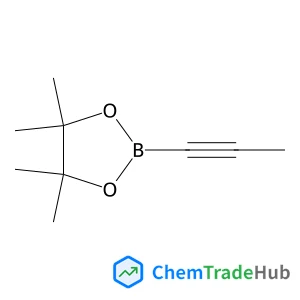
4,4,5,5-Tetramethyl-2-(1-propyn-1-YL)-1,3,2-dioxaborolane
CAS Number:
347389-75-7
Molecular Formula:
C9H15BO2
Recommended Suppliers




Disclaimer
This page provides academic journal information for reference and research purposes only. We are not affiliated with any journal publishers and do not handle publication submissions. For publication-related inquiries, please contact the respective journal publishers directly.
If you notice any inaccuracies in the information displayed, please contact us at support@chemtradehub.com. We will promptly review and address your concerns.