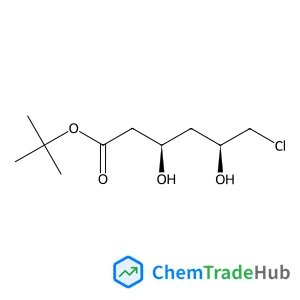
2-Methyl-2-propanyl (3R,5S)-6-chloro-3,5-dihydroxyhexanoate
CAS Number:
154026-93-4
Molecular Formula:
C10H19ClO4
Fuyuhiko Inagaki, Miyuki Momose, Naoya Maruyama, Kenkyo Matsuura, Tsukasa Matsunaga, Chisato Mukai
Concisely synthesized and functionalized dihydroasparagusic acid (DHAA) derivatives were used to show that the introduction of a hydrophobic functional group dramatically reduced air oxidation activity at the dithiol moieties and dominantly activated the cleavage of S–S bonds in proteins, presumably due to the hydrophobization and lipophilization. Notably, the reaction sites of water-reactive dithiol moieties behaved similarly to hydrophobic and lipophilic functional groups, which suggests impersonation of the reaction site.

Main Group Chemistry

Chinese Journal of Chemistry

Journal of Chemical Sciences

Acta Metallurgica Sinica-English Letters

Bioorganic & Medicinal Chemistry

Journal of Asian Natural Products Research

Journal of the Indian Institute of Science

Topics in Catalysis

Bioorganic & Medicinal Chemistry Letters

Colloid Journal
Fangzhi Hu, Lubin Xu
DOI: 10.1039/D0QO00344A
Zhengwei Ding, Zhi Liu, Guanghu Tong, Linlin Hu, Yangqing He, Yueyun Bao, Zhouhang Lei, Hailong Zhang
DOI: 10.1039/D0QO00424C
Xuelan Wen, Chang-Qiang Ke, Tian Zhang, Ligen Lin, Sheng Yao, Jason D. Goodpaster, Chunping Tang
DOI: 10.1039/D0QO00093K
Si-Meng Zhao, Mei-Fen Bao, Xiang-Hai Cai
DOI: 10.1039/D0QO00296H
Changming Dong, Tianjiao Qiao, Yi Xie, Xiao Zhang, Junli Ao, Guangxin Liang
DOI: 10.1039/D0QO00576B
Bang Li, Qi Mao, Jia Zhou, Feng Liu, Na Ye
DOI: 10.1039/C8OB03073A
Zhenzhen Wu, Mei Zhang, Yu Shi, Genping Huang
DOI: 10.1039/D0QO00174K
Johan Palmfeldt
DOI: 10.1039/C8OB03017K
Sem Raj Tamang, Anthony F. Cozzolino, Michael Findlater
DOI: 10.1039/C8OB02661K
(1R,3S)-1,3-Cyclopentanediol finds applications in various industries. In the ph...
When handling N'-[4-(Dimethylamino)phenyl]-N,N-dimethyl-1,4-benzenediamine, it i...
There are several alternatives to 5-(2,4-Difluorophenyl)-2-methoxypyrimidine in ...
1-(3-Methoxyphenoxy)propan-2-ol (CAS: 382141-68-6) must comply with the Globally...
Tetrodotoxin Citrate is extremely dangerous and should be handled with extreme c...
2-Methyl-2-propanyl [(1R,3S)-3-hydroxycyclopentyl]carbamate (CAS: 225641-84-9) i...
Waste containing 4-(2-Hydroxyhexafluoroisopropyl)Benzoic Acid (CAS: 16261-80-6) ...
2-Methyl-2-proanyl {(2S)-1-[(benzyloxy)amino]-3-hydroxy-3-methyl-1-oxo-2-butanyl...
Benzeneethanamine, α-ethyl-, hydrochloride (1:1) is an organic compound with the...
In the synthesis of compounds similar to 3-{(E)-[4-(Dimethylamino)phenyl]diazeny...

Organic & Biomolecular Chemistry (OBC) publishes original and high impact research and reviews in organic chemistry. We welcome research that shows new or significantly improved protocols or methodologies in total synthesis, synthetic methodology or physical and theoretical organic chemistry as well as research that shows a significant advance in the organic chemistry or molecular design aspects of chemical biology, catalysis, supramolecular and macromolecular chemistry, theoretical chemistry, mechanism-oriented physical organic chemistry, medicinal chemistry or natural products. Articles published in the journal should report new work which makes a highly-significant impact in the field. Routine and incremental work is generally not suitable for publication in the journal. More details about key areas of our scope are below. In all cases authors should include in their article clear rationale for why their research has been carried out.
![N-[(9H-Fluoren-9-ylmethoxy)carbonyl]-beta-phenyl-L-phenylalanine structure](https://static.chemtradehub.com/structs/201/201484-50-6-c2fc.webp "N-[(9H-Fluoren-9-ylmethoxy)carbonyl]-beta-phenyl-L-phenylalanine structure")