












Palladium-catalyzed selective synthesis of 3,4-dihydroquinazolines from electron-rich arylamines, electron-poor arylamines and glyoxalates
Literature Information
Publication Date
2018-06-25
DOI
10.1039/C8OB01005F
Impact Factor
3.876
Authors
Jie Wang, Xing-Yu Zhang, Guo-Kai Jia, Zhong Cao, Zilong Tang, Xianyong Yu, Xinhua Xu
View Original
Abstract
A simple palladium-catalyzed selective synthesis of structurally diverse 3,4-dihydroquinazolines from electron-rich arylamines, electron-poor arylamines and glyoxalates has been developed under mild conditions. This reaction is carried out in a tandem manner constituted by the condensation of arylamines and glyoxalates, the selective Diels–Alder cycloaddition and oxidation processes, in which 4-nitrothiophenol was used as the key ligand.
Related Literature
Long-term stability of phase-separated half-Heusler compounds
B. Balke, S. Ouardi, S. Selle, T. Höche, C. Felser, W. Hermes, M. Schwind
2015-10-15
Paper
DOI: 10.1039/C4CP04875J
Hierarchical core/shell structure of MnO2@polyaniline composites grown on carbon fiber paper for application in pseudocapacitors
MinHo Yang, Seok Bok Hong, Bong Gill Choi
2015-10-21
Paper
DOI: 10.1039/C5CP04761G
Local electric fields and molecular properties in heterogeneous environments through polarizable embedding
Nanna Holmgaard List, Hans Jørgen Aagaard Jensen, Jacob Kongsted
2016-02-25
Paper
DOI: 10.1039/C6CP00669H
DFT-based ab initio MD simulation of the ionic conduction in doped ZrO2 systems under epitaxial strain
M. Oka
2015-09-22
Paper
DOI: 10.1039/C5CP03238E
Kinetic isotope effects for fast deuterium and proton exchange rates
Daniele Mammoli
2016-03-09
Paper
DOI: 10.1039/C5CP07459B
Theoretical study of polyiodide formation and stability on monolayer and bilayer graphene
Pascal Puech, Iann C. Gerber
2015-10-19
Paper
DOI: 10.1039/C5CP04594K
Interfacial charge-transfer transitions in a TiO2-benzenedithiol complex with Ti–S–C linkages
Jun-ichi Fujisawa, Ryuki Muroga, Minoru Hanaya
2015-10-02
Paper
DOI: 10.1039/C5CP05046D
Controlling electron emission from the photoactive yellow protein chromophore by substitution at the coumaric acid group
Michael A. Parkes, Ciara Phillips, Michael J. Porter, Helen H. Fielding
2016-03-24
Paper
DOI: 10.1039/C6CP00565A
Thermal optical non-linearity of nematic mesophase enhanced by gold nanoparticles – an experimental and numerical investigation
O. Kurochkin, Y. K. Murugesan, T. P. Bennett, G. D'Alessandro, Y. Reznikov, B. J. Tang, G. H. Mehl, M. Kaczmarek
2016-03-01
Paper
DOI: 10.1039/C6CP00116E
Zeta potential-assisted sorption of uranyl tricarbonate complex from aqueous solution by polyamidoxime-functionalized colloidal particles
Lixia Zhang, Li Huang, Zehua Zeng, Jun Qian
2016-04-25
Paper
DOI: 10.1039/C6CP01234E
You might also like
Compound Q&A
What is the market or research trend for N-(4-Methoxybenzyl)-2-pyridinamine (CAS: 52818-63-0)?
N-(4-Methoxybenzyl)-2-pyridinamine (CAS: 52818-63-0) is increasingly being used ...
52818-63-0N-(4-Methoxybenzyl)-...
Compound Q&A
What precautions should be taken when handling Ethyl 4-(2-chlorophenyl)-1,3-thiazole-2-carboxylate (CAS: 1050507-06-6)?
When handling Ethyl 4-(2-chlorophenyl)-1,3-thiazole-2-carboxylate, appropriate p...
1050507-06-6Ethyl 4-(2-chlorophe...
Compound Q&A
What regulatory guidelines apply to diethyldiselane (CAS: 628-39-7)?
Diethyldiselane (CAS: 628-39-7) is classified under the Globally Harmonized Syst...
628-39-7Diethyldiselane
Compound Q&A
What is the market or research trend for oxocopper (CAS: 12053-18-8)?
The market for oxocopper (CAS: 12053-18-8) is primarily driven by its use in cat...
12053-18-8oxocopper; oxo-(oxoc...
Compound Q&A
What is the market or research trend for 5-{[(2-Methyl-2-propanyl)oxy]carbonyl}-5-azaspiro[2.4]heptane-7-carboxylic acid?
The market for 5-{[(2-Methyl-2-propanyl)oxy]carbonyl}-5-azaspiro[2.4]heptane-7-c...
1268519-54-55-{[(2-Methyl-2-prop...
Compound Q&A
What is 2-(1-Pyrrolidinyl)-4-pyridinamine (CAS: 35981-63-6)?
2-(1-Pyrrolidinyl)-4-pyridinamine is a chemical compound with the CAS number 359...
35981-63-62-(1-Pyrrolidinyl)-4...
Compound Q&A
What are the physical and chemical properties of 2-(3-Pyridinyl)-1-azabicyclo[2.2.2]octane (CAS: 91556-75-1)?
2-(3-Pyridinyl)-1-azabicyclo[2.2.2]octane (CAS: 91556-75-1) is a crystalline sol...
91556-75-12-(3-Pyridinyl)-1-az...
Compound Q&A
How is (S)-Alpha-allyl-proline hydrochloride (CAS: 129704-91-2) typically synthesized?
(S)-Alpha-allyl-proline hydrochloride is usually synthesized via a Wittig reacti...
129704-91-2(S)-Alpha-allyl-prol...
Compound Q&A
What is 3-Methyl-1,2-oxazole-5-carboxylic acid (CAS: 4857-42-5)?
3-Methyl-1,2-oxazole-5-carboxylic acid (CAS: 4857-42-5) is an organic compound w...
4857-42-53-Methyl-1,2-oxazole...
Compound Q&A
How is Lys-SMCC-DM1 (CAS: 1281816-04-3) typically synthesized?
Lys-SMCC-DM1 is synthesized via a multi-step process involving the coupling of S...
1281816-04-3Lys-SMCC-DM1
Source Journal
Organic & Biomolecular Chemistry

CiteScore:
3.4
Self-citation Rate:
10.3%
Articles per Year:
1041
Organic & Biomolecular Chemistry (OBC) publishes original and high impact research and reviews in organic chemistry. We welcome research that shows new or significantly improved protocols or methodologies in total synthesis, synthetic methodology or physical and theoretical organic chemistry as well as research that shows a significant advance in the organic chemistry or molecular design aspects of chemical biology, catalysis, supramolecular and macromolecular chemistry, theoretical chemistry, mechanism-oriented physical organic chemistry, medicinal chemistry or natural products. Articles published in the journal should report new work which makes a highly-significant impact in the field. Routine and incremental work is generally not suitable for publication in the journal. More details about key areas of our scope are below. In all cases authors should include in their article clear rationale for why their research has been carried out.
Recommended Compounds
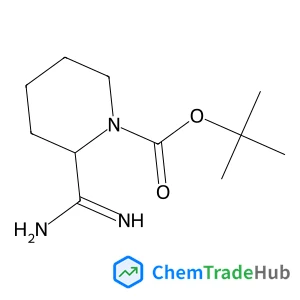
2-Methyl-2-propanyl 2-carbamimidoyl-1-piperidinecarboxylate
CAS Number:
1258640-98-0
Molecular Formula:
C11H21N3O2
Recommended Suppliers





Disclaimer
This page provides academic journal information for reference and research purposes only. We are not affiliated with any journal publishers and do not handle publication submissions. For publication-related inquiries, please contact the respective journal publishers directly.
If you notice any inaccuracies in the information displayed, please contact us at support@chemtradehub.com. We will promptly review and address your concerns.