












Palladium mediated deallylation in fully aqueous conditions for native chemical ligation at aspartic and glutamic acid sites
Literature Information
Publication Date
2018-05-07
DOI
10.1039/C8OB00890F
Impact Factor
3.876
Authors
Muhammad Jbara, Emad Eid, Ashraf Brik
View Original
Abstract
An efficient native chemical ligation approach at Asp and Glu sites is reported applying a hydrazide precursor, as a peptide thioester, and allyl protection at the side chain of Asp and Glu. The allyl protection was efficiently removed, after the ligation step, using the water-soluble palladium complex [Pd(allyl)Cl]2 and glutathione within a few minutes under fully aqueous conditions.
Related Literature
Direct re-lithiation strategy for spent lithium iron phosphate battery in Li-based eutectic using organic reducing agents
Tanongsak Yingnakorn, Jennifer Hartley, Jason S. Terreblanche, Chunhong Lei, Andrew P. Abbott
2023-11-02
Paper
DOI: 10.1039/D3SU00237C
A green process for the specific decomposition of chicken feather keratin into polythiol building blocks
Julia Diener, Christian Bartsch, Florian Dietrich, Claudia Falcke, Iva Anic, Steffen Roth, Andreas Taden, Michael Richter
2023-12-07
Paper
DOI: 10.1039/D3SU00269A
Structure and properties of biobased polyamide 36,9/cellulose nanocomposites
Biqiong Chen
2023-10-20
Paper
DOI: 10.1039/D3SU00302G
Effect of temperature and packaging materials on the shelf-life stability and in vitro properties of microencapsulated and spray-dried synbiotic legume-based instant beverage powder
Smriti Chaturvedi, Snehasis Chakraborty
2023-10-27
Paper
DOI: 10.1039/D3FB00094J
Engineering Pt nanoclusters on CeO2 surface with abundant point defects by in situ confined-domain encapsulation strategy for the catalytic elimination of VOCs
Weiliang Han, Weigao Han, Zhicheng Tang
2023-10-09
Paper
DOI: 10.1039/D3LF00147D
The role of ceria/precious metal interfaces in catalysis
Michele Melchionna
2023-11-29
Perspective
DOI: 10.1039/D3LF00202K
An assessment of spent coffee grounds as a replacement for peat in the production of Scotch whisky: chemical extraction and pyrolysis studies
Kacper P. Krakowiak, Ruaraidh D. McIntosh, David Ellis
2023-11-13
Paper
DOI: 10.1039/D3FB00088E
Dye adsorption-assisted colloidal dispersion of single-walled carbon nanotubes in polar solvents
Akiho Horibe, Tomoko Murayama, Tsuyoshi Kawai, Yoshiyuki Nonoguchi
2023-09-18
Paper
DOI: 10.1039/D3LF00119A
Recovery of anthocyanins from Eugenia spp. fruit peels: a comparison between heat- and ultrasound-assisted extraction
M. Beatriz P. P. Oliveira
2023-10-30
Paper
DOI: 10.1039/D3FB00115F
You might also like
Compound Q&A
What industries use (1R,3S)-1,3-Cyclopentanediol (CAS: 16326-97-9)?
(1R,3S)-1,3-Cyclopentanediol finds applications in various industries. In the ph...
16326-97-9(1R,3S)-1,3-Cyclopen...
Compound Q&A
What precautions should be taken when handling N'-[4-(Dimethylamino)phenyl]-N,N-dimethyl-1,4-benzenediamine (CAS: 637-31-0)?
When handling N'-[4-(Dimethylamino)phenyl]-N,N-dimethyl-1,4-benzenediamine, it i...
637-31-0N'-[4-(Dimethylamino...
Compound Q&A
Are there alternatives to 5-(2,4-Difluorophenyl)-2-methoxypyrimidine (CAS: 1352318-16-1) in synthesis?
There are several alternatives to 5-(2,4-Difluorophenyl)-2-methoxypyrimidine in ...
1352318-16-15-(2,4-Difluoropheny...
Compound Q&A
What regulatory guidelines apply to 1-(3-Methoxyphenoxy)propan-2-ol (CAS: 382141-68-6)?
1-(3-Methoxyphenoxy)propan-2-ol (CAS: 382141-68-6) must comply with the Globally...
382141-68-61-(3-Methoxyphenoxy)...
Compound Q&A
Is Tetrodotoxin Citrate (CAS: 18660-81-6) safe?
Tetrodotoxin Citrate is extremely dangerous and should be handled with extreme c...
18660-81-6Tetrodotoxin Citrate
Compound Q&A
What are the main uses of 2-Methyl-2-propanyl [(1R,3S)-3-hydroxycyclopentyl]carbamate (CAS: 225641-84-9)?
2-Methyl-2-propanyl [(1R,3S)-3-hydroxycyclopentyl]carbamate (CAS: 225641-84-9) i...
225641-84-92-Methyl-2-propanyl ...
Compound Q&A
How should waste containing 4-(2-Hydroxyhexafluoroisopropyl)Benzoic Acid (CAS: 16261-80-6) be handled?
Waste containing 4-(2-Hydroxyhexafluoroisopropyl)Benzoic Acid (CAS: 16261-80-6) ...
16261-80-64-(2-Hydroxyhexafluo...
Compound Q&A
How is 2-Methyl-2-proanyl {(2S)-1-[(benzyloxy)amino]-3-hydroxy-3-methyl-1-oxo-2-butanyl}carbamate (CAS: 102507-19-7) typically synthesized?
2-Methyl-2-proanyl {(2S)-1-[(benzyloxy)amino]-3-hydroxy-3-methyl-1-oxo-2-butanyl...
102507-19-72-Methyl-2-propanyl ...
Compound Q&A
What is Benzeneethanamine, α-ethyl-, hydrochloride (1:1) (CAS: 20735-15-3)?
Benzeneethanamine, α-ethyl-, hydrochloride (1:1) is an organic compound with the...
20735-15-3Benzeneethanamine, α...
Compound Q&A
Are there alternatives to 3-{(E)-[4-(Dimethylamino)phenyl]diazenyl}benzoic acid (CAS: 20691-84-3) in synthesis?
In the synthesis of compounds similar to 3-{(E)-[4-(Dimethylamino)phenyl]diazeny...
20691-84-33-{(E)-[4-(Dimethyla...
Source Journal
Organic & Biomolecular Chemistry

CiteScore:
3.4
Self-citation Rate:
10.3%
Articles per Year:
1041
Organic & Biomolecular Chemistry (OBC) publishes original and high impact research and reviews in organic chemistry. We welcome research that shows new or significantly improved protocols or methodologies in total synthesis, synthetic methodology or physical and theoretical organic chemistry as well as research that shows a significant advance in the organic chemistry or molecular design aspects of chemical biology, catalysis, supramolecular and macromolecular chemistry, theoretical chemistry, mechanism-oriented physical organic chemistry, medicinal chemistry or natural products. Articles published in the journal should report new work which makes a highly-significant impact in the field. Routine and incremental work is generally not suitable for publication in the journal. More details about key areas of our scope are below. In all cases authors should include in their article clear rationale for why their research has been carried out.
Recommended Compounds
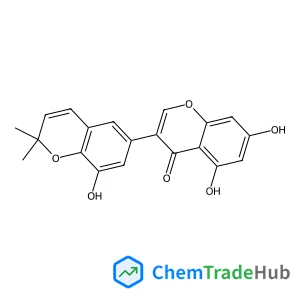
5,7,8'-Trihydroxy-2',2'-dimethyl-2'H,4H-3,6'-bichromen-4-one
CAS Number:
129280-33-7
Molecular Formula:
C20H16O6
Recommended Suppliers





Disclaimer
This page provides academic journal information for reference and research purposes only. We are not affiliated with any journal publishers and do not handle publication submissions. For publication-related inquiries, please contact the respective journal publishers directly.
If you notice any inaccuracies in the information displayed, please contact us at support@chemtradehub.com. We will promptly review and address your concerns.