













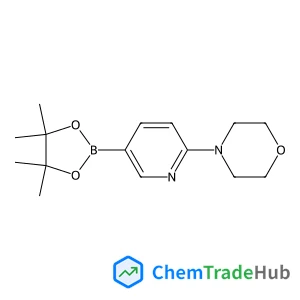
4-(5-(4,4,5,5-tetramethyl-1,3,2-dioxaborolan-2-yl)pyridin-2-yl)morpholine
CAS Number:
485799-04-0
Molecular Formula:
C15H23BN2O3
Julia Diener, Christian Bartsch, Florian Dietrich, Claudia Falcke, Iva Anic, Steffen Roth, Andreas Taden, Michael Richter
Defined peptides with exclusive molecular functionalities from biomass streams provide an untapped treasure for innovative biogenic specialty chemicals and materials. In this context, feather keratin, a natural structural protein with high L-cysteine content, enables access to polythiol-containing peptides, which can be used as matrix compounds for new materials per se and be specifically modified via their amino and acid moieties. This study describes an innovative two-step approach for tailored feather keratin fragmentation involving selective enzymatic hydrolysis followed by optional chemical reduction. Several proteases were investigated to serve as a benchmark for the decomposition of chicken feather keratin, and we succeeded in the controlled decomposition of chicken feathers using trypsin and other specific proteases, producing polythiol-containing peptide fragments. We were able to implement a green hydrolysis process without the need for any denaturants or reducing agents and achieved yields of soluble protein up to 81% (w/w) and thiol concentrations up to 21 mmol L−1. The obtained hydrolysates were used to produce peptide films, and the scalability of the newly developed hydrolysis process has been demonstrated in 25 L batch reactions.
Haiyan Cao, Yu Huang, Yuanyang Xie, Wenbing Shi, Cuicui Fu, Wei He
DOI: 10.1039/C8AN00849C
Eric Besson, Stéphane Gastaldi, Emily Bloch, Selma Aslan, Hakim Karoui, Olivier Ouari, Micael Hardy
DOI: 10.1039/C9AN00468H
Yuqing Chen, Yawen Lian, Mengna Huang, Lin Wei, Lehui Xiao
DOI: 10.1039/C9AN00850K
Janice B. Rabor, Koki Kawamura, Junichi Kurawaki, Yasuro Niidome
DOI: 10.1039/C9AN00247B
Bangrong Lu, Bei Wang, Xuesi Zhou, Jiangfeng Ding
DOI: 10.1039/C9AN00343F
(1R,3S)-1,3-Cyclopentanediol finds applications in various industries. In the ph...
When handling N'-[4-(Dimethylamino)phenyl]-N,N-dimethyl-1,4-benzenediamine, it i...
There are several alternatives to 5-(2,4-Difluorophenyl)-2-methoxypyrimidine in ...
1-(3-Methoxyphenoxy)propan-2-ol (CAS: 382141-68-6) must comply with the Globally...
Tetrodotoxin Citrate is extremely dangerous and should be handled with extreme c...
2-Methyl-2-propanyl [(1R,3S)-3-hydroxycyclopentyl]carbamate (CAS: 225641-84-9) i...
Waste containing 4-(2-Hydroxyhexafluoroisopropyl)Benzoic Acid (CAS: 16261-80-6) ...
2-Methyl-2-proanyl {(2S)-1-[(benzyloxy)amino]-3-hydroxy-3-methyl-1-oxo-2-butanyl...
Benzeneethanamine, α-ethyl-, hydrochloride (1:1) is an organic compound with the...
In the synthesis of compounds similar to 3-{(E)-[4-(Dimethylamino)phenyl]diazeny...
![N-[(5,6-Dichloro-1H-benzimidazol-2-yl)methyl]-9-(1-methyl-1H-pyrazol-4-yl)-2-(4-morpholinyl)-9H-purin-6-amine structure](https://static.chemtradehub.com/structs/238/2387704-62-1-25f4.webp "N-[(5,6-Dichloro-1H-benzimidazol-2-yl)methyl]-9-(1-methyl-1H-pyrazol-4-yl)-2-(4-morpholinyl)-9H-purin-6-amine structure")



