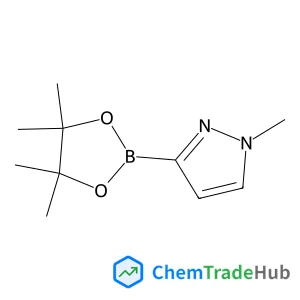
1-Methyl-3-(4,4,5,5-tetramethyl-1,3,2-dioxaborolan-2-yl)-1H-pyrazole
CAS Number:
1020174-04-2
Molecular Formula:
C10H17BN2O2
Khoubaib Ben Haj Salah, Sanjit Das, Nicolas Ruiz, Vanessa Andreu, Jean Martinez, Emmanuel Wenger, Muriel Amblard, Claude Didierjean, Baptiste Legrand, Nicolas Inguimbert
1,4-Disubstituted-1,2,3-triazole (Tz) is widely used in peptides as a trans-amide bond mimic, despite having hazardous effects on the native peptide activity. The impact of amide bond substitution by Tz on peptide secondary structures is scarcely documented. We performed a Tz scan, by systematically replacing peptide bonds following the Aib residues with Tz on two model peptaibols: alamethicin F50/5 and bergofungin D, which adopt stable α- and 310 helices, respectively. We observed that the Tz insertion, whatever its position in the peptide sequences, abolished their antimicrobial activity. The structural consequences of this insertion were further investigated using CD, NMR and X-ray diffraction. Importantly, five crystal structures that were incorporated with Tz were solved, showing various degrees of alteration of the helical structures, from minor structural perturbation of the helix to partial disorder. Together, these results showed that Tz insertions impair helical secondary structures.
Richard Buchner, Glenn Hefter
DOI: 10.1039/B906555P
E. D. de Rooij, U. von Toussaint, W. J. Goedheer
DOI: 10.1039/B908389H
Michael Nosonovsky, Ryoichi Amano, Jose M. Lucci, Pradeep K. Rohatgi
DOI: 10.1039/B912433K
Iftach Nevo, Lotte Holmegaard, Jens H. Nielsen, Jonas L. Hansen, Frank Filsinger, Gerard Meijer, Jochen Küpper
DOI: 10.1039/B910423B
Matthew R. Hudson, Damian G. Allis, Wayne Ouellette, Bruce S. Hudson
DOI: 10.1039/B905070A
Antonio Stocco, Dominique Langevin, Bingbo Wei, Bernard P. Binks
DOI: 10.1039/B907903C
Waste containing N-Methoxy-N-methyl-1,3-thiazole-5-carboxamide (CAS: 898825-89-3...
N-(4-Biphenylyl)dibenzo[b,d]furan-4-amine should be stored in a tightly sealed c...
The market for 3-Acetamido-5-amino-2,4,6-triiodobenzoic acid (CAS: 1713-07-1) is...
Benzyl 2-O-acetyl-3,4,6-tri-O-benzyl-beta-D-galactopyranoside (CAS: 61820-03-9) ...
2-Ethylpiperazine dihydrochloride (CAS: 438050-52-3) is regulated under the Glob...
1,1'-[1,3-Phenylenebis(methylene)]bis(3-methyl-1H-pyrrole-2,5-dione) (CAS: 11946...
Several alternatives can be used in the synthesis of 5-Fluoro-2-(1-pyrrolidinyl)...
Proper personal protective equipment (PPE) must be worn when handling this compo...
When handling 6-Bromoimidazo[1,2-a]pyridin-8-amine, it is important to wear appr...
Alternatives to (2S,4R)-4-(4-Nitrobenzyl)pyrrolidine-2-carboxylic acid hydrochlo...

Organic & Biomolecular Chemistry (OBC) publishes original and high impact research and reviews in organic chemistry. We welcome research that shows new or significantly improved protocols or methodologies in total synthesis, synthetic methodology or physical and theoretical organic chemistry as well as research that shows a significant advance in the organic chemistry or molecular design aspects of chemical biology, catalysis, supramolecular and macromolecular chemistry, theoretical chemistry, mechanism-oriented physical organic chemistry, medicinal chemistry or natural products. Articles published in the journal should report new work which makes a highly-significant impact in the field. Routine and incremental work is generally not suitable for publication in the journal. More details about key areas of our scope are below. In all cases authors should include in their article clear rationale for why their research has been carried out.