












Synthesis of diphenylamine macrocycles and their anti-inflammatory effects
Literature Information
Publication Date
2019-01-16
DOI
10.1039/C8OB03121E
Impact Factor
3.876
Authors
Alejandra Chávez-Riveros, Eduardo Hernández-Vázquez, Antonio Nieto-Camacho, Teresa Ramírez-Apan, Luis D. Miranda
View Original
Abstract
A collection of fourteen diphenylamine macrocyclic derivatives containing a peptide chain with different substituents was synthesized using a protocol of two Ugi four component reactions (Ugi-4CR) and a Buchwald–Hartwig macrocyclization. Their anti-inflammatory effects were assayed with an ear edema model using 12-O-tetradecanoylphorbol-13-acetate, while the activity of myeloperoxidase was determined to evaluate the index of leukocyte infiltration. Compound 5e had an ID50 of 0.18 μM per ear with a potency higher than that of the reference drugs indomethacin and celecoxib (0.24 and 0.91 μM per ear, respectively). Moreover, the cytotoxicity of the macrocycles was determined in two healthy cell lines, showing a low percentage of toxicity.
Related Literature
A novel catalyst with high activity for polyhydric alcohol oxidation: nanosilver/zeolite film
Jiang Shen, Wei Shan, Yahong Zhang, Junming Du, Hualong Xu, Kangnian Fan, Wei Shen, Yi Tang
2004-11-15
Communication
DOI: 10.1039/B412986E
Doubly N-fused meso-aryl substituted hexaphyrins(1.1.1.1.1.1)
Masaaki Suzuki, Ryuichiro Taniguchi
2004-10-06
Communication
DOI: 10.1039/B410011E
Silica coated fullerenols: seeded growth of silica spheres under acidic conditions
Elizabeth A. Whitsitt, Andrew R. Barron
2003-04-04
Communication
DOI: 10.1039/B212808J
Reduction of nitroaromatics to arylnitrenium ions by vinyl halide cations
Hao Chen, Xubin Zheng, Pengxiang Yang, R. Graham Cooks
2004-02-12
Communication
DOI: 10.1039/B314713D
Fabrication of a stable inorganic–organic hybrid multilayer film with uniform and dense inorganic nanoparticle deposition
Xurong Xu, Joong Tark Han, Kilwon Cho
2003-03-18
Communication
DOI: 10.1039/B300581J
Iron(iii) salen-type catalysts for the cross-coupling of aryl Grignards with alkyl halides bearing β-hydrogens
Robin B. Bedford, Duncan W. Bruce, Robert M. Frost, John W. Goodby, Michael Hird
2004-10-27
Communication
DOI: 10.1039/B413790F
Dispersing palladium nanoparticles using a water-in-oil microemulsion—homogenization of heterogeneous catalysis
Byunghoon Yoon, Hakwon Kim, Chien M. Wai
2003-04-02
Communication
DOI: 10.1039/B211836J
Supramolecular control of complexation-induced fluorescence change of water-soluble, β-cyclodextrin-modified CdS quantum dots
Kumaranand Palaniappan, Stephen A. Hackney, Jian Liu
2004-10-11
Communication
DOI: 10.1039/B409075F
Synthesis of monodisperse chromium nanoparticles from the thermolysis of a Fischer carbene complex
Seung Uk Son, Youngjin Jang, Ki Youl Yoon, Changhua An, Yosun Hwang, Je-Geun Park, Han-Jin Noh, Jae-Young Kim, Jae-Hoon Park, Taeghwan Hyeon
2004-11-26
Communication
DOI: 10.1039/B411656A
Bioinspired synthesis of new silica structures
Siddharth V. Patwardhan, Niloy Mukherjee, Miriam Steinitz-Kannan, Stephen J. Clarson
2003-04-23
Communication
DOI: 10.1039/B302056H
You might also like
Compound Q&A
What industries use (1R,3S)-1,3-Cyclopentanediol (CAS: 16326-97-9)?
(1R,3S)-1,3-Cyclopentanediol finds applications in various industries. In the ph...
16326-97-9(1R,3S)-1,3-Cyclopen...
Compound Q&A
What precautions should be taken when handling N'-[4-(Dimethylamino)phenyl]-N,N-dimethyl-1,4-benzenediamine (CAS: 637-31-0)?
When handling N'-[4-(Dimethylamino)phenyl]-N,N-dimethyl-1,4-benzenediamine, it i...
637-31-0N'-[4-(Dimethylamino...
Compound Q&A
Are there alternatives to 5-(2,4-Difluorophenyl)-2-methoxypyrimidine (CAS: 1352318-16-1) in synthesis?
There are several alternatives to 5-(2,4-Difluorophenyl)-2-methoxypyrimidine in ...
1352318-16-15-(2,4-Difluoropheny...
Compound Q&A
What regulatory guidelines apply to 1-(3-Methoxyphenoxy)propan-2-ol (CAS: 382141-68-6)?
1-(3-Methoxyphenoxy)propan-2-ol (CAS: 382141-68-6) must comply with the Globally...
382141-68-61-(3-Methoxyphenoxy)...
Compound Q&A
Is Tetrodotoxin Citrate (CAS: 18660-81-6) safe?
Tetrodotoxin Citrate is extremely dangerous and should be handled with extreme c...
18660-81-6Tetrodotoxin Citrate
Compound Q&A
What are the main uses of 2-Methyl-2-propanyl [(1R,3S)-3-hydroxycyclopentyl]carbamate (CAS: 225641-84-9)?
2-Methyl-2-propanyl [(1R,3S)-3-hydroxycyclopentyl]carbamate (CAS: 225641-84-9) i...
225641-84-92-Methyl-2-propanyl ...
Compound Q&A
How should waste containing 4-(2-Hydroxyhexafluoroisopropyl)Benzoic Acid (CAS: 16261-80-6) be handled?
Waste containing 4-(2-Hydroxyhexafluoroisopropyl)Benzoic Acid (CAS: 16261-80-6) ...
16261-80-64-(2-Hydroxyhexafluo...
Compound Q&A
How is 2-Methyl-2-proanyl {(2S)-1-[(benzyloxy)amino]-3-hydroxy-3-methyl-1-oxo-2-butanyl}carbamate (CAS: 102507-19-7) typically synthesized?
2-Methyl-2-proanyl {(2S)-1-[(benzyloxy)amino]-3-hydroxy-3-methyl-1-oxo-2-butanyl...
102507-19-72-Methyl-2-propanyl ...
Compound Q&A
What is Benzeneethanamine, α-ethyl-, hydrochloride (1:1) (CAS: 20735-15-3)?
Benzeneethanamine, α-ethyl-, hydrochloride (1:1) is an organic compound with the...
20735-15-3Benzeneethanamine, α...
Compound Q&A
Are there alternatives to 3-{(E)-[4-(Dimethylamino)phenyl]diazenyl}benzoic acid (CAS: 20691-84-3) in synthesis?
In the synthesis of compounds similar to 3-{(E)-[4-(Dimethylamino)phenyl]diazeny...
20691-84-33-{(E)-[4-(Dimethyla...
Source Journal
Organic & Biomolecular Chemistry

CiteScore:
3.4
Self-citation Rate:
10.3%
Articles per Year:
1041
Organic & Biomolecular Chemistry (OBC) publishes original and high impact research and reviews in organic chemistry. We welcome research that shows new or significantly improved protocols or methodologies in total synthesis, synthetic methodology or physical and theoretical organic chemistry as well as research that shows a significant advance in the organic chemistry or molecular design aspects of chemical biology, catalysis, supramolecular and macromolecular chemistry, theoretical chemistry, mechanism-oriented physical organic chemistry, medicinal chemistry or natural products. Articles published in the journal should report new work which makes a highly-significant impact in the field. Routine and incremental work is generally not suitable for publication in the journal. More details about key areas of our scope are below. In all cases authors should include in their article clear rationale for why their research has been carried out.
Recommended Compounds
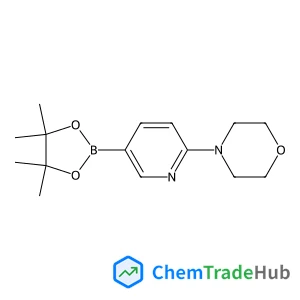
4-(5-(4,4,5,5-tetramethyl-1,3,2-dioxaborolan-2-yl)pyridin-2-yl)morpholine
CAS Number:
485799-04-0
Molecular Formula:
C15H23BN2O3
Recommended Suppliers




Disclaimer
This page provides academic journal information for reference and research purposes only. We are not affiliated with any journal publishers and do not handle publication submissions. For publication-related inquiries, please contact the respective journal publishers directly.
If you notice any inaccuracies in the information displayed, please contact us at support@chemtradehub.com. We will promptly review and address your concerns.