


The protecting group enabled para-selective C–H benzylation of anilides via iron(ii) catalysis: a convenient approach for the synthesis of triarylmethanes
Literature Information
Publication Date
2020-06-10
DOI
10.1039/D0QO00402B
Impact Factor
5.281
Authors
Yi Han, Guobao Li, Lingling Liu, Chenyang Dai, Da-Qing Shi, Yingsheng Zhao
View Original
Abstract
We report the para-selective C–H benzylation of phenyl carbamate with an iron(II) catalyst. This new method provides an efficient and convenient approach for the synthesis of triarylmethanes starting from readily available anilines and diphenylmethane. Preliminary mechanistic studies revealed that the iron(II) catalyst was essential and the use of the sterically demanding isobutoxy group led to high para-selectivity.
Recommended Journals

Journal of Asian Natural Products Research

Atomization and Sprays

Journal of Chemical Sciences

Medicinal Chemistry Research

Main Group Chemistry

Cellulose

Critical Reviews in Solid State and Materials Sciences

Herald of the Russian Academy of Sciences

Chinese Journal of Chemistry

Acta Metallurgica Sinica-English Letters
Related Literature
Investigation of hairpin DNA and chelerythrine interaction by a single bio-nanopore sensing interface
Yuan-Min Liu, Xiu-Yu Fang, Fang Fang, Zhi-Yong Wu
2019-05-29
Paper
DOI: 10.1039/C9AN00113A
Direct-laser-writing of three-dimensional porous graphene frameworks on indium-tin oxide for sensitive electrochemical biosensing
Qing Hong, Limin Yang, Lei Ge, Zhenhui Liu, Feng Li
2018-06-11
Paper
DOI: 10.1039/C8AN00888D
Label-free tracking of nanosized graphene oxide cellular uptake by confocal Raman microscopy
Michal Bodík, Nikola Bugárová, Martina Labudová, Miriam Zaťovičová, Tibor Hianik, Mária Omastová, Matej Jergel, Silvia Pastoreková
2018-06-12
Paper
DOI: 10.1039/C8AN00225H
A simple architecture with self-assembled monolayers to build immunosensors for detecting the pancreatic cancer biomarker CA19-9
Juliana Coatrini Soares, Valquiria da Cruz Rodrigues, Iram Taj Awan, Matias Eliseo Melendez, Maria Helena Oliveira Piazzetta, Angelo Luiz Gobbi, José Humberto T. G. Fregnani, André Lopes Carvalho, Osvaldo N. Oliveira, Jr
2018-04-19
Paper
DOI: 10.1039/C8AN00430G
You might also like
Compound Q&A
What industries use (1R,3S)-1,3-Cyclopentanediol (CAS: 16326-97-9)?
(1R,3S)-1,3-Cyclopentanediol finds applications in various industries. In the ph...
16326-97-9(1R,3S)-1,3-Cyclopen...
Compound Q&A
What precautions should be taken when handling N'-[4-(Dimethylamino)phenyl]-N,N-dimethyl-1,4-benzenediamine (CAS: 637-31-0)?
When handling N'-[4-(Dimethylamino)phenyl]-N,N-dimethyl-1,4-benzenediamine, it i...
637-31-0N'-[4-(Dimethylamino...
Compound Q&A
Are there alternatives to 5-(2,4-Difluorophenyl)-2-methoxypyrimidine (CAS: 1352318-16-1) in synthesis?
There are several alternatives to 5-(2,4-Difluorophenyl)-2-methoxypyrimidine in ...
1352318-16-15-(2,4-Difluoropheny...
Compound Q&A
What regulatory guidelines apply to 1-(3-Methoxyphenoxy)propan-2-ol (CAS: 382141-68-6)?
1-(3-Methoxyphenoxy)propan-2-ol (CAS: 382141-68-6) must comply with the Globally...
382141-68-61-(3-Methoxyphenoxy)...
Compound Q&A
Is Tetrodotoxin Citrate (CAS: 18660-81-6) safe?
Tetrodotoxin Citrate is extremely dangerous and should be handled with extreme c...
18660-81-6Tetrodotoxin Citrate
Compound Q&A
What are the main uses of 2-Methyl-2-propanyl [(1R,3S)-3-hydroxycyclopentyl]carbamate (CAS: 225641-84-9)?
2-Methyl-2-propanyl [(1R,3S)-3-hydroxycyclopentyl]carbamate (CAS: 225641-84-9) i...
225641-84-92-Methyl-2-propanyl ...
Compound Q&A
How should waste containing 4-(2-Hydroxyhexafluoroisopropyl)Benzoic Acid (CAS: 16261-80-6) be handled?
Waste containing 4-(2-Hydroxyhexafluoroisopropyl)Benzoic Acid (CAS: 16261-80-6) ...
16261-80-64-(2-Hydroxyhexafluo...
Compound Q&A
How is 2-Methyl-2-proanyl {(2S)-1-[(benzyloxy)amino]-3-hydroxy-3-methyl-1-oxo-2-butanyl}carbamate (CAS: 102507-19-7) typically synthesized?
2-Methyl-2-proanyl {(2S)-1-[(benzyloxy)amino]-3-hydroxy-3-methyl-1-oxo-2-butanyl...
102507-19-72-Methyl-2-propanyl ...
Compound Q&A
What is Benzeneethanamine, α-ethyl-, hydrochloride (1:1) (CAS: 20735-15-3)?
Benzeneethanamine, α-ethyl-, hydrochloride (1:1) is an organic compound with the...
20735-15-3Benzeneethanamine, α...
Compound Q&A
Are there alternatives to 3-{(E)-[4-(Dimethylamino)phenyl]diazenyl}benzoic acid (CAS: 20691-84-3) in synthesis?
In the synthesis of compounds similar to 3-{(E)-[4-(Dimethylamino)phenyl]diazeny...
20691-84-33-{(E)-[4-(Dimethyla...
Source Journal
Organic Chemistry Frontiers

CiteScore:
7.8
Self-citation Rate:
8.7%
Articles per Year:
724
Organic Chemistry Frontiers publishes high-quality research from across organic chemistry. Emphases are placed on studies that make significant contributions to the field of organic chemistry by reporting either new or significantly improved protocols or methodologies. Topics include, but are not limited to the following: Organic synthesis Development of synthetic methodologies Catalysis Natural products Functional organic materials Supramolecular and macromolecular chemistry Physical and computational organic chemistry
Recommended Compounds


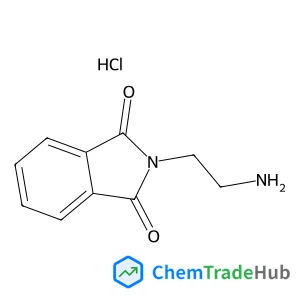
2-(2-Aminoethyl)-1H-isoindole-1,3(2H)-dione hydrochloride (1:1)
CAS Number:
30250-67-0
Molecular Formula:
C10H11ClN2O2
Recommended Suppliers





Disclaimer
This page provides academic journal information for reference and research purposes only. We are not affiliated with any journal publishers and do not handle publication submissions. For publication-related inquiries, please contact the respective journal publishers directly.
If you notice any inaccuracies in the information displayed, please contact us at support@chemtradehub.com. We will promptly review and address your concerns.