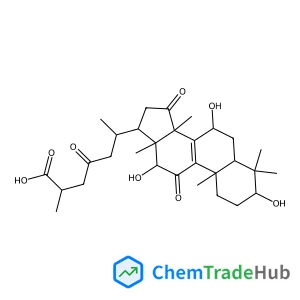
(3beta,7beta,12beta)-3,7,12-Trihydroxy-11,15,23-trioxolanost-8-en-26-oic acid
CAS Number:
98665-22-6
Molecular Formula:
C30H44O8
Yuan-Yuan Ren, Shou-Fei Zhu
Transition metal-catalyzed carbene insertion into X–H bonds (X = N, O, S, and C) represents a typical carbene transfer reaction and has been widely used in organic synthesis. The enantioselectivity-determining step in some of these insertion reactions is the proton transfer of active intermediates such as ylides, metal enolates, or free enols. Since most of the traditional chiral transition metal catalysts tend to dissociate from these active intermediates and cannot be involved in the proton-transfer step, enantiocontrol of these insertion reactions has long been a challenging task. Since 2011, we have developed chiral spiro phosphoric acids as chiral proton-transfer shuttle (CPTS) catalysts, which have been proven to be efficient catalysts for the proton transfer of active intermediates in carbene insertion reactions. Upon combining with achiral dirhodium catalysts, the CPTS catalysts accomplish highly enantioselective insertions of N–H, S–H, and C–H bonds. Herein, a number of important chiral building blocks, including α-amino acid derivatives, α-amino ketones, α-thioesters, and α,α-diaryl acetates, were prepared with high yields and high enantioselectivities through these insertion reactions.
Sandra Monti, Stefano Ottani, Francesco Manoli, Ilse Manet, Francesco Scagnolari, Barbara Zambelli, Giancarlo Marconi
DOI: 10.1039/B906021A
Grant Paterson, Sarandis Marinakis, Matthew L. Costen, Kenneth G. McKendrick
DOI: 10.1039/B909051G
M. Torrent-Sucarrat, J. M. Anglada, J. M. Luis
DOI: 10.1039/B904736K
Haoyuan Cai, Zhaobin Qiu
DOI: 10.1039/B907677H
Svetlana Kilina, Alexey Koposov, Milan Sykora, Sergei Tretiak
DOI: 10.1039/B924910A
Britt-Elfriede Schuster, M. Benedetta Casu, Indro Biswas, Alexander Hinderhofer, Alexander Gerlach, Frank Schreiber, Thomas Chassé
DOI: 10.1039/B912790A
Iftach Nevo, Lotte Holmegaard, Jens H. Nielsen, Jonas L. Hansen, Frank Filsinger, Gerard Meijer, Jochen Küpper
DOI: 10.1039/B910423B
Wei Chen, Yongcai Qiu, Shihe Yang
DOI: 10.1039/C000584C
Waste containing N-Methoxy-N-methyl-1,3-thiazole-5-carboxamide (CAS: 898825-89-3...
N-(4-Biphenylyl)dibenzo[b,d]furan-4-amine should be stored in a tightly sealed c...
The market for 3-Acetamido-5-amino-2,4,6-triiodobenzoic acid (CAS: 1713-07-1) is...
Benzyl 2-O-acetyl-3,4,6-tri-O-benzyl-beta-D-galactopyranoside (CAS: 61820-03-9) ...
2-Ethylpiperazine dihydrochloride (CAS: 438050-52-3) is regulated under the Glob...
1,1'-[1,3-Phenylenebis(methylene)]bis(3-methyl-1H-pyrrole-2,5-dione) (CAS: 11946...
Several alternatives can be used in the synthesis of 5-Fluoro-2-(1-pyrrolidinyl)...
Proper personal protective equipment (PPE) must be worn when handling this compo...
When handling 6-Bromoimidazo[1,2-a]pyridin-8-amine, it is important to wear appr...
Alternatives to (2S,4R)-4-(4-Nitrobenzyl)pyrrolidine-2-carboxylic acid hydrochlo...

Organic & Biomolecular Chemistry (OBC) publishes original and high impact research and reviews in organic chemistry. We welcome research that shows new or significantly improved protocols or methodologies in total synthesis, synthetic methodology or physical and theoretical organic chemistry as well as research that shows a significant advance in the organic chemistry or molecular design aspects of chemical biology, catalysis, supramolecular and macromolecular chemistry, theoretical chemistry, mechanism-oriented physical organic chemistry, medicinal chemistry or natural products. Articles published in the journal should report new work which makes a highly-significant impact in the field. Routine and incremental work is generally not suitable for publication in the journal. More details about key areas of our scope are below. In all cases authors should include in their article clear rationale for why their research has been carried out.