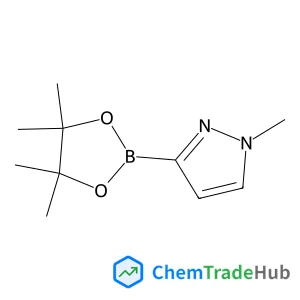
1-Methyl-3-(4,4,5,5-tetramethyl-1,3,2-dioxaborolan-2-yl)-1H-pyrazole
CAS Number:
1020174-04-2
Molecular Formula:
C10H17BN2O2
Sandra Monti, Stefano Ottani, Francesco Manoli, Ilse Manet, Francesco Scagnolari, Barbara Zambelli, Giancarlo Marconi
The interaction of enantiomeric ketoprofen (KP) with BSA and HSA was studied by isothermal titration calorimetry (ITC). Affinity constants and thermodynamic parameters for complexation in two main protein sites were determined. Affinity constants for both proteins are generally lower for S(+)- than for R(−)-KP. Large enthalpic contributions to Gibbs free energy are compensated by large negative entropic terms for S(+) in the BSA-subdomain IIIA and HSA-subdomain IIA. The lowest energy BSA complexes of both enantiomers were structurally characterized by combining molecular mechanics (MM) and molecular dynamics (MD) with circular dichroism (CD). Comparison of quantum mechanically calculated rotational strengths with the CD signals of the complexes supported the structures. These allowed to identify the main interactions of the KP enantiomers with surrounding aminoacids at short distances, that limit significantly KP mobility in both sites. In the primary binding site S(+) is close to Tyr 409 in subdomain IIIA (Sudlow site II), and R(−) is close to Trp 212 and His 240 in subdomain IIA (Sudlow site I). The same sites are involved in the formation of 2:1 complexes. The equilibrium structures are characterized by marked geometrical distortion of KP.
Houyang Chen
DOI: 10.1039/C6CP08621G
Frédéric Aitken, Ferdinand Volino, Luis Guillermo Mendoza-Luna, Klaus von Haeften, Jussi Eloranta
DOI: 10.1039/C7CP03067C
Daniel F. S. Machado, Valter H. Carvalho-Silva, Leonardo G. Paterno, Heibbe Cristhian B. de Oliveira
DOI: 10.1039/C6CP07900H
Tony Pham, Katherine A. Forrest, Matthew Mostrom, Joseph R. Hunt, Hiroyasu Furukawa, Brian Space
DOI: 10.1039/C7CP00924K
DOI: 10.1039/C7CP00828G
Haiying He, Yesukhei Jagvaral
DOI: 10.1039/C7CP00915A
S. Vangaveti, R. J. D'Esposito, J. L. Lippens, S. V. Ranganathan
DOI: 10.1039/C7CP00717E
Jianbo Ma, Sunting Xuan, Abby C. Guerin, Tianyi Yu, Donghui Zhang, Daniel G. Kuroda
DOI: 10.1039/C6CP08536A
Tianhui Liu, Bina Fu, Dong H. Zhang
DOI: 10.1039/C7CP01770G
Xiaoxiao Cao, Yingying Huang, Xue Jiang, Yan Su, Jijun Zhao
DOI: 10.1039/C7CP01147D
Waste containing N-Methoxy-N-methyl-1,3-thiazole-5-carboxamide (CAS: 898825-89-3...
N-(4-Biphenylyl)dibenzo[b,d]furan-4-amine should be stored in a tightly sealed c...
The market for 3-Acetamido-5-amino-2,4,6-triiodobenzoic acid (CAS: 1713-07-1) is...
Benzyl 2-O-acetyl-3,4,6-tri-O-benzyl-beta-D-galactopyranoside (CAS: 61820-03-9) ...
2-Ethylpiperazine dihydrochloride (CAS: 438050-52-3) is regulated under the Glob...
1,1'-[1,3-Phenylenebis(methylene)]bis(3-methyl-1H-pyrrole-2,5-dione) (CAS: 11946...
Several alternatives can be used in the synthesis of 5-Fluoro-2-(1-pyrrolidinyl)...
Proper personal protective equipment (PPE) must be worn when handling this compo...
When handling 6-Bromoimidazo[1,2-a]pyridin-8-amine, it is important to wear appr...
Alternatives to (2S,4R)-4-(4-Nitrobenzyl)pyrrolidine-2-carboxylic acid hydrochlo...

Physical Chemistry Chemical Physics (PCCP) is an international journal co-owned by 19 physical chemistry and physics societies from around the world. This journal publishes original, cutting-edge research in physical chemistry, chemical physics and biophysical chemistry. To be suitable for publication in PCCP, articles must include significant innovation and/or insight into physical chemistry; this is the most important criterion that reviewers and Editors will judge against when evaluating submissions. The journal has a broad scope and welcomes contributions spanning experiment, theory, computation and data science. Topical coverage includes spectroscopy, dynamics, kinetics, statistical mechanics, thermodynamics, electrochemistry, catalysis, surface science, quantum mechanics, quantum computing and machine learning. Interdisciplinary research areas such as polymers and soft matter, materials, nanoscience, energy, surfaces/interfaces, and biophysical chemistry are welcomed if they demonstrate significant innovation and/or insight into physical chemistry. Joined experimental/theoretical studies are particularly appreciated when complementary and based on up-to-date approaches.

![[4-Amino-2-(methylsulfanyl)-5-pyrimidinyl]methanol structure](https://static.chemtradehub.com/structs/588/588-36-3-fc73.webp "[4-Amino-2-(methylsulfanyl)-5-pyrimidinyl]methanol structure")