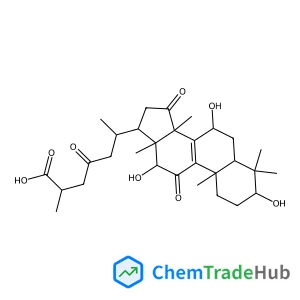
(3beta,7beta,12beta)-3,7,12-Trihydroxy-11,15,23-trioxolanost-8-en-26-oic acid
CAS Number:
98665-22-6
Molecular Formula:
C30H44O8
Marcel Ritter, Sandesh Neupane, Christoph Steinbeck
A new bilirubin oxidation end product (BOX) was isolated and characterized. The formation of the so-called Z-BOX C proceeds from bilirubin via propentdyopents as intermediates. This BOX was detected in pathological human bile samples using liquid chromatography/mass spectrometry and has potential relevance for liver dysfunction and cerebral vasospasms.
H. Mohammadi-Manesh, Saman Alavi, Tom K. Woo, Mahmud Ashrafizaadeh, Bijan Najafi
DOI: 10.1039/B905233J
Paramaconi Rodriguez, Marc T. M. Koper
DOI: 10.1039/B926365A
Wei Chen, Christoph Tegenkamp, Herbert Pfnür, Thomas Bredow
DOI: 10.1039/B911944B
Haoyuan Cai, Zhaobin Qiu
DOI: 10.1039/B907677H
Grant Paterson, Sarandis Marinakis, Jacek Kłos, Matthew L. Costen, Kenneth G. McKendrick
DOI: 10.1039/B909050A
Yasuyoshi Iwase, Ken Motokura, To-ru Koyama, Akimitsu Miyaji, Toshihide Baba
DOI: 10.1039/B911659A
Daniela Polino, Alessandro Barbato, Carlo Cavallotti
DOI: 10.1039/C002221G
M. Nolan, S. A. M. Tofail
DOI: 10.1039/C002562C
Waste containing N-Methoxy-N-methyl-1,3-thiazole-5-carboxamide (CAS: 898825-89-3...
N-(4-Biphenylyl)dibenzo[b,d]furan-4-amine should be stored in a tightly sealed c...
The market for 3-Acetamido-5-amino-2,4,6-triiodobenzoic acid (CAS: 1713-07-1) is...
Benzyl 2-O-acetyl-3,4,6-tri-O-benzyl-beta-D-galactopyranoside (CAS: 61820-03-9) ...
2-Ethylpiperazine dihydrochloride (CAS: 438050-52-3) is regulated under the Glob...
1,1'-[1,3-Phenylenebis(methylene)]bis(3-methyl-1H-pyrrole-2,5-dione) (CAS: 11946...
Several alternatives can be used in the synthesis of 5-Fluoro-2-(1-pyrrolidinyl)...
Proper personal protective equipment (PPE) must be worn when handling this compo...
When handling 6-Bromoimidazo[1,2-a]pyridin-8-amine, it is important to wear appr...
Alternatives to (2S,4R)-4-(4-Nitrobenzyl)pyrrolidine-2-carboxylic acid hydrochlo...

Organic & Biomolecular Chemistry (OBC) publishes original and high impact research and reviews in organic chemistry. We welcome research that shows new or significantly improved protocols or methodologies in total synthesis, synthetic methodology or physical and theoretical organic chemistry as well as research that shows a significant advance in the organic chemistry or molecular design aspects of chemical biology, catalysis, supramolecular and macromolecular chemistry, theoretical chemistry, mechanism-oriented physical organic chemistry, medicinal chemistry or natural products. Articles published in the journal should report new work which makes a highly-significant impact in the field. Routine and incremental work is generally not suitable for publication in the journal. More details about key areas of our scope are below. In all cases authors should include in their article clear rationale for why their research has been carried out.