












Activation of CO2 at the electrode–electrolyte interface by a co-adsorbed cation and an electric field
Literature Information
Publication Date
2019-04-01
DOI
10.1039/C8CP07807F
Impact Factor
3.676
Authors
Sathish Ponnurangam
View Original
Abstract
Carboxylate *CO2− has recently been identified as the first intermediate of the CO2 electroreduction independent of the reaction pathway. However, on the fundamental level, the structural and electronic properties of *CO2− remain poorly understood especially under the electrocatalytic conditions, which limits our capacity to rationally control the transformation of this reaction intermediate to CO or formate. To close this gap, we model using density functional theory (DFT) the interactions of *CO2− with the copper Cu(111) surface and a co-adsorbed sodium cation in the electric double layer (EDL), as well as the effects of electrode potential on these interactions. We demonstrate that *CO2− is activated by a co-adsorbed alkali cation most strongly when it forms with the cation a noncovalent bond (ion pair), where the cation is coordinated in the on-top position. The most stable structure of this ion pair with a sodium cation is hydration-shared. An external negative electric field not only enhances activation of *CO2− but also tilts it in the *CO2− plane, elongating the metal–C bond and contracting the metal–O bond. This tilting facilitates hydrogenation of the C atom and dissociation of the surface-coordinated C–O bond. Based on a detailed analysis of the projected density of states (pDOS), we interpret these findings in terms of electrostatic and chemical effects. The provided insights can help understand the relationship between properties of the catalytic system and its catalytic activity in the CO2 conversion to CO and formate, and hence help develop new CO2 electroreduction catalysts.
Related Literature
Controlled synthesis of luminescent polymers using a bis-dithiobenzoate RAFT agent
Ming Chen, Kenneth P. Ghiggino, Ezio Rizzardo, San H. Thang, Gerard J. Wilson
2008-01-03
Communication
DOI: 10.1039/B716471H
Reversible lithium insertion and copper extrusion in layered oxysulfides
Oliver J. Rutt, Gareth R. Williams, Simon J. Clarke
2006-06-06
Communication
DOI: 10.1039/B605105G
Facile routes to Alkyl-BIAN ligands
Jennifer A. Moore, Kalyan Vasudevan, Nicholas J. Hill, Gregor Reeske, Alan H. Cowley
2006-06-05
Communication
DOI: 10.1039/B606390J
Synergistic effect of binary component ligands in chiral catalyst library engineering for enantioselective reactions
2008-01-21
Feature Article
DOI: 10.1039/B710668H
Crystal structure of tricyclo-DNA: an unusual compensatory change of two adjacent backbone torsion angles
Pradeep S. Pallan, Damian Ittig, Annie Héroux, Zdzislaw Wawrzak, Christian J. Leumann, Martin Egli
2007-12-21
Communication
DOI: 10.1039/B716390H
An imidazole-functionalized polyacetylene: convenient synthesis and selective chemosensor for metal ions and cyanide
Qi Zeng, Ping Cai, Zhen Li, Jingui Qin, Ben Zhong Tang
2008-01-29
Communication
DOI: 10.1039/B717764J
The first soluble conjugated poly(2,6-anthrylene): synthesis and properties
Weibin Cui, Yubo Wu, Hongkun Tian, Yanhou Geng, Fosong Wang
2007-12-18
Communication
DOI: 10.1039/B713463K
Asymmetric aldol reactions catalyzed by tryptophan in water
Zhian Liang, Xiaoyu Wu
2006-05-26
Communication
DOI: 10.1039/B606154K
Diastereoselective diaza-Cope rearrangement reaction
Hyunwoo Kim, Doo Seoung Choi, Cindy Pai-Hui Yen, Alan J. Lough, Choong Eui Song, Jik Chin
2008-01-23
Communication
DOI: 10.1039/B716253G
You might also like
Compound Q&A
Are there alternatives to 1-(4-Chlorophenyl)-N-hydroxymethanimine (CAS: 3848-36-0) in synthesis?
When considering alternatives to 1-(4-Chlorophenyl)-N-hydroxymethanimine (CAS: 3...
3848-36-01-(4-Chlorophenyl)-N...
Compound Q&A
How should (1R,9S,10S,12S,14E,16S,19R,20R,21S,22R)-3,9,21-Trihydroxy-5,10,12,14,16,20,22-heptamethyl-23,24-dioxatetracyclo[17.3.1.1~6,9~.0~2,7~]tetracosa-2,5,7,14-tetraen-4-one (CAS: 183202-73-5) be stored?
This compound should be stored in a cool, dry place away from direct sunlight. I...
183202-73-5(1R,9S,10S,12S,14E,1...
Compound Q&A
How is 3-(4-Bromophenyl)-5-(2-fluorophenyl)-1,2,4-oxadiazole (CAS: 419553-16-5) typically synthesized?
3-(4-Bromophenyl)-5-(2-fluorophenyl)-1,2,4-oxadiazole is synthesized through a m...
419553-16-53-(4-Bromophenyl)-5-...
Compound Q&A
How is 5-Chloro-2-(4-chlorophenyl)-4-methyl-6-[3-(1-piperidinyl)propoxy]pyrimidine (CAS: 1639220-19-1) typically synthesized?
5-Chloro-2-(4-chlorophenyl)-4-methyl-6-[3-(1-piperidinyl)propoxy]pyrimidine (CAS...
1639220-19-15-Chloro-2-(4-chloro...
Compound Q&A
What industries use 2-Chloro-4-(difluoromethoxy)pyridine (CAS: 1206978-15-5)?
2-Chloro-4-(difluoromethoxy)pyridine is used in the pharmaceutical industry for ...
1206978-15-52-Chloro-4-(difluoro...
Compound Q&A
What regulatory guidelines apply to 3-Chloro-6-methylpyridazine (CAS: 1121-79-5)?
3-Chloro-6-methylpyridazine (CAS: 1121-79-5) is classified under the Globally Ha...
1121-79-53-Chloro-6-methylpyr...
Compound Q&A
Are there alternatives to Methyl 4,5-dimethyl-2-nitrobenzoate in synthesis?
Several alternatives can be used in the synthesis of Methyl 4,5-dimethyl-2-nitro...
90922-74-0Methyl 4,5-dimethyl-...
Compound Q&A
Are there alternatives to (2E,2'E)-3,3'-(1,4-Phenylene)bisacrylaldehyde in synthesis?
Alternatives to (2E,2'E)-3,3'-(1,4-Phenylene)bisacrylaldehyde include other acry...
63405-68-5(2E,2'E)-3,3'-(1,4-P...
Compound Q&A
What is 3-Amino-5-chloropyridin-2-ol hydrochloride (CAS: 1261906-29-9)?
3-Amino-5-chloropyridin-2-ol hydrochloride is an organic compound with the CAS n...
1261906-29-93-Amino-5-chloropyri...
Compound Q&A
What precautions should be taken when handling 6,7-Difluoro-2,3-dihydro-4H-chromen-4-one (CAS: 1092349-93-3)?
When handling 6,7-Difluoro-2,3-dihydro-4H-chromen-4-one, it is essential to wear...
1092349-93-36,7-Difluoro-2,3-dih...
Source Journal
Physical Chemistry Chemical Physics

CiteScore:
5.5
Self-citation Rate:
10.3%
Articles per Year:
3036
Physical Chemistry Chemical Physics (PCCP) is an international journal co-owned by 19 physical chemistry and physics societies from around the world. This journal publishes original, cutting-edge research in physical chemistry, chemical physics and biophysical chemistry. To be suitable for publication in PCCP, articles must include significant innovation and/or insight into physical chemistry; this is the most important criterion that reviewers and Editors will judge against when evaluating submissions. The journal has a broad scope and welcomes contributions spanning experiment, theory, computation and data science. Topical coverage includes spectroscopy, dynamics, kinetics, statistical mechanics, thermodynamics, electrochemistry, catalysis, surface science, quantum mechanics, quantum computing and machine learning. Interdisciplinary research areas such as polymers and soft matter, materials, nanoscience, energy, surfaces/interfaces, and biophysical chemistry are welcomed if they demonstrate significant innovation and/or insight into physical chemistry. Joined experimental/theoretical studies are particularly appreciated when complementary and based on up-to-date approaches.
Recommended Compounds
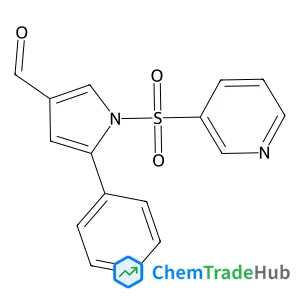
5-Phenyl-1-(pyridin-3-ylsulfonyl)-1H-pyrrole-3-carbaldehyde
CAS Number:
881676-90-0
Molecular Formula:
C16H12N2O3S
Recommended Suppliers





Disclaimer
This page provides academic journal information for reference and research purposes only. We are not affiliated with any journal publishers and do not handle publication submissions. For publication-related inquiries, please contact the respective journal publishers directly.
If you notice any inaccuracies in the information displayed, please contact us at support@chemtradehub.com. We will promptly review and address your concerns.