












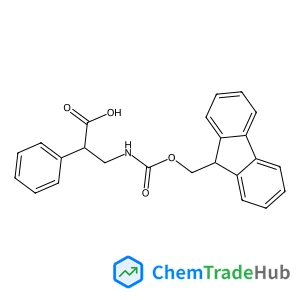
(S)-3-((((9H-Fluoren-9-yl)methoxy)carbonyl)amino)-2-phenylpropanoic acid
CAS Number:
1217663-60-9
Molecular Formula:
C24H21NO4
Bin Li, Ran Zhang
Fibrillation of amyloid peptides induces human diseases such as Alzheimer's disease, which has become a huge challenge. Some nanoparticles (NPs) could enhance peptide fibrillation by decreasing the lag time, yet how the size and shape of NPs affect amyloid fibrillation as well as the underlying mechanism remains unclear. Here, we investigated amyloid fibrillation on the surface of spherical NPs and cylindrical nanorods (NRs) of different sizes using coarse-grained Monte Carlo simulations. We focused on the curvature effect of NPs/NRs on the adsorption and fibrillation of peptide chains due to the size/shape difference. As the size of the NPs/NRs increases, the number of assembled peptide chains shows a non-monotonic tendency, and there is an optimal size for the highest adsorption. In most cases, the NRs could adsorb more peptides than the NPs of the same diameter due to the lower curvature. The mechanism beneath these observations was elucidated from a thermodynamic point of view. Our findings could provide a physical basis for the adsorption and fibrillation of amyloid peptides on NPs, and guide the design of future curvature-dependent NP-based amyloid treatment.
Sensuke Ogoshi, Tomoya Arai, Masato Ohashi, Hideo Kurosawa
DOI: 10.1039/B717261C
Placidus B. Amama, Oluwaseyi Ogebule
DOI: 10.1039/B602623K
Weibin Cui, Yubo Wu, Hongkun Tian, Yanhou Geng, Fosong Wang
DOI: 10.1039/B713463K
Ashima Sah, Robert Kreiter, Dave H. A. Blank, Jaap F. Vente, Johan E. ten Elshof
DOI: 10.1039/B718082A
Chang-Cheng You, Rochelle R. Arvizo, Vincent M. Rotello
DOI: 10.1039/B605508G
Thibault Cantat, Frédéric Biaso, Aurélien Momin, Louis Ricard, Michel Geoffroy, Nicolas Mézailles, Pascal Le Floch
DOI: 10.1039/B715380E
Masakazu Morimoto, Seiya Kobatake, Masahiro Irie
DOI: 10.1039/B604388G
Sebastian Burck, Daniela Förster, Dietrich Gudat
DOI: 10.1039/B605278A
Karl Fisher, David J. Lowe, Jan Petersen
DOI: 10.1039/B605133B
When considering alternatives to 1-(4-Chlorophenyl)-N-hydroxymethanimine (CAS: 3...
This compound should be stored in a cool, dry place away from direct sunlight. I...
3-(4-Bromophenyl)-5-(2-fluorophenyl)-1,2,4-oxadiazole is synthesized through a m...
5-Chloro-2-(4-chlorophenyl)-4-methyl-6-[3-(1-piperidinyl)propoxy]pyrimidine (CAS...
2-Chloro-4-(difluoromethoxy)pyridine is used in the pharmaceutical industry for ...
3-Chloro-6-methylpyridazine (CAS: 1121-79-5) is classified under the Globally Ha...
Several alternatives can be used in the synthesis of Methyl 4,5-dimethyl-2-nitro...
Alternatives to (2E,2'E)-3,3'-(1,4-Phenylene)bisacrylaldehyde include other acry...
3-Amino-5-chloropyridin-2-ol hydrochloride is an organic compound with the CAS n...
When handling 6,7-Difluoro-2,3-dihydro-4H-chromen-4-one, it is essential to wear...

Physical Chemistry Chemical Physics (PCCP) is an international journal co-owned by 19 physical chemistry and physics societies from around the world. This journal publishes original, cutting-edge research in physical chemistry, chemical physics and biophysical chemistry. To be suitable for publication in PCCP, articles must include significant innovation and/or insight into physical chemistry; this is the most important criterion that reviewers and Editors will judge against when evaluating submissions. The journal has a broad scope and welcomes contributions spanning experiment, theory, computation and data science. Topical coverage includes spectroscopy, dynamics, kinetics, statistical mechanics, thermodynamics, electrochemistry, catalysis, surface science, quantum mechanics, quantum computing and machine learning. Interdisciplinary research areas such as polymers and soft matter, materials, nanoscience, energy, surfaces/interfaces, and biophysical chemistry are welcomed if they demonstrate significant innovation and/or insight into physical chemistry. Joined experimental/theoretical studies are particularly appreciated when complementary and based on up-to-date approaches.
![4-[(3-Chloro-2-fluorophenyl)amino]-7-methoxy-6-quinazolinyl acetate structure](https://static.chemtradehub.com/structs/740/740081-22-5-f58f.webp "4-[(3-Chloro-2-fluorophenyl)amino]-7-methoxy-6-quinazolinyl acetate structure")
![6-Bromo-2,3-dihydro-1H-pyrido[2,3-b][1,4]oxazine structure](https://static.chemtradehub.com/structs/120/1203499-17-5-b4d1.webp "6-Bromo-2,3-dihydro-1H-pyrido[2,3-b][1,4]oxazine structure")





