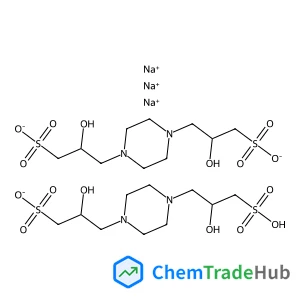
3,3'-(Piperazine-1,4-diyl)bis(2-hydroxypropane-1-sulfonic acid) Sodium Salt
CAS Number:
108321-08-0
Molecular Formula:
C20H41N4Na3O16S4
D. Jaya Prasanna Kumar, Sachin Verma, Kabeer Jasuja, Pratyush Dayal
The classic Belousov–Zhabotinsky (BZ) reaction, which involves transition metal catalysed redox reactions, represents a family of nonlinear chemical oscillators. Here, we show that it is possible to tune the oscillatory dynamics of the BZ reaction by using a hybrid 2D material, i.e., graphene-based nanosheets decorated with Ru nanoparticles. Specifically, we demonstrate that the frequency of chemical oscillations in a BZ reaction increases, by up to four-fold, when catalyzed by the Ru–graphene nanocomposite. We show that this observed behaviour is attributed to enhanced access to active catalytic sites on Ru nanoparticles, as well as the rapid shuttling of electrons facilitated by the highly conductive graphene platform. We further demonstrate that this enhancement of oscillations facilitated by the graphene platform can be simulated using the Oregonator model. Our numerical simulations reveal a strong correlation between the rate of charge transfer and the frequency of chemical oscillations. This ability of a 2D material, like graphene, to influence the dynamics of an oscillatory chemical reaction, as showcased in this work, is studied for the first time and opens up new avenues to tune the dynamics of chemical oscillators. We anticipate that these findings would enable us to design a variety of intrinsically powered biomimetic systems with controllable dynamic behavior.
DOI: 10.1039/A902615K
3-Fluoro-2-methylbenzylamine is an organic compound with the CAS number 771573-3...
Tert-butyl 2-(oxetan-3-ylidene)acetate is considered safe for its intended uses ...
Proper personal protective equipment (PPE) such as gloves, goggles, and a lab co...
2-Ethyl-4-methyl-1,3-thiazole is commonly synthesized via the reaction of thiour...
This compound should be stored in a cool, dry place away from direct sunlight an...
L-Lysine Acetate Salt (CAS: 52315-92-1) is subject to various regulatory guideli...
6-Fluoro-3-hydroxy-2-pyrazinecarboxamide (CAS: 259793-96-9) is generally conside...
1,1'-Sulfonylbis(1H-imidazole) is a crystalline solid with a molecular weight of...
4-Methyl-7-nitro-1H-indole-3-carbonitrile (CAS: 289483-82-5) is primarily used i...
Waste containing 5-Bromo-3-indolyl-beta-galactoside (CAS: 97753-82-7) should be ...

Physical Chemistry Chemical Physics (PCCP) is an international journal co-owned by 19 physical chemistry and physics societies from around the world. This journal publishes original, cutting-edge research in physical chemistry, chemical physics and biophysical chemistry. To be suitable for publication in PCCP, articles must include significant innovation and/or insight into physical chemistry; this is the most important criterion that reviewers and Editors will judge against when evaluating submissions. The journal has a broad scope and welcomes contributions spanning experiment, theory, computation and data science. Topical coverage includes spectroscopy, dynamics, kinetics, statistical mechanics, thermodynamics, electrochemistry, catalysis, surface science, quantum mechanics, quantum computing and machine learning. Interdisciplinary research areas such as polymers and soft matter, materials, nanoscience, energy, surfaces/interfaces, and biophysical chemistry are welcomed if they demonstrate significant innovation and/or insight into physical chemistry. Joined experimental/theoretical studies are particularly appreciated when complementary and based on up-to-date approaches.
![O-Benzyl-N-[(9H-fluoren-9-ylmethoxy)carbonyl]-N-methyl-L-threonine structure](https://static.chemtradehub.com/structs/198/198561-81-8-a56e.webp "O-Benzyl-N-[(9H-fluoren-9-ylmethoxy)carbonyl]-N-methyl-L-threonine structure")