












Solvation structure and bromo complexation of neodymium(III) and yttrium(III) ions in solvent mixtures of N,N-dimethylformamide and N,N-dimethylacetamide
Literature Information
Publication Date
DOI
10.1039/A901225G
Impact Factor
3.676
Authors
View Original
Abstract
Bromo complexation of neodymium(III) and yttrium(III) in solvent mixtures of N,N-dimethylformamide (DMF) and N,N-dimethylacetamide (DMA) has been studied by precise titration calorimetry, 89Y NMR and extended X-ray absorption fine structure (EXAFS). With regard to neodymium(III), calorimetric data in the mixture of DMA content x are explained satisfactorily in terms of formation of mononuclear NdBrn(3-n)+(n=1, 2 at x=0.5 and n=1, 2, 3 at x=0.6, 0.75, 0.85). With yttrium(III), calorimetric data are also explained well in terms of formation of mononuclear YBrn(3-n)+(n=1, 2 at x=0.25, 0.5, 0.6 and n=1, 2, 3 at x=0.65, 0.75, 0.85). Formation enthalpy and entropy values of the monobromo complex remain practically unchanged up to x≈0.5, and then significantly increase with increasing x. It is thus suggested in both metal(III) systems that outer-sphere bromo complexes are formed in the DMF-rich mixture, while inner-sphere bromo complexes are formed in the DMA-rich mixture in equilibrium with the outer-sphere ones, and the formation of inner-sphere complexes becomes more favorable with increasing DMA content. The marked difference in the complexation in DMF and DMA may be ascribed to the solvation steric effect. The solvation steric effect is enhanced with increasing DMA content leading to an enhanced complexation and a simultaneous geometry transition from outer- to inner-sphere coordination of the bromide ion. Evidence of the geometry transition has been obtained by EXAFS for neodymium(III), and by 89Y NMR for yttrium(III). Interestingly, although ionic radii of neodymium(III) and yttrium(III) ions are significantly different, no appreciable metal-ion dependence is found with the geometry transition from outer- to inner-sphere bromo complex. This indicates that the geometry transition of the metal(III) solvate ion from eight- to seven-coordination is not always the necessary condition for the transition from outer- to inner-sphere complexation.
Related Literature
Impact of cation redox chemistry on continuous hydrothermal synthesis of 2D-Ni(Co/Fe) hydroxides
Massimo Rosa, Debora Marani, Giovanni Perin, Søren Bredmose Simonsen, Philipp Zielke, Antonella Glisenti, Ragnar Kiebach, Andreas Lesch, Vincenzo Esposito
2019-10-08
Paper
DOI: 10.1039/C9RE00334G
Continuous manufacturing of silver nanoparticles between 5 and 80 nm with rapid online optical size and shape evaluation
Bruno Pinho, Laura Torrente-Murciano
2019-12-06
Paper
DOI: 10.1039/C9RE00452A
Oxygen sensors for flow reactors – measuring dissolved oxygen in organic solvents
2019-08-30
Paper
DOI: 10.1039/C9RE00253G
All-aqueous continuous-flow RAFT dispersion polymerisation for efficient preparation of diblock copolymer spheres, worms and vesicles
Sam Parkinson, Nicole S. Hondow, John S. Conteh, Nicholas J. Warren
2019-02-11
Paper
DOI: 10.1039/C8RE00211H
Development of semi-continuous chemo-enzymatic terpene epoxidation: combination of anthraquinone autooxidation and the lipase-mediated epoxidation process
Sumanth Ranganathan
2017-10-03
Paper
DOI: 10.1039/C7RE00112F
Ruthenium polypyridyl complex-catalysed aryl alkoxylation of styrenes: improving reactivity using a continuous flow photo-microreactor
Eiji Yamaguchi, Nao Taguchi, Akichika Itoh
2019-04-17
Communication
DOI: 10.1039/C9RE00061E
Continuous nitration of alcohols in a Freon flow
Mikhail N. Zharkov, Svetlana S. Arabadzhi, Ilya V. Kuchurov, Sergei G. Zlotin
2019-04-12
Paper
DOI: 10.1039/C9RE00035F
Microfluidic approaches for accessing thermophysical properties of fluid systems
Nicolas Pannacci, Ghislain Bergeot, Claire Marliere, Samuel Marre
2019-06-19
Review Article
DOI: 10.1039/C9RE00130A
You might also like
Compound Q&A
What is 3-Fluoro-2-methylbenzylamine (CAS: 771573-36-5)?
3-Fluoro-2-methylbenzylamine is an organic compound with the CAS number 771573-3...
771573-36-53-Fluoro-2-methylben...
Compound Q&A
Is Tert-butyl 2-(oxetan-3-ylidene)acetate (CAS: 1207175-03-8) safe?
Tert-butyl 2-(oxetan-3-ylidene)acetate is considered safe for its intended uses ...
1207175-03-8Tert-butyl 2-(oxetan...
Compound Q&A
What precautions should be taken when handling 4-Acetyl-2-fluorobenzonitrile (CAS: 214760-18-6)?
Proper personal protective equipment (PPE) such as gloves, goggles, and a lab co...
214760-18-64-Acetyl-2-fluoroben...
Compound Q&A
How is 2-Ethyl-4-methyl-1,3-thiazole (CAS: 15679-12-6) typically synthesized?
2-Ethyl-4-methyl-1,3-thiazole is commonly synthesized via the reaction of thiour...
15679-12-62-Ethyl-4-methyl-1,3...
Compound Q&A
How should 5',5''-([2,2'-Bithiophene]-5,5'-diyl)bis(([1,1':3',1''-terphenyl]-4,4''-dicarboxylic acid)) (CAS: 1227780-71-3) be stored?
This compound should be stored in a cool, dry place away from direct sunlight an...
1227780-71-35',5''''-([2,2'-Bith...
Compound Q&A
What regulatory guidelines apply to L-Lysine Acetate Salt (CAS: 52315-92-1)?
L-Lysine Acetate Salt (CAS: 52315-92-1) is subject to various regulatory guideli...
52315-92-1L-LYSINE ACETATE SAL...
Compound Q&A
Is 6-Fluoro-3-hydroxy-2-pyrazinecarboxamide (CAS: 259793-96-9) safe?
6-Fluoro-3-hydroxy-2-pyrazinecarboxamide (CAS: 259793-96-9) is generally conside...
259793-96-96-Fluoro-3-hydroxy-2...
Compound Q&A
What are the physical and chemical properties of 1,1'-Sulfonylbis(1H-imidazole) (CAS: 7189-69-7)?
1,1'-Sulfonylbis(1H-imidazole) is a crystalline solid with a molecular weight of...
7189-69-71,1'-Sulfonylbis(1H-...
Compound Q&A
What industries use 4-methyl-7-nitro-1H-indole-3-carbonitrile (CAS: 289483-82-5)?
4-Methyl-7-nitro-1H-indole-3-carbonitrile (CAS: 289483-82-5) is primarily used i...
289483-82-54-methyl-7-nitro-1H-...
Compound Q&A
How should waste containing 5-Bromo-3-indolyl-beta-galactoside (CAS: 97753-82-7) be handled?
Waste containing 5-Bromo-3-indolyl-beta-galactoside (CAS: 97753-82-7) should be ...
97753-82-75-Bromo-3-indolyl-be...
Source Journal
Physical Chemistry Chemical Physics

CiteScore:
5.5
Self-citation Rate:
10.3%
Articles per Year:
3036
Physical Chemistry Chemical Physics (PCCP) is an international journal co-owned by 19 physical chemistry and physics societies from around the world. This journal publishes original, cutting-edge research in physical chemistry, chemical physics and biophysical chemistry. To be suitable for publication in PCCP, articles must include significant innovation and/or insight into physical chemistry; this is the most important criterion that reviewers and Editors will judge against when evaluating submissions. The journal has a broad scope and welcomes contributions spanning experiment, theory, computation and data science. Topical coverage includes spectroscopy, dynamics, kinetics, statistical mechanics, thermodynamics, electrochemistry, catalysis, surface science, quantum mechanics, quantum computing and machine learning. Interdisciplinary research areas such as polymers and soft matter, materials, nanoscience, energy, surfaces/interfaces, and biophysical chemistry are welcomed if they demonstrate significant innovation and/or insight into physical chemistry. Joined experimental/theoretical studies are particularly appreciated when complementary and based on up-to-date approaches.
Recommended Compounds
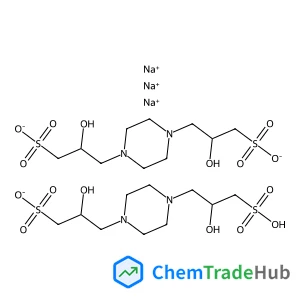
3,3'-(Piperazine-1,4-diyl)bis(2-hydroxypropane-1-sulfonic acid) Sodium Salt
CAS Number:
108321-08-0
Molecular Formula:
C20H41N4Na3O16S4


Recommended Suppliers





Disclaimer
This page provides academic journal information for reference and research purposes only. We are not affiliated with any journal publishers and do not handle publication submissions. For publication-related inquiries, please contact the respective journal publishers directly.
If you notice any inaccuracies in the information displayed, please contact us at support@chemtradehub.com. We will promptly review and address your concerns.