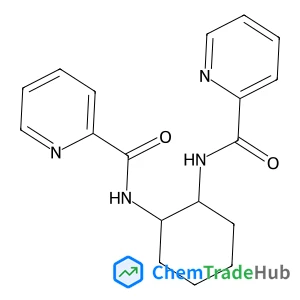
N,N'-(1R,2R)-1,2-Cyclohexanediyldi(2-pyridinecarboxamide)
CAS Number:
218290-24-5
Molecular Formula:
C18H20N4O2
F. A. Gianturco, A. D. Dörfler, S. Willitsch, E. Yurtsever, T. González-Lezana, P. Villarreal
By employing ab initio computed intermolecular potential energy surfaces we calculate the radiative association probabilities and rates for two different associative mechanisms involving trapped molecular ions N2+(2Σg) interacting either directly with ultracold Rb atoms or undergoing charge-exchange (CE) processes leading to the formation of complexes of the strongly exothermic products N2(X1Σg) plus Rb+(1S0). The two processes are expected to provide possible paths to ion losses in the trap within the timescale of experiments. The present calculations suggest that the associative rates for the ‘vibrational’ direct process are too small to be of any significant importance at the millikelvin temperatures considered in the experiments, while the ‘vibronic’ path into radiatively associating the CE products has a probability of occurring which is several orders of magnitude larger. However the reaction rate constants attributed to non-adiabatic CE [F. H. J. Hall and S. Willist, Phys. Rev. Lett., 2012, 109, 233202] are in turn several orders of magnitude larger than the radiative ones calculated here, thereby making the primary experimental process substantially unaffected by the radiative losses channel.
Daniel P. Sanders, Daniel J. Coady, Manabu Yasumoto, Masaki Fujiwara, Haritz Sardon, James L. Hedrick
DOI: 10.1039/C3PY01128C
Marta Liras, Isabel Quijada-Garrido, Marta Palacios-Cuesta, Sonia Muñoz-Durieux, Olga García
DOI: 10.1039/C3PY00987D
Zhigui Zheng, Yuan Zhou, Zhengbiao Zhang, Xiulin Zhu
DOI: 10.1039/C3PY00879G
Naoya Sakai, Mingoo Jin, Shin-ichiro Sato, Toshifumi Satoh, Toyoji Kakuchi
DOI: 10.1039/C3PY00972F
D. Döhler, P. Zare, W. H. Binder
DOI: 10.1039/C3PY01151H
Toshifumi Satoh, Naoki Nishikawa, Daisuke Kawato, Daichi Suemasa, Sungmin Jung, Young Yong Kim, Moonhor Ree, Toyoji Kakuchi
DOI: 10.1039/C3PY00985H
Masaki Takara, Masayuki Toyoshima, Hirokazu Seto, Yu Hoshino, Yoshiko Miura
DOI: 10.1039/C3PY01001E
Yang Su, Xin Xiao, Shentong Li, Meihan Dan, Xiaohui Wang, Wangqing Zhang
DOI: 10.1039/C3PY00995E
Weichun Huang, Yingbo Wan, Jianying Chen, Qiaozhen Xu, Xiaohong Li, Xiaoming Yang, Yaowen Li, Yingfeng Tu
DOI: 10.1039/C3PY00932G
1H-Indazole-6-carbonitrile finds applications in pharmaceuticals, where it serve...
Waste containing Dioctyl (2E)-2-butenedioate (CAS: 2997-85-5) should be collecte...
Sodium [(1,2-benzoxazol-3-ylmethyl)sulfonyl]azanide is primarily used in pharmac...
Dimethyl 4-(4,4,5,5-tetramethyl-1,3,2-dioxaborolan-2-yl)-2,6-pyridinedicarboxyla...
Waste containing 2-Fluoro-6-hydrazinopyridine (CAS: 80714-39-2) should be manage...
6-Formyl-2-pyridinecarboxylic acid is an organic compound with the molecular for...
Research trends for this compound indicate a focus on its potential applications...
9H-Tribenzo[b,d,f]azepine is typically synthesized via a multi-step process invo...
1-Cyclopropyl-7-ethoxy-6-fluoro-8-methoxy-4-oxo-1,4-dihydro-3-quinolinecarboxyli...
Waste containing Methyl 3-oxo-1,2,3,4-tetrahydro-6-quinoxalinecarboxylate (CAS: ...

Physical Chemistry Chemical Physics (PCCP) is an international journal co-owned by 19 physical chemistry and physics societies from around the world. This journal publishes original, cutting-edge research in physical chemistry, chemical physics and biophysical chemistry. To be suitable for publication in PCCP, articles must include significant innovation and/or insight into physical chemistry; this is the most important criterion that reviewers and Editors will judge against when evaluating submissions. The journal has a broad scope and welcomes contributions spanning experiment, theory, computation and data science. Topical coverage includes spectroscopy, dynamics, kinetics, statistical mechanics, thermodynamics, electrochemistry, catalysis, surface science, quantum mechanics, quantum computing and machine learning. Interdisciplinary research areas such as polymers and soft matter, materials, nanoscience, energy, surfaces/interfaces, and biophysical chemistry are welcomed if they demonstrate significant innovation and/or insight into physical chemistry. Joined experimental/theoretical studies are particularly appreciated when complementary and based on up-to-date approaches.