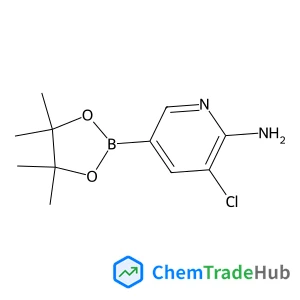
3-Chloro-5-(4,4,5,5-tetramethyl-1,3,2-dioxaborolan-2-yl)-2-pyridinamine
CAS Number:
1032758-99-8
Molecular Formula:
C11H16BClN2O2
S. Sarkar, A. Mondal, N. Giri, R. Ray
We have synthesized Co3O4 nanoparticles having 40 nm average size, which are anchored on reduced graphene oxide. X-ray diffraction, FESEM, TEM and Raman spectroscopy are performed for the characterization. The temperature dependence of field cooled (FC) and zero field cooled (ZFC) magnetization curves exhibits antiferromagnetic (AFM) transition around ∼30 K, as observed for bulk Co3O4. The exchange bias effect is observed below ∼30 K. A significant change in the exchange bias effect is noted around ∼8 K, which is close to a spin-glass-like transition. The spin-glass-like phase has been confirmed by the memory effects observed by different experimental protocols. The possible origin of exchange bias is discussed in the manuscript.
N. Crivillers, A. Liscio, F. Di Stasio, C. Van Dyck, S. Osella, D. Cornil, S. Mian, G. M. Lazzerini, O. Fenwick, E. Orgiu, F. Reinders, S. Braun, M. Fahlman, J. Cornil, V. Palermo, F. Cacialli, P. Samorì
DOI: 10.1039/C1CP20851A
Yuhui Lu, Craig Lent
DOI: 10.1039/C1CP21332F
Micael J. T. Oliveira, Miguel A. L. Marques
DOI: 10.1039/C1CP20719A
Pedro B. Coto, Luis Serrano-Andrés, Thomas Gustavsson, Takashige Fujiwara, Edward C. Lim
DOI: 10.1039/C1CP21089K
Peilin Liao, Emily A. Carter
DOI: 10.1039/C1CP20829B
ChiYung Yam, Lingyi Meng, GuanHua Chen, Quan Chen, Ngai Wong
DOI: 10.1039/C1CP20766K
Che-Hung Kuo, Chi-Ping Liu, Szu-Hsian Lee, Hsun-Yun Chang, Wei-Chun Lin, Yun-Wen You, Hua-Yang Liao
DOI: 10.1039/C1CP20590K
Grant Copeland, Mariana V. Ghosh, Dudley E. Shallcross, Carl J. Percival, John M. Dyke
DOI: 10.1039/C0CP03004J
Christine Cézard, Frédéric Aubry, Florence Djedaïni-Pilard, François-Yves Dupradeau
DOI: 10.1039/C1CP20854C
This compound is mainly used as an intermediate in the synthesis of antipsychoti...
Waste containing 1-(D-Ribofuranosyl)-1,4-dihydro-3-pyridinecarboxamide (CAS: 191...
2-Methyl-2-propanyl 3-bromo-3-(hydroxymethyl)-1-azetidinecarboxylate (CAS: 20079...
N-(4-Chloro-2-pyridinyl)acetamide (CAS: 245056-66-0) is a chemical compound with...
5-Chloro-2-hydroxybenzoic acid, also known as 5-chlorosalicylic acid, is an arom...
When handling 1,1-Dichloro-1-fluoroethane (CAS: 1717-00-6), it is important to u...
Fmoc-(2S,3R)-3-phenylpyrrolidine-2-carboxylic acid is a white crystalline solid ...
4-Amino-5-bromo-2-pyridinecarboxylic acid is primarily used as a precursor in th...
Handling this compound should be done with personal protective equipment (PPE) i...
When handling 8-bromo-2,2-dimethyl-3,4-dihydro-2H-1,4-benzoxazin-3-one, use prop...

Physical Chemistry Chemical Physics (PCCP) is an international journal co-owned by 19 physical chemistry and physics societies from around the world. This journal publishes original, cutting-edge research in physical chemistry, chemical physics and biophysical chemistry. To be suitable for publication in PCCP, articles must include significant innovation and/or insight into physical chemistry; this is the most important criterion that reviewers and Editors will judge against when evaluating submissions. The journal has a broad scope and welcomes contributions spanning experiment, theory, computation and data science. Topical coverage includes spectroscopy, dynamics, kinetics, statistical mechanics, thermodynamics, electrochemistry, catalysis, surface science, quantum mechanics, quantum computing and machine learning. Interdisciplinary research areas such as polymers and soft matter, materials, nanoscience, energy, surfaces/interfaces, and biophysical chemistry are welcomed if they demonstrate significant innovation and/or insight into physical chemistry. Joined experimental/theoretical studies are particularly appreciated when complementary and based on up-to-date approaches.
![2,6-Bis({(2R)-2-[hydroxy(diphenyl)methyl]-1-pyrrolidinyl}methyl)-4-methylphenol structure](https://static.chemtradehub.com/structs/877/877395-58-9-70bf.webp "2,6-Bis({(2R)-2-[hydroxy(diphenyl)methyl]-1-pyrrolidinyl}methyl)-4-methylphenol structure")