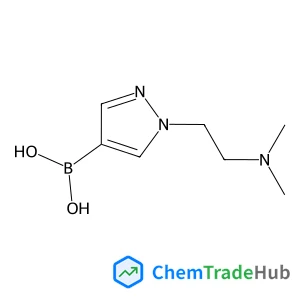
(1-(2-(Dimethylamino)ethyl)-1H-pyrazol-4-yl)boronic acid
CAS Number:
1086063-73-1
Molecular Formula:
C7H14BN3O2
H. U. Din, M. Idrees, Chuong V. Nguyen, Li-Yong Gan, M. Maqbool, B. Amin
The stacking of monolayers in the form of van der Waals heterostructures is a useful strategy for band gap engineering and the control of dynamics of excitons for potential nano-electronic devices. We performed first-principles calculations to investigate the structural, electronic, optical and photocatalytic properties of the SiC–MX2 (M = Mo, W and X = S, Se) van der Waals heterostructures. The stability of most favorable stacking is confirmed by calculating the binding energy and phonon spectrum. SiC–MoS2 is found to be a direct band gap type-II semiconducting heterostructure. Moderate in-plane tensile strain is used to achieve a direct band gap with type-II alignment in the SiC–WS2, SiC–MoSe2 and SiC–WSe2 heterostructures. A difference in the ionization potential of the corresponding monolayers and interlayer charge transfer further confirmed the type-II band alignment in these heterostructures. Furthermore, the optical behaviour is investigated by calculation of the absorption spectra in terms of ε2(ω) of the heterostructures and the corresponding monolayers. The photocatalytic response shows that the SiC–Mo(W)S2 heterostructures can oxidize H2O to O2. An enhanced photocatalytic performance with respect to the parent monolayers makes the SiC–Mo(W)Se2 heterostructures promising candidates for water splitting.
Kazumasa Funabiki, Hiroki Iwata, Yosuke Yano, Yasuhiro Kubota, Masaki Matsui
DOI: 10.1039/C5QO00008D
N. Kodiah Beyeh, Sandip Bhowmik, Fangfang Pan, K. Rissanen
DOI: 10.1039/C4QO00326H
Yu Du, Qiang Kang
DOI: 10.1039/C8QO00809D
Jinwei Yuan, Junhao Fu, Jihong Yin, Zhenhua Dong, Yongmei Xiao, Pu Mao
DOI: 10.1039/C8QO00731D
Zaigang Luo, Xinxin Han, Yuyu Fang, Peng Liu, Chengtao Feng, Zhong Li, Xuemei Xu
DOI: 10.1039/C8QO00927A
Dong-Liang Zhang, Cheng-Kun Li, Run-Sheng Zeng, Adedamola Shoberu, Jian-Ping Zou
DOI: 10.1039/C8QO01098F
Jia-hao Zhang, Yin Wei
DOI: 10.1039/C8QO00907D
2-(2-Chloroacetamido)-3-phenylpropanoic acid (CAS: 7765-11-9) is generally consi...
2-(Benzyloxy)-5-bromobenzoic acid can be handled safely if appropriate precautio...
(4-Methyl-1,2,5-oxadiazol-3-yl)methanamine hydrochloride is a chemical compound ...
2-(5-Hexylthiophen-2-yl)-4,4,5,5-tetramethyl-1,3,2-dioxaborolane (CAS: 917985-54...
While 4-(8-Methyl-9H-1,3-dioxolo[4,5-h][2,3]benzodiazepin-5-yl)benzenamine (CAS:...
The market for tert-butyl 3-hydroxy-4,5,7,8-tetrahydro-2H-pyrazolo[3,4-d]azepine...
Waste containing 3,5-Diamino-1H-pyrazole-4-carbonitrile (CAS: 6844-58-2) should ...
(6-Fluoro-3-pyridinyl)boronic acid can be synthesized through the reaction of 6-...
Dibenzyl carbonimidoylbiscarbamate (CAS: 10065-79-9) finds applications in vario...
The market for (beta,beta,2,3,4,5,6-~2~H_7_)Phenylalanine (CAS: 74228-83-4) is g...

Physical Chemistry Chemical Physics (PCCP) is an international journal co-owned by 19 physical chemistry and physics societies from around the world. This journal publishes original, cutting-edge research in physical chemistry, chemical physics and biophysical chemistry. To be suitable for publication in PCCP, articles must include significant innovation and/or insight into physical chemistry; this is the most important criterion that reviewers and Editors will judge against when evaluating submissions. The journal has a broad scope and welcomes contributions spanning experiment, theory, computation and data science. Topical coverage includes spectroscopy, dynamics, kinetics, statistical mechanics, thermodynamics, electrochemistry, catalysis, surface science, quantum mechanics, quantum computing and machine learning. Interdisciplinary research areas such as polymers and soft matter, materials, nanoscience, energy, surfaces/interfaces, and biophysical chemistry are welcomed if they demonstrate significant innovation and/or insight into physical chemistry. Joined experimental/theoretical studies are particularly appreciated when complementary and based on up-to-date approaches.
![Heptadecanoic Acid 3-[2-[4-(6-Fluoro-1,2-benzisoxazol-3-yl)-1-piperidinyl]ethyl]-6,7,8,9-tetrahydro-2-methyl-4-oxo-4H-pyrido[1,2-a]pyrimidin-9-yl Ester structure](https://static.chemtradehub.com/structs/140/1404053-62-8-9da4.webp "Heptadecanoic Acid 3-[2-[4-(6-Fluoro-1,2-benzisoxazol-3-yl)-1-piperidinyl]ethyl]-6,7,8,9-tetrahydro-2-methyl-4-oxo-4H-pyrido[1,2-a]pyrimidin-9-yl Ester structure")