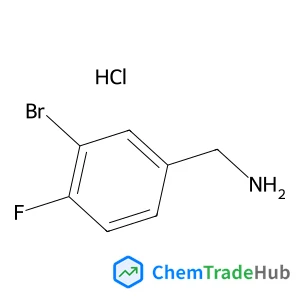
1-(3-Bromo-4-fluorophenyl)methanamine hydrochloride (1:1)
CAS Number:
202865-68-7
Molecular Formula:
C7H8BrClFN
Wenqi Huang, Hong Yang, Buwen Cheng, Chunlai Xue
Recently, two-dimensional germanium-tin (2D-GeSn) alloys have attracted considerable attention because they have been predicted to possess a direct bandgap, and this bandgap can be tuned by changing the Sn concentration. However, the tuning efficiency of alloying Sn is still relatively low, and alloying more Sn in 2D-GeSn is difficult to accomplish. To address this issue, the band structures for 2D-GeSn under different strain types (including biaxial and uniaxial strain along the armchair direction, as well as compressive and tensile strain) are investigated using a first-principles method based on density functional theory combined with a GGA+U method and special quasirandom structures. For tensile strain, the results indicate that both biaxially and uniaxially strained 2D-GeSn alloys exhibit direct bandgaps, and their bandgaps decrease as the strain strength increases. The bandgap tuning efficiency for biaxial strain is higher than that for uniaxial strain. For compressive strain, both biaxially and uniaxially strained 2D-GeSn alloys exhibit a large indirect bandgap area, and their bandgaps increase as the strain strength increases; however, their distribution shapes are slightly different. To uncover the physical origin of the difference between them, the projected band, the projected density of the states, the bond length and the bond angle for 2D-GeSn are analyzed. Overall, these results indicate that the combination of alloying Sn and applying an external strain is a good way to reduce the necessary Sn concentration, and this may provide comprehensive theoretical guidance for the strain energy band engineering of 2D-GeSn.
Yao Guo, Qiang Li, Xiaojing Bai, Yuanbin Xue, Changwei Lai, Yuhua Wang
DOI: 10.1039/D3CP04090A
Sabine N. Neal, Dario Stacchiola, Samuel A. Tenney
DOI: 10.1039/D3CP03958G
DOI: 10.1039/A800776D
Xinyang Li, Yu Zhang
DOI: 10.1039/D3CP01415K
Viktor Szél, Balázs Zoltán Zsidó, Norbert Jeszenői, Csaba Hetényi
DOI: 10.1039/D3CP04483A
Kiran Yadav, Nirat Ray
DOI: 10.1039/D3CP04343F
Ghulam Hasnain Tariq, Ghulam Asghar, M. Shahzad Shifa, M. Anis-Ur-Rehman, Sana Ullah, Zulfiqar Ali Shah, Ahmed M. Tawfeek, Farooq Sher
DOI: 10.1039/D3CP04332K
Jining Li, Wenxin Lu
DOI: 10.1039/D3CP04746F
When considering alternatives to 1-(4-Chlorophenyl)-N-hydroxymethanimine (CAS: 3...
This compound should be stored in a cool, dry place away from direct sunlight. I...
3-(4-Bromophenyl)-5-(2-fluorophenyl)-1,2,4-oxadiazole is synthesized through a m...
5-Chloro-2-(4-chlorophenyl)-4-methyl-6-[3-(1-piperidinyl)propoxy]pyrimidine (CAS...
2-Chloro-4-(difluoromethoxy)pyridine is used in the pharmaceutical industry for ...
3-Chloro-6-methylpyridazine (CAS: 1121-79-5) is classified under the Globally Ha...
Several alternatives can be used in the synthesis of Methyl 4,5-dimethyl-2-nitro...
Alternatives to (2E,2'E)-3,3'-(1,4-Phenylene)bisacrylaldehyde include other acry...
3-Amino-5-chloropyridin-2-ol hydrochloride is an organic compound with the CAS n...
When handling 6,7-Difluoro-2,3-dihydro-4H-chromen-4-one, it is essential to wear...

Physical Chemistry Chemical Physics (PCCP) is an international journal co-owned by 19 physical chemistry and physics societies from around the world. This journal publishes original, cutting-edge research in physical chemistry, chemical physics and biophysical chemistry. To be suitable for publication in PCCP, articles must include significant innovation and/or insight into physical chemistry; this is the most important criterion that reviewers and Editors will judge against when evaluating submissions. The journal has a broad scope and welcomes contributions spanning experiment, theory, computation and data science. Topical coverage includes spectroscopy, dynamics, kinetics, statistical mechanics, thermodynamics, electrochemistry, catalysis, surface science, quantum mechanics, quantum computing and machine learning. Interdisciplinary research areas such as polymers and soft matter, materials, nanoscience, energy, surfaces/interfaces, and biophysical chemistry are welcomed if they demonstrate significant innovation and/or insight into physical chemistry. Joined experimental/theoretical studies are particularly appreciated when complementary and based on up-to-date approaches.
![6-Bromo-2,3-dihydro-1H-pyrido[2,3-b][1,4]oxazine structure](https://static.chemtradehub.com/structs/120/1203499-17-5-b4d1.webp "6-Bromo-2,3-dihydro-1H-pyrido[2,3-b][1,4]oxazine structure")