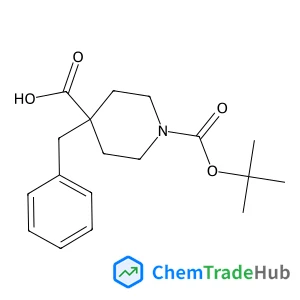
4-Benzyl-1-(tert-butoxycarbonyl)piperidine-4-carboxylic acid
CAS Number:
170838-87-6
Molecular Formula:
C18H25NO4
Marina Corbella, Zi S. D. Toa, Gregory D. Scholes, F. Javier Luque, Carles Curutchet
The light-harvesting mechanisms of cryptophyte antenna complexes have attracted considerable attention due to their ability to exhibit maximal photosynthetic activity under very low-light conditions and to display several colors, as well as the observation of vibronic coherent features in their two-dimensional electronic spectra. However, detailed investigations on the interplay between the protein environment and their light-harvesting properties are hampered by the uncertainty related to the protonation state of the underlying bilin pigments. Here we study the protonation preferences of four types of bilin pigments including 15,16-dihydrobiliverdin (DBV), phycoerythrobilin (PEB), phycocyanobilin (PCB) and mesobiliverdin (MBV), which are found in phycoerythrin PE545 and phycocyanin PC577, PC612, PC630 and PC645 complexes. We apply quantum chemical calculations coupled to continuum solvation calculations to predict the intrinsic acidity of bilins in aqueous solution, and then combine molecular dynamics simulations with empirical pKa estimates to investigate the impact of the local protein environment on the acidity of the pigments. We also report measurements of the absorption spectra of the five complexes in a wide range of pH in order to validate our simulations and investigate possible changes in the light harvesting properties of the complexes in the range of physiological pH found in the lumen (pH ∼ 5–7). The results suggest a pKa > 7 for DBV and MBV pigments in the α polypeptide chains of PE545 and PC630/PC645 complexes, which are not coordinated to a negatively charged amino acid. For the other PEB, DBV and PCB pigments, which interact with a Glu or Asp side chain, higher pKa values (pKa > 8) are estimated. Overall, the results support a preferential population of the fully protonated state for bilins in cryptophyte complexes under physiological conditions regardless of the specific type of pigment and local protein environment.
Zhiqi Li, Shujun Li, Zhihui Zhang, Xinyuan Zhang, Jingfeng Li, Chunyu Liu, Wenbin Guo, Shengping Ruan
DOI: 10.1039/C6CP00989A
Lanju Mei, Tzung-Han Chou, Yu-Shen Cheng, Ming-Jiang Huang, Li-Hsien Yeh, Shizhi Qian
DOI: 10.1039/C5CP05728K
N. V. Suetin, S. A. Evlashin, A. V. Egorov, K. V. Mironovich, S. A. Dagesyan, L. V. Yashina, E. A. Goodilin, V. A. Krivchenko
DOI: 10.1039/C6CP01638C
Qin Wang, Shunyong Hou, Liang Xu, Jianping Yin
DOI: 10.1039/C5CP06392B
M. A. Stevens, J. E. McKay, J. L. S. Robinson, H. EL Mkami, G. M. Smith, D. G. Norman
DOI: 10.1039/C5CP04753F
Wenhui Zhong, Jinxia Liang, Wei Hu, Xinrui Cao, Chuanyi Jia, Jun Jiang
DOI: 10.1039/C6CP00336B
L. D. Antonov, W. Boomsma, T. Hamelryck
DOI: 10.1039/C5CP04886A
Christina Clare Fisher
DOI: 10.1039/C5CP07100C
This compound is mainly used as an intermediate in the synthesis of antipsychoti...
Waste containing 1-(D-Ribofuranosyl)-1,4-dihydro-3-pyridinecarboxamide (CAS: 191...
2-Methyl-2-propanyl 3-bromo-3-(hydroxymethyl)-1-azetidinecarboxylate (CAS: 20079...
N-(4-Chloro-2-pyridinyl)acetamide (CAS: 245056-66-0) is a chemical compound with...
5-Chloro-2-hydroxybenzoic acid, also known as 5-chlorosalicylic acid, is an arom...
When handling 1,1-Dichloro-1-fluoroethane (CAS: 1717-00-6), it is important to u...
Fmoc-(2S,3R)-3-phenylpyrrolidine-2-carboxylic acid is a white crystalline solid ...
4-Amino-5-bromo-2-pyridinecarboxylic acid is primarily used as a precursor in th...
Handling this compound should be done with personal protective equipment (PPE) i...
When handling 8-bromo-2,2-dimethyl-3,4-dihydro-2H-1,4-benzoxazin-3-one, use prop...

Physical Chemistry Chemical Physics (PCCP) is an international journal co-owned by 19 physical chemistry and physics societies from around the world. This journal publishes original, cutting-edge research in physical chemistry, chemical physics and biophysical chemistry. To be suitable for publication in PCCP, articles must include significant innovation and/or insight into physical chemistry; this is the most important criterion that reviewers and Editors will judge against when evaluating submissions. The journal has a broad scope and welcomes contributions spanning experiment, theory, computation and data science. Topical coverage includes spectroscopy, dynamics, kinetics, statistical mechanics, thermodynamics, electrochemistry, catalysis, surface science, quantum mechanics, quantum computing and machine learning. Interdisciplinary research areas such as polymers and soft matter, materials, nanoscience, energy, surfaces/interfaces, and biophysical chemistry are welcomed if they demonstrate significant innovation and/or insight into physical chemistry. Joined experimental/theoretical studies are particularly appreciated when complementary and based on up-to-date approaches.