












![N-[(Benzyloxy)carbonyl]serine structure](https://static.chemtradehub.com/structs/276/2768-56-1-77f7.webp "N-[(Benzyloxy)carbonyl]serine structure")
The dependence of the β-to-α phase transition behavior of poly(1,4-butylene adipate) on phase separated morphology in its blends with poly(vinylidene fluoride)
Literature Information
Publication Date
2018-06-01
DOI
10.1039/C8CP02464B
Impact Factor
3.676
Authors
Chunyue Hou, Huihui Li, Xiaoli Sun, Yanfang Wang, Shangtao Chen
View Original
Abstract
Synchrotron wide-angle X-ray diffraction was used to monitor the melting and β-to-α transition behavior of β-poly(1,4-butylene adipate) (β-PBA) and its blends with poly(vinylidene fluoride) (PVDF). Two kinds of typical phase separated morphologies are prepared: interfabrillar (70/30 PBA/PVDF) and interlamellar (50/50 PBA/PVDF) morphologies. After melt recrystallization at 10 °C, β-PBA crystals are obtained. The thermal expansion, phase transition and melting behavior of β crystals highly depend on the phase separated morphology. The β crystals show the highest melting temperature and β-to-α phase transition temperature in 70% PBA, which is caused by the thick lamellae of PBA and/or the lower surface energy of chain folding, while the β crystals show the lowest melting temperature and β-to-α phase transition temperature in 50% PBA, which is caused by the thinner lamellae of PBA. An unexpectedly high melting temperature of α crystals transited from β crystals observed in 50% PBA due to the lamellar thickening occuring in the heating process. The different phase separated morphologies lead to different lamellae thicknesses and surface energies of chain folding which consequently alter the stability of the crystals. The phase transition and melting behavior of β-PBA in PBA/PVDF is also compared with its blends with poly(vinyl phenol) (PVPh). Completely different factors influence the phase transition behavior of β crystals in these two systems.
Related Literature
Phosphazene/triisobutylaluminum-promoted anionic ring-opening polymerization of 1,2-epoxybutane initiated by secondary carbamates
L. Hassouna, N. Illy, P. Guégan
2017-06-13
Paper
DOI: 10.1039/C7PY00675F
Polymer side-chain substituents elucidate thermochromism of benzodithiophene–dithiophenylacrylonitrile copolymers – polymer solubility correlation of thermochromism and photovoltaic performance
Chiao-Wen Lin, Chao-Tsen Chen, Jan Golder
2017-05-23
Paper
DOI: 10.1039/C7PY00338B
Microplasma-assisted rapid, chemical oxidant-free and controllable polymerization of dopamine for surface modification
Zhe Wang, Chao Xu, Yuexiang Lu, Guoyu Wei, Gang Ye, Taoxiang Sun, Jing Chen
2017-06-26
Paper
DOI: 10.1039/C7PY00805H
Cationic half-sandwich rare-earth metal alkyl species catalyzed polymerization and copolymerization of aryl isocyanides possessing polar, bulky, or chiral substituents
Xinwen Yan, Shaowen Zhang, Deqian Peng, Pengfei Zhang, Junge Zhi, Xiaolu Wu, Lin Wang, Yuping Dong, Xiaofang Li
2018-01-18
Paper
DOI: 10.1039/C8PY00007G
RAFT synthesis and micellization of a photo-, temperature- and pH-responsive diblock copolymer based on spiropyran
Yuan Zhang, Mengjiao Cao, Bing Yuan, Tianying Guo
2017-11-03
Paper
DOI: 10.1039/C7PY01714F
Hybrid single-chain nanoparticles via the metal induced crosslinking of N-donor functionalized polymer chains
Karen Freytag, Stefanie Säfken, Kai Wolter, Jan C. Namyslo, Eike G. Hübner
2017-11-16
Paper
DOI: 10.1039/C7PY01487B
Enzymatic grafting of amylose on chitin nanofibers for hierarchical construction of controlled microstructures
Naomichi Egashira, Kazuya Yamamoto, Jun-ichi Kadokawa
2017-05-05
Paper
DOI: 10.1039/C7PY00521K
Effect of conjugation length and metal-backbone interactions on charge transport properties of conducting metallopolymers
Minh T. Nguyen, Richard A. Jones, Bradley J. Holliday
2017-06-13
Paper
DOI: 10.1039/C7PY00673J
One-pot blue-light triggered tough interpenetrating polymeric network (IPN) using CuAAC and methacrylate reactions
Abhishek U. Shete
2017-05-08
Communication
DOI: 10.1039/C7PY00623C
Facile construction of crosslinked anion exchange membranes based on fluorenyl-containing polysulfone via click chemistry
Bo Hu, Luyang Miao, Yang Bai, Changli Lü
2017-06-27
Paper
DOI: 10.1039/C7PY00789B
You might also like
Compound Q&A
What precautions should be taken when handling 4-(2-Furylmethyl)thiomorpholine 1,1-dioxide (CAS: 79206-94-3)?
When handling 4-(2-Furylmethyl)thiomorpholine 1,1-dioxide (CAS: 79206-94-3), it ...
79206-94-34-(2-Furylmethyl)thi...
Compound Q&A
What precautions should be taken when handling 4-Chloro-N-[2-(4-morpholinyl)ethyl]benzamide (CAS: 71320-77-9)?
When handling 4-Chloro-N-[2-(4-morpholinyl)ethyl]benzamide (CAS: 71320-77-9), it...
71320-77-94-Chloro-N-[2-(4-mor...
Compound Q&A
How should waste containing 2-[2-(2-Methoxyethoxy)ethoxy]ethyl 4-methylbenzenesulfonate (CAS: 62921-74-8) be handled?
Waste containing this compound (CAS: 62921-74-8) should be handled according to ...
62921-74-82-[2-(2-Methoxyethox...
Compound Q&A
How should waste containing (S)-Methyl 2-amino-3-cyclohexylpropanoate be handled?
Waste containing (S)-Methyl 2-amino-3-cyclohexylpropanoate should be collected i...
40056-18-6(S)-Methyl 2-amino-3...
Compound Q&A
How is 5-({4-[(2S,4R)-4-Hydroxy-2-methyltetrahydro-2H-pyran-4-yl]-2-thienyl}sulfanyl)-1-methyl-1,3-dihydro-2H-indol-2-one (CAS: 166882-70-8) typically synthesized?
This compound can be synthesized using a multi-step process involving the conjug...
166882-70-85-({4-[(2S,4R)-4-Hyd...
Compound Q&A
Are there alternatives to (2E)-3-(3,4-Dichlorophenyl)acrylic acid (CAS: 7312-27-8) in synthesis?
There are several alternatives to (2E)-3-(3,4-Dichlorophenyl)acrylic acid in syn...
7312-27-8(2E)-3-(3,4-Dichloro...
Compound Q&A
How should Ethyl 6-(2-nitrophenyl)imidazo[2,1-b][1,3]thiazole-3-carboxylate (CAS: 925437-84-9) be stored?
Ethyl 6-(2-nitrophenyl)imidazo[2,1-b][1,3]thiazole-3-carboxylate (CAS: 925437-84...
925437-84-9Ethyl 6-(2-nitrophen...
Compound Q&A
How should waste containing 2-(1,3-Thiazol-2-yl)ethanamine (CAS: 18453-07-1) be handled?
Waste containing 2-(1,3-Thiazol-2-yl)ethanamine (CAS: 18453-07-1) should be coll...
18453-07-12-(1,3-Thiazol-2-yl)...
Compound Q&A
How is Methyl 5-iodo-2-methylbenzoate (CAS: 103440-54-6) typically synthesized?
Methyl 5-iodo-2-methylbenzoate can be synthesized through the iodination of meth...
103440-54-6Methyl 5-iodo-2-meth...
Compound Q&A
How is 5-Chloro[1,2,4]triazolo[1,5-a]pyridine (CAS: 1427399-34-5) typically synthesized?
5-Chloro[1,2,4]triazolo[1,5-a]pyridine is commonly synthesized via the condensat...
1427399-34-55-Chloro[1,2,4]triaz...
Source Journal
Physical Chemistry Chemical Physics

CiteScore:
5.5
Self-citation Rate:
10.3%
Articles per Year:
3036
Physical Chemistry Chemical Physics (PCCP) is an international journal co-owned by 19 physical chemistry and physics societies from around the world. This journal publishes original, cutting-edge research in physical chemistry, chemical physics and biophysical chemistry. To be suitable for publication in PCCP, articles must include significant innovation and/or insight into physical chemistry; this is the most important criterion that reviewers and Editors will judge against when evaluating submissions. The journal has a broad scope and welcomes contributions spanning experiment, theory, computation and data science. Topical coverage includes spectroscopy, dynamics, kinetics, statistical mechanics, thermodynamics, electrochemistry, catalysis, surface science, quantum mechanics, quantum computing and machine learning. Interdisciplinary research areas such as polymers and soft matter, materials, nanoscience, energy, surfaces/interfaces, and biophysical chemistry are welcomed if they demonstrate significant innovation and/or insight into physical chemistry. Joined experimental/theoretical studies are particularly appreciated when complementary and based on up-to-date approaches.
Recommended Compounds
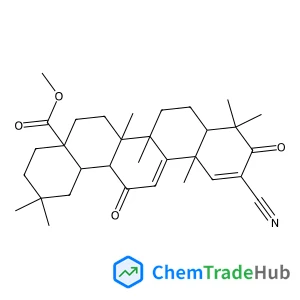
Methyl 2-cyano-3,12-dioxooleana-1,9(11)-dien-28-oate
CAS Number:
218600-53-4
Molecular Formula:
C32H43NO4
Recommended Suppliers





Disclaimer
This page provides academic journal information for reference and research purposes only. We are not affiliated with any journal publishers and do not handle publication submissions. For publication-related inquiries, please contact the respective journal publishers directly.
If you notice any inaccuracies in the information displayed, please contact us at support@chemtradehub.com. We will promptly review and address your concerns.