












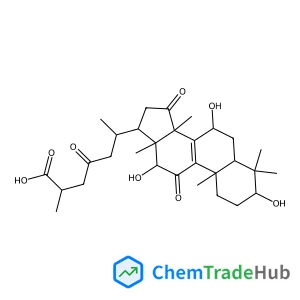
(3beta,7beta,12beta)-3,7,12-Trihydroxy-11,15,23-trioxolanost-8-en-26-oic acid
CAS Number:
98665-22-6
Molecular Formula:
C30H44O8
Minh T. Nguyen, Richard A. Jones, Bradley J. Holliday
A systematic study on the effect of variation in length of the conjugated organic backbone, and therefore the redox interactions between metal centers and the polymer backbones, of thiophene-based conducting metallopolymers (CMPs) on their charge transport properties has been conducted. Schiff-base ligands bearing various numbers of thiophene units (1–3) on both sides of a salpen center (salicyaldehyde connected through a 1,3-propylenediamine backbone) and the corresponding metal complexes of both redox-active and redox-inactive metals have been synthesized and characterized. Conducting polymers from these electropolymerizable monomers were obtained via electrochemical synthesis and studied by cyclic voltammetry, vis-NIR spectroelectrochemistry, and in situ conductivity. The results indicate that charge transport properties of ligand polymers are dramatically affected by the conjugation length of the organic backbone. The conductivity of ligand polymers increases by approximately one order of magnitude when varying the repeating units of the polymers from a bithiophene (2T) to a quarterthiophene (4T) or from a 4T to a sexithiophene (6T). However, the conductivity of the metallopolymers is significantly influenced by the interactions between the metal centers and the organic backbone. Copper(II) metallopolymers, which show no metal redox event, exhibit similar conductivity for CMPs bearing different conjugated lengths of the organic backbone. CMPs of redox-active metals (i.e., Ni(II), Co(II), and V(IV)O), on the other hand, show significant changes in conductivity depending on the relative redox potential of the metal centers and that of the organic backbone. Among metallopolymers which bear the same metal, CMPs with redox matching exhibit the highest conductivities in the series. We define redox matching as the condition in which the redox potential of the metal center is slightly higher than, but does not exceed, that of the organic backbone by ca. 0.5 V. The studies herein provide insights in understanding the structure–property relationship of CMPs, particularly on the role of the organic conjugated length, the metal centers, and metal-backbone interactions on the charge transport properties of Wolf Type III CMPs.
Magdalena Skompska, Angela Jackson, A. Robert Hillman
DOI: 10.1039/B004807K
DOI: 10.1039/B005315P
DOI: 10.1039/A902118C
DOI: 10.1039/A809994D
DOI: 10.1039/A902369K
Régis D. Gougeon, Philippe R. Bodart, Robin K. Harris, Dina M. Kolonia, Dimitris E. Petrakis, Philippos J. Pomonis
DOI: 10.1039/B005598K
Edwin K. L. Yeow, Paul J. Sintic, Nuno M. Cabral, Joost N. H. Reek, Maxwell J. Crossley, Kenneth P. Ghiggino
DOI: 10.1039/B003612I
Thomas Gutsmann, Andra B. Schromm, Michel H. J. Koch, S. Kusumoto, K. Fukase, M. Oikawa, Ulrich Seydel, Klaus Brandenburg
DOI: 10.1039/B004188M
When handling 4-(2-Furylmethyl)thiomorpholine 1,1-dioxide (CAS: 79206-94-3), it ...
When handling 4-Chloro-N-[2-(4-morpholinyl)ethyl]benzamide (CAS: 71320-77-9), it...
Waste containing this compound (CAS: 62921-74-8) should be handled according to ...
Waste containing (S)-Methyl 2-amino-3-cyclohexylpropanoate should be collected i...
This compound can be synthesized using a multi-step process involving the conjug...
There are several alternatives to (2E)-3-(3,4-Dichlorophenyl)acrylic acid in syn...
Ethyl 6-(2-nitrophenyl)imidazo[2,1-b][1,3]thiazole-3-carboxylate (CAS: 925437-84...
Waste containing 2-(1,3-Thiazol-2-yl)ethanamine (CAS: 18453-07-1) should be coll...
Methyl 5-iodo-2-methylbenzoate can be synthesized through the iodination of meth...
5-Chloro[1,2,4]triazolo[1,5-a]pyridine is commonly synthesized via the condensat...

Polymer Chemistry welcomes submissions in all areas of polymer science that have a strong focus on macromolecular chemistry. Manuscripts may cover a broad range of fields, yet no direct application focus is required.
![5-Acetyl-2,3-dihydrobenzo[b]furan structure](https://static.chemtradehub.com/structs/908/90843-31-5-eea4.webp "5-Acetyl-2,3-dihydrobenzo[b]furan structure")




