












Graphene-wrapped CoNi-layered double hydroxide microspheres as a new anode material for lithium-ion batteries
Literature Information
Publication Date
2018-05-23
DOI
10.1039/C8CP01681J
Impact Factor
3.676
Authors
Liluo Shi, Yaxin Chen, Renyue He, Xiaohong Chen, Huaihe Song
View Original
Abstract
High-performance electrode materials that can be easily prepared are imperative for obtaining highly efficient lithium-ion batteries (LIBs). In this study, graphene-wrapped CoNi-layered double hydroxide (LDH) microspheres were first fabricated and used as an anode material for LIBs. The composite electrode with a mass ratio of 2.5 : 1 (CoNi-LDH/graphene) showed a high reversible specific capacity of 1428.0 mA h g−1 at 0.05 A g−1, excellent rate performances (977.5, 670.8 and 328.1 mA h g−1 at 0.5, 2 and 10 A g−1, respectively) and long-cycling performance (75% retention at 10 A g−1 after 10 000 cycles). The excellent electrochemical performances could be due to the following reasons: CoNi-LDHs had high chemical reactivity, and the graphene shell improved the electrical conductivity of CoNi-LDHs, which facilitated charge transfer; the graphene shell also suppressed the volume expansion of metal hydroxides during charge–discharge cycling and enhanced the cycle stability of the electrode. More importantly, this is a significant study to directly use LDHs as a potential electrode for LIBs, which can promote applications of electro-active LDHs in energy storage and conversion fields.
Related Literature
Two-dimensional zeolites: dream or reality?
Wieslaw J. Roth, Jiří Čejka
2011-02-08
Perspective
DOI: 10.1039/C0CY00027B
Functionalization of luminescent cyclometalated iridium(iii) polypyridine complexes with a fluorous moiety: photophysics, protein-binding, bioconjugation, and cellular uptake properties
Siu-Kit Leung, Hua-Wei Liu, Kenneth Kam-Wing Lo
2011-04-27
Communication
DOI: 10.1039/C1CC11423A
Rhodium-catalyzed asymmetric phenylation of N-phosphinoylarylimines with triphenylborane‡
Xinyu Hao, Qian Chen, Masami Kuriyama, Ken-ichi Yamada, Yasutomo Yamamoto, Kiyoshi Tomioka
2011-02-04
Communication
DOI: 10.1039/C0CY00083C
NbO lattice MOFs based on octahedral M(ii) and ditopic pyridyl substituted diketonate ligands: structure, encapsulation and guest-driven luminescent property
Gui-Ge Hou, Yue Liu, Qi-Kui Liu, Jian-Ping Ma, Yu-Bin Dong
2011-08-25
Communication
DOI: 10.1039/C1CC14115E
Empirical modelling as an experimental approach to optimize lactone production
Nelma Gomes, José A. Teixeira, Isabel Belo
2011-02-04
Paper
DOI: 10.1039/C0CY00017E
Titanium nitride catalyst cathode in a Li–air fuel cell with an acidic aqueous solution
Ping He, Yonggang Wang, Haoshen Zhou
2011-09-05
Communication
DOI: 10.1039/C1CC14144A
Extraction and isolation of shikimic acid from Ginkgo biloba leaves utilizing an ionic liquid that dissolves cellulose
Toyonobu Usuki, Nanae Yasuda, Masahiro Yoshizawa-Fujita, Masahiro Rikukawa
2011-08-25
Communication
DOI: 10.1039/C1CC13306C
Efficient coating of polystyrene microspheres with graphene nanosheets
Yunxing Li, Zhaoqun Wang, Liang Yang, Hao Gu
2011-08-24
Communication
DOI: 10.1039/C1CC14614A
Model oxide supported MoS2 HDS catalysts: structure and surface properties
Federico Cesano, Serena Bertarione, Andrea Piovano, Giovanni Agostini, Mohammed Mastabur Rahman, Elena Groppo, Francesca Bonino, Domenica Scarano, Carlo Lamberti, Silvia Bordiga, Luciano Montanari, Lucia Bonoldi, Roberto Millini, Adriano Zecchina
2011-01-31
Paper
DOI: 10.1039/C0CY00050G
You might also like
Compound Q&A
What industries use (1R,3S)-1,3-Cyclopentanediol (CAS: 16326-97-9)?
(1R,3S)-1,3-Cyclopentanediol finds applications in various industries. In the ph...
16326-97-9(1R,3S)-1,3-Cyclopen...
Compound Q&A
What precautions should be taken when handling N'-[4-(Dimethylamino)phenyl]-N,N-dimethyl-1,4-benzenediamine (CAS: 637-31-0)?
When handling N'-[4-(Dimethylamino)phenyl]-N,N-dimethyl-1,4-benzenediamine, it i...
637-31-0N'-[4-(Dimethylamino...
Compound Q&A
Are there alternatives to 5-(2,4-Difluorophenyl)-2-methoxypyrimidine (CAS: 1352318-16-1) in synthesis?
There are several alternatives to 5-(2,4-Difluorophenyl)-2-methoxypyrimidine in ...
1352318-16-15-(2,4-Difluoropheny...
Compound Q&A
What regulatory guidelines apply to 1-(3-Methoxyphenoxy)propan-2-ol (CAS: 382141-68-6)?
1-(3-Methoxyphenoxy)propan-2-ol (CAS: 382141-68-6) must comply with the Globally...
382141-68-61-(3-Methoxyphenoxy)...
Compound Q&A
Is Tetrodotoxin Citrate (CAS: 18660-81-6) safe?
Tetrodotoxin Citrate is extremely dangerous and should be handled with extreme c...
18660-81-6Tetrodotoxin Citrate
Compound Q&A
What are the main uses of 2-Methyl-2-propanyl [(1R,3S)-3-hydroxycyclopentyl]carbamate (CAS: 225641-84-9)?
2-Methyl-2-propanyl [(1R,3S)-3-hydroxycyclopentyl]carbamate (CAS: 225641-84-9) i...
225641-84-92-Methyl-2-propanyl ...
Compound Q&A
How should waste containing 4-(2-Hydroxyhexafluoroisopropyl)Benzoic Acid (CAS: 16261-80-6) be handled?
Waste containing 4-(2-Hydroxyhexafluoroisopropyl)Benzoic Acid (CAS: 16261-80-6) ...
16261-80-64-(2-Hydroxyhexafluo...
Compound Q&A
How is 2-Methyl-2-proanyl {(2S)-1-[(benzyloxy)amino]-3-hydroxy-3-methyl-1-oxo-2-butanyl}carbamate (CAS: 102507-19-7) typically synthesized?
2-Methyl-2-proanyl {(2S)-1-[(benzyloxy)amino]-3-hydroxy-3-methyl-1-oxo-2-butanyl...
102507-19-72-Methyl-2-propanyl ...
Compound Q&A
What is Benzeneethanamine, α-ethyl-, hydrochloride (1:1) (CAS: 20735-15-3)?
Benzeneethanamine, α-ethyl-, hydrochloride (1:1) is an organic compound with the...
20735-15-3Benzeneethanamine, α...
Compound Q&A
Are there alternatives to 3-{(E)-[4-(Dimethylamino)phenyl]diazenyl}benzoic acid (CAS: 20691-84-3) in synthesis?
In the synthesis of compounds similar to 3-{(E)-[4-(Dimethylamino)phenyl]diazeny...
20691-84-33-{(E)-[4-(Dimethyla...
Source Journal
Physical Chemistry Chemical Physics

CiteScore:
5.5
Self-citation Rate:
10.3%
Articles per Year:
3036
Physical Chemistry Chemical Physics (PCCP) is an international journal co-owned by 19 physical chemistry and physics societies from around the world. This journal publishes original, cutting-edge research in physical chemistry, chemical physics and biophysical chemistry. To be suitable for publication in PCCP, articles must include significant innovation and/or insight into physical chemistry; this is the most important criterion that reviewers and Editors will judge against when evaluating submissions. The journal has a broad scope and welcomes contributions spanning experiment, theory, computation and data science. Topical coverage includes spectroscopy, dynamics, kinetics, statistical mechanics, thermodynamics, electrochemistry, catalysis, surface science, quantum mechanics, quantum computing and machine learning. Interdisciplinary research areas such as polymers and soft matter, materials, nanoscience, energy, surfaces/interfaces, and biophysical chemistry are welcomed if they demonstrate significant innovation and/or insight into physical chemistry. Joined experimental/theoretical studies are particularly appreciated when complementary and based on up-to-date approaches.
Recommended Compounds

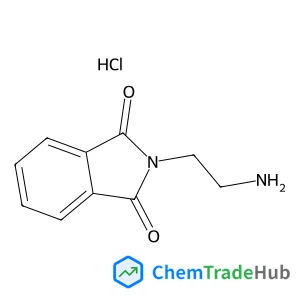
2-(2-Aminoethyl)-1H-isoindole-1,3(2H)-dione hydrochloride (1:1)
CAS Number:
30250-67-0
Molecular Formula:
C10H11ClN2O2

Recommended Suppliers






Disclaimer
This page provides academic journal information for reference and research purposes only. We are not affiliated with any journal publishers and do not handle publication submissions. For publication-related inquiries, please contact the respective journal publishers directly.
If you notice any inaccuracies in the information displayed, please contact us at support@chemtradehub.com. We will promptly review and address your concerns.