











Extraction and isolation of shikimic acid from Ginkgo biloba leaves utilizing an ionic liquid that dissolves cellulose
Literature Information
Publication Date
2011-08-25
DOI
10.1039/C1CC13306C
Impact Factor
6.222
Authors
Toyonobu Usuki, Nanae Yasuda, Masahiro Yoshizawa-Fujita, Masahiro Rikukawa
View Original
Abstract
Shikimic acid, the starting material in the commercial synthesis of oseltamivir phosphate (Tamiflu®), was efficiently extracted and isolated from Ginkgo biloba leaves utilizing the ionic liquid 1-butyl-3-methylimidazolium chloride ([bmim]Cl), which dissolves cellulose.
Recommended Journals
Related Literature
A novel {Fei–Feii–Feii–Fei} iron thiolate carbonyl assembly which electrocatalyses hydrogen evolution
Cédric Tard, Xiaoming Liu, David L. Hughes, Christopher J. Pickett
2004-11-11
Communication
DOI: 10.1039/B411559G
Attachment of glycosaminoglycan oligosaccharides to thiol-derivatised gold surfaces
Susannah J. Patey, Jeremy E. Turnbull
2004-10-11
Communication
DOI: 10.1039/B411726C
1,4-Dihydro-1,4-diphosphinine fused with two tetrathiafulvalenes
Narcis Avarvari, Marc Fourmigué
2004-11-09
Communication
DOI: 10.1039/B412193G
Facile resolution of constrained geometry indenyl-phenoxide ligation
Luke E. Turner, Matthew G. Thorn, Phillip E. Fanwick, Ian P. Rothwell
2003-03-28
Communication
DOI: 10.1039/B212724E
Synthesis and characterization of multiferroic BiFeO3 nanotubes
Tae-Jin Park, Yuanbing Mao
2004-10-13
Communication
DOI: 10.1039/B409988E
A novel catalyst with high activity for polyhydric alcohol oxidation: nanosilver/zeolite film
Jiang Shen, Wei Shan, Yahong Zhang, Junming Du, Hualong Xu, Kangnian Fan, Wei Shen, Yi Tang
2004-11-15
Communication
DOI: 10.1039/B412986E
Palladium catalysed cyclisation–carbonylation of enynes to give cyclic γ,δ-unsaturated acids
Varinder K. Aggarwal, Mike Butters, Paul W. Davies
2003-04-02
Communication
DOI: 10.1039/B300719G
CoII5(OH)6(SO4)2(H2O)4: the first ferromagnet based on a layered cobalt–hydroxide pillared by inorganic ⋯OSO3–Co(H2O)4–O3SO⋯
Serge Vilminot, Mireille Richard-Plouet, Gilles André, Tahar Mhiri, Mohamedally Kurmoo
2004-10-06
Communication
DOI: 10.1039/B411304G
Mo2P4O15 – the most complex oxide structure solved by single crystal methods?
Sarah E. Lister, Ivana Radosavljevic Evans, Judith A. K. Howard, Alan Coelho, John S. O. Evans
2004-10-04
Communication
DOI: 10.1039/B408413F
Trimethyltriazacyclohexane as bridging ligand for triangular Cu3 units and C–H hydride abstraction into a Cu6 cluster
Randolf D. Köhn, Zhida Pan, Mary F. Mahon, Gabriele Kociok-Köhn
2003-05-02
Communication
DOI: 10.1039/B302670A
You might also like
Compound Q&A
What industries use (1R,3S)-1,3-Cyclopentanediol (CAS: 16326-97-9)?
(1R,3S)-1,3-Cyclopentanediol finds applications in various industries. In the ph...
16326-97-9(1R,3S)-1,3-Cyclopen...
Compound Q&A
What precautions should be taken when handling N'-[4-(Dimethylamino)phenyl]-N,N-dimethyl-1,4-benzenediamine (CAS: 637-31-0)?
When handling N'-[4-(Dimethylamino)phenyl]-N,N-dimethyl-1,4-benzenediamine, it i...
637-31-0N'-[4-(Dimethylamino...
Compound Q&A
Are there alternatives to 5-(2,4-Difluorophenyl)-2-methoxypyrimidine (CAS: 1352318-16-1) in synthesis?
There are several alternatives to 5-(2,4-Difluorophenyl)-2-methoxypyrimidine in ...
1352318-16-15-(2,4-Difluoropheny...
Compound Q&A
What regulatory guidelines apply to 1-(3-Methoxyphenoxy)propan-2-ol (CAS: 382141-68-6)?
1-(3-Methoxyphenoxy)propan-2-ol (CAS: 382141-68-6) must comply with the Globally...
382141-68-61-(3-Methoxyphenoxy)...
Compound Q&A
Is Tetrodotoxin Citrate (CAS: 18660-81-6) safe?
Tetrodotoxin Citrate is extremely dangerous and should be handled with extreme c...
18660-81-6Tetrodotoxin Citrate
Compound Q&A
What are the main uses of 2-Methyl-2-propanyl [(1R,3S)-3-hydroxycyclopentyl]carbamate (CAS: 225641-84-9)?
2-Methyl-2-propanyl [(1R,3S)-3-hydroxycyclopentyl]carbamate (CAS: 225641-84-9) i...
225641-84-92-Methyl-2-propanyl ...
Compound Q&A
How should waste containing 4-(2-Hydroxyhexafluoroisopropyl)Benzoic Acid (CAS: 16261-80-6) be handled?
Waste containing 4-(2-Hydroxyhexafluoroisopropyl)Benzoic Acid (CAS: 16261-80-6) ...
16261-80-64-(2-Hydroxyhexafluo...
Compound Q&A
How is 2-Methyl-2-proanyl {(2S)-1-[(benzyloxy)amino]-3-hydroxy-3-methyl-1-oxo-2-butanyl}carbamate (CAS: 102507-19-7) typically synthesized?
2-Methyl-2-proanyl {(2S)-1-[(benzyloxy)amino]-3-hydroxy-3-methyl-1-oxo-2-butanyl...
102507-19-72-Methyl-2-propanyl ...
Compound Q&A
What is Benzeneethanamine, α-ethyl-, hydrochloride (1:1) (CAS: 20735-15-3)?
Benzeneethanamine, α-ethyl-, hydrochloride (1:1) is an organic compound with the...
20735-15-3Benzeneethanamine, α...
Compound Q&A
Are there alternatives to 3-{(E)-[4-(Dimethylamino)phenyl]diazenyl}benzoic acid (CAS: 20691-84-3) in synthesis?
In the synthesis of compounds similar to 3-{(E)-[4-(Dimethylamino)phenyl]diazeny...
20691-84-33-{(E)-[4-(Dimethyla...
Source Journal
Chemical Communications

CiteScore:
8.6
Self-citation Rate:
4.7%
Articles per Year:
2458
ChemComm publishes urgent research which is of outstanding significance and interest to experts in the field, while also appealing to the journal’s broad chemistry readership. Our communication format is ideally suited to short, urgent studies that are of such importance that they require accelerated publication. Our scope covers all topics in chemistry, and research at the interface of chemistry and other disciplines (such as materials science, nanoscience, physics, engineering and biology) where there is a significant novelty in the chemistry aspects. Major topic areas covered include: Analytical Chemistry Catalysis Chemical Biology and medicinal chemistry Computational Chemistry and Machine Learning Energy and sustainable chemistry Environmental Chemistry Green Chemistry Inorganic Chemistry Materials Chemistry Nanoscience Organic Chemistry Physical Chemistry Polymer Chemistry Supramolecular Chemistry
Recommended Compounds
![N-[(1S,2R,4S)-2-Amino-4-(dimethylcarbamoyl)cyclohexyl]-N'-(5-chloro-2-pyridinyl)ethanediamide structure](https://static.chemtradehub.com/structs/480/480452-37-7-0898.webp "N-[(1S,2R,4S)-2-Amino-4-(dimethylcarbamoyl)cyclohexyl]-N'-(5-chloro-2-pyridinyl)ethanediamide structure")
N-[(1S,2R,4S)-2-Amino-4-(dimethylcarbamoyl)cyclohexyl]-N'-(5-chloro-2-pyridinyl)ethanediamide
CAS Number:
480452-37-7
Molecular Formula:
C16H22ClN5O3
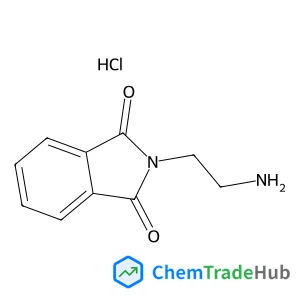
2-(2-Aminoethyl)-1H-isoindole-1,3(2H)-dione hydrochloride (1:1)
CAS Number:
30250-67-0
Molecular Formula:
C10H11ClN2O2
![Ethyl 3-((6-(4,5-dihydro-1H-benzo[d]azepin-3(2H)-yl)-2-(pyridin-2-yl)pyrimidin-4-yl)amino)propanoate structure](https://static.chemtradehub.com/structs/137/1373423-53-0-496a.webp "Ethyl 3-((6-(4,5-dihydro-1H-benzo[d]azepin-3(2H)-yl)-2-(pyridin-2-yl)pyrimidin-4-yl)amino)propanoate structure")
Ethyl 3-((6-(4,5-dihydro-1H-benzo[d]azepin-3(2H)-yl)-2-(pyridin-2-yl)pyrimidin-4-yl)amino)propanoate
CAS Number:
1373423-53-0
Molecular Formula:
C24H27N5O2
Recommended Suppliers





Disclaimer
This page provides academic journal information for reference and research purposes only. We are not affiliated with any journal publishers and do not handle publication submissions. For publication-related inquiries, please contact the respective journal publishers directly.
If you notice any inaccuracies in the information displayed, please contact us at support@chemtradehub.com. We will promptly review and address your concerns.