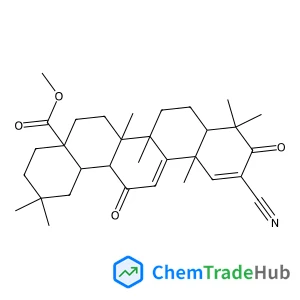
Methyl 2-cyano-3,12-dioxooleana-1,9(11)-dien-28-oate
CAS Number:
218600-53-4
Molecular Formula:
C32H43NO4
Hai-Ru Li, Miao Yan, Qiang Chen, Yue-Wen Mu, Hai-Gang Lu, Yan-Bo Wu, Si-Dian Li
Recent joint experimental and theoretical investigations have shown that seashell-like C2 B28 is the smallest neutral borospherene reported to date, while seashell-like Cs B29− (1−) as a minor isomer competes with its quasi-planar counterparts in B29− cluster beams. Extensive global minimum searches and first-principles theory calculations performed in this work indicate that with two valence electrons detached from B29−, the B29+ monocation favors a seashell-like Cs B29+ (1+) much different from Cs B29− (1−) in geometry which is overwhelmingly the global minimum of the system with three B7 heptagonal holes in the front, on the back, and at the bottom, respectively, unveiling an interesting charge-induced structural transition from Cs B29− (1−) to Cs B29+ (1+). Detailed bonding analyses show that with one less σ bond than B29− (1−), Cs B29+ (1+) also possesses nine delocalized π-bonds over its σ-skeleton on the cage surface with a σ + π double delocalization bonding pattern and follows the 2(n + 1)2 electron counting rule for 3D spherical aromaticity (n = 2). B29+ (1+) is therefore the smallest borospherene monocation reported to date which is π-isovalent with the smallest neutral borospherene C2 B28. The IR, Raman, and UV-vis spectra of B29+ (1+) are computationally simulated to facilitate its spectroscopic characterization.

Israel Journal of Chemistry

Helvetica Chimica Acta

Organic Preparations and Procedures International

Journal of Physics and Chemistry of Solids

Fibre Chemistry

Russian Chemical Reviews

Pure and Applied Chemistry

Proceedings of the National Academy of Sciences of the United States of America

Science

Journal of Organometallic Chemistry
Wolfgang Meier, Alexandra Graff, Anke Diederich, Mathias Winterhalter
DOI: 10.1039/B004073H
H. Binder, G. Köhler, K. Arnold, O. Zschörnig
DOI: 10.1039/B003033N
DOI: 10.1039/A900683D
DOI: 10.1039/B003695L
DOI: 10.1039/B005457G
DOI: 10.1039/A902689D
Bernhard Schartel, Thomas Damerau, Manfred Hennecke
DOI: 10.1039/B004931J
Giuliano Alagona, Caterina Ghio, Susanna Monti
DOI: 10.1039/B004476H
DOI: 10.1039/A901768B
When handling 4-(2-Furylmethyl)thiomorpholine 1,1-dioxide (CAS: 79206-94-3), it ...
When handling 4-Chloro-N-[2-(4-morpholinyl)ethyl]benzamide (CAS: 71320-77-9), it...
Waste containing this compound (CAS: 62921-74-8) should be handled according to ...
Waste containing (S)-Methyl 2-amino-3-cyclohexylpropanoate should be collected i...
This compound can be synthesized using a multi-step process involving the conjug...
There are several alternatives to (2E)-3-(3,4-Dichlorophenyl)acrylic acid in syn...
Ethyl 6-(2-nitrophenyl)imidazo[2,1-b][1,3]thiazole-3-carboxylate (CAS: 925437-84...
Waste containing 2-(1,3-Thiazol-2-yl)ethanamine (CAS: 18453-07-1) should be coll...
Methyl 5-iodo-2-methylbenzoate can be synthesized through the iodination of meth...
5-Chloro[1,2,4]triazolo[1,5-a]pyridine is commonly synthesized via the condensat...

Physical Chemistry Chemical Physics (PCCP) is an international journal co-owned by 19 physical chemistry and physics societies from around the world. This journal publishes original, cutting-edge research in physical chemistry, chemical physics and biophysical chemistry. To be suitable for publication in PCCP, articles must include significant innovation and/or insight into physical chemistry; this is the most important criterion that reviewers and Editors will judge against when evaluating submissions. The journal has a broad scope and welcomes contributions spanning experiment, theory, computation and data science. Topical coverage includes spectroscopy, dynamics, kinetics, statistical mechanics, thermodynamics, electrochemistry, catalysis, surface science, quantum mechanics, quantum computing and machine learning. Interdisciplinary research areas such as polymers and soft matter, materials, nanoscience, energy, surfaces/interfaces, and biophysical chemistry are welcomed if they demonstrate significant innovation and/or insight into physical chemistry. Joined experimental/theoretical studies are particularly appreciated when complementary and based on up-to-date approaches.