












![6-Bromo-3-ethyl-3H-imidazo[4,5-b]pyridine structure](https://static.chemtradehub.com/structs/103/1033202-59-3-2a8f.webp "6-Bromo-3-ethyl-3H-imidazo[4,5-b]pyridine structure")
Direct monitoring of light mediated hyperthermia induced within mammalian tissues using surface enhanced spatially offset Raman spectroscopy (T-SESORS)
Literature Information
Publication Date
2019-05-03
DOI
10.1039/C8AN02466A
Impact Factor
4.616
Authors
Benjamin Gardner, Pavel Matousek, Nick Stone
View Original
Abstract
Here we demonstrate light mediated heating of nanoparticles confined deep inside mammalian tissue, whilst directly monitoring their temperature non-invasively using a form of deep Raman spectroscopy, T-SESORS. One of the main barriers to the introduction of photo-thermal therapies (PTT) has been recognised as the inability to directly monitor the local temperature deep within the tissue at the point of therapy. Here Au nanoparticles with a Raman reporter molecule (temperature reporters) are used in combination with Au nanoshells (heat mediators) to provide simultaneously heating under NIR illumination and direct spectroscopic monitoring of local temperature deep within mammalian tissues. The surface enhanced Raman signal was read out at the tissue surface using a transmission geometry in this example and the temperature of the tissue was ascertained from the anti-Stokes to Stokes Raman reporter. This approach opens the prospect of non-invasive hyperthermia treatments with direct temperature feedback from deep inside within tissue, where nanoparticles can be used to both provide localised heating and accurately monitor the local temperature.
Related Literature
A new non-diffusional gas bubble production route in used nuclear fuel: implications for fission gas release, cladding corrosion, and next generation fuel design
Jon M. Schwantes, Jacob L. Bair, Edgar C. Buck, Ram Devanathan, Sean H. Kessler, Timothy G. Lach, Jason M. Lonergan, Bruce K. McNamara, Camille J. Palmer, Richard A. Clark
2020-01-28
Paper
DOI: 10.1039/C9CP05363H
High-performance natural-sunlight-driven Ag/AgCl photocatalysts with a cube-like morphology and blunt edges via a bola-type surfactant-assisted synthesis
Zhong-Fei Xu, Guangwei Geng, Dongjun Wang
2020-01-11
Paper
DOI: 10.1039/C9CP05273A
First-principles comparative study of perfect and defective CsPbX3 (X = Br, I) crystals
R. A. Evarestov, A. Senocrate, R. K. Kremer, J. Maier
2020-01-27
Paper
DOI: 10.1039/C9CP06322F
Identification of a receiver triplet state in the ultrafast intersystem crossing of carbonylpyrenes
Lekshmi R. S., Gayathri B. Kurup, Sivaranjana Reddy Vennapusa
2020-02-17
Paper
DOI: 10.1039/C9CP06857K
How flexible is the water molecule structure? Analysis of crystal structures and the potential energy surface
Milan R. Milovanović, Jelena M. Živković, Dragan B. Ninković, Ivana M. Stanković
2020-01-28
Paper
DOI: 10.1039/C9CP07042G
Influence of the interfacial interaction strength on the viscoelasticity of hard–soft block copolymer based nanocomposites: a molecular dynamics simulation study
Ruiqi Zhao, Yu Wang, Xinglong Gong
2020-01-27
Paper
DOI: 10.1039/C9CP06314E
DNP NMR spectroscopy of cross-linked organic polymers: rational guidelines towards optimal sample preparation
Wei-Chih Liao, Atsuko Ogawa, Kazuhiko Sato, Christophe Copéret
2019-12-12
Paper
DOI: 10.1039/C9CP05208A
Mirror symmetry origin of Dirac cone formation in rectangular two-dimensional materials
Xuming Qin, Yi Liu, Gui Yang, Dongqiu Zhao
2020-03-02
Paper
DOI: 10.1039/D0CP00244E
Large scale indium tin oxide (ITO) one dimensional gratings for ultrafast signal modulation in the visible spectral region
Michele Guizzardi, Silvio Bonfadini, Ilka Kriegel, Luigino Criante
2020-03-05
Paper
DOI: 10.1039/C9CP06839B
You might also like
Compound Q&A
What is the market or research trend for N-(4-Methoxybenzyl)-2-pyridinamine (CAS: 52818-63-0)?
N-(4-Methoxybenzyl)-2-pyridinamine (CAS: 52818-63-0) is increasingly being used ...
52818-63-0N-(4-Methoxybenzyl)-...
Compound Q&A
What precautions should be taken when handling Ethyl 4-(2-chlorophenyl)-1,3-thiazole-2-carboxylate (CAS: 1050507-06-6)?
When handling Ethyl 4-(2-chlorophenyl)-1,3-thiazole-2-carboxylate, appropriate p...
1050507-06-6Ethyl 4-(2-chlorophe...
Compound Q&A
What regulatory guidelines apply to diethyldiselane (CAS: 628-39-7)?
Diethyldiselane (CAS: 628-39-7) is classified under the Globally Harmonized Syst...
628-39-7Diethyldiselane
Compound Q&A
What is the market or research trend for oxocopper (CAS: 12053-18-8)?
The market for oxocopper (CAS: 12053-18-8) is primarily driven by its use in cat...
12053-18-8oxocopper; oxo-(oxoc...
Compound Q&A
What is the market or research trend for 5-{[(2-Methyl-2-propanyl)oxy]carbonyl}-5-azaspiro[2.4]heptane-7-carboxylic acid?
The market for 5-{[(2-Methyl-2-propanyl)oxy]carbonyl}-5-azaspiro[2.4]heptane-7-c...
1268519-54-55-{[(2-Methyl-2-prop...
Compound Q&A
What is 2-(1-Pyrrolidinyl)-4-pyridinamine (CAS: 35981-63-6)?
2-(1-Pyrrolidinyl)-4-pyridinamine is a chemical compound with the CAS number 359...
35981-63-62-(1-Pyrrolidinyl)-4...
Compound Q&A
What are the physical and chemical properties of 2-(3-Pyridinyl)-1-azabicyclo[2.2.2]octane (CAS: 91556-75-1)?
2-(3-Pyridinyl)-1-azabicyclo[2.2.2]octane (CAS: 91556-75-1) is a crystalline sol...
91556-75-12-(3-Pyridinyl)-1-az...
Compound Q&A
How is (S)-Alpha-allyl-proline hydrochloride (CAS: 129704-91-2) typically synthesized?
(S)-Alpha-allyl-proline hydrochloride is usually synthesized via a Wittig reacti...
129704-91-2(S)-Alpha-allyl-prol...
Compound Q&A
What is 3-Methyl-1,2-oxazole-5-carboxylic acid (CAS: 4857-42-5)?
3-Methyl-1,2-oxazole-5-carboxylic acid (CAS: 4857-42-5) is an organic compound w...
4857-42-53-Methyl-1,2-oxazole...
Compound Q&A
How is Lys-SMCC-DM1 (CAS: 1281816-04-3) typically synthesized?
Lys-SMCC-DM1 is synthesized via a multi-step process involving the coupling of S...
1281816-04-3Lys-SMCC-DM1
Source Journal
Analyst

CiteScore:
7.8
Self-citation Rate:
5.6%
Articles per Year:
653
Analyst publishes analytical and bioanalytical research that reports premier fundamental discoveries and inventions, and the applications of those discoveries, unconfined by traditional discipline barriers.
Recommended Compounds
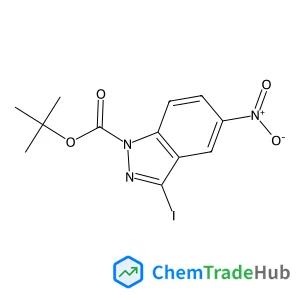
Tert-butyl 3-iodo-5-nitro-1H-indazole-1-carboxylate
CAS Number:
459133-69-8
Molecular Formula:
C12H12IN3O4
Recommended Suppliers





Disclaimer
This page provides academic journal information for reference and research purposes only. We are not affiliated with any journal publishers and do not handle publication submissions. For publication-related inquiries, please contact the respective journal publishers directly.
If you notice any inaccuracies in the information displayed, please contact us at support@chemtradehub.com. We will promptly review and address your concerns.