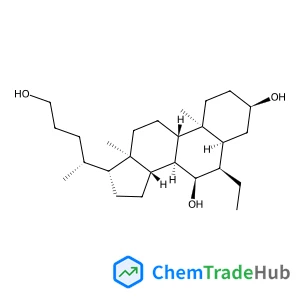
(3alpha,5beta,6alpha,7alpha)-6-Ethylcholane-3,7,24-triol
CAS Number:
1537866-49-1
Molecular Formula:
C26H46O3
Susheel K. Mittal, Sonia Rana, Navneet Kaur, Craig E. Banks
Herein, a potent electrochemical ionophore (SMS-2) based on a Schiff base has been used for the modification of a screen-printed electrode (SPE). The modified disposable electrode can selectively detect ferric ions in an aqueous medium. Redox behavior of the proposed strip was characterized using cyclic voltammetry (CV) and differential pulse voltammetry (DPV). Incorporation of the ligand in the ink of the SPE enhanced the analytical performance of the electrode, and its surface modification was confirmed by SEM and EDX analysis. Shifting/quenching of the cathodic peak potential of the ionophore after binding with Fe(III) ions was used to detect and measure the ferric ion concentration. This sensor can identify Fe(III) in the detection range from 0.625 μM to 7.5 μM. The modified SPE can selectively detect ferric ions in the presence of many other interfering ions and has been successfully used to determine the Fe(III) content in blood serum samples. The metal–ionophore complex structure was optimized using DFT calculations to study the energetics of the metal–ionophore interactions.
Alejandro Cruz
DOI: 10.1039/D1CP01338F
Xiuting Chen, Yu Gong
DOI: 10.1039/D1CP03092B
Sadra Kashefolgheta, Shuzhe Wang, William E. Acree, Jr., Philippe H. Hünenberger
DOI: 10.1039/D1CP00215E
Chithra M. J., Probal Nag, Sivaranjana Reddy Vennapusa
DOI: 10.1039/D1CP02587B
Lisa Djuandhi, Neeraj Sharma, Bruce C. C. Cowie, Thanh V. Nguyen, Aditya Rawal
DOI: 10.1039/D1CP01838H
Jozef Rakovský, Ondrej Votava
DOI: 10.1039/D1CP02639A
Matthew Szydagis, Cecilia Levy, Yujia Huang, Alvine C. Kamaha, Corwin C. Knight, Gregory R. C. Rischbieter
DOI: 10.1039/D1CP01083B
Bing-shuang Qian, Wen-de Tian
DOI: 10.1039/D1CP01234G
Yongjian Zang, Xuhua Li, Yizhen Zhao, He Wang, Dongxiao Hao, Lei Zhang, Zhiwei Yang, Xiaohui Yuan, Shengli Zhang
DOI: 10.1039/D1CP01611C
Chikako Sakai, Kazuo Toyota, Kazunobu Sato, Daisuke Shiomi
DOI: 10.1039/D1CP03156B
N-(4-Methoxybenzyl)-2-pyridinamine (CAS: 52818-63-0) is increasingly being used ...
When handling Ethyl 4-(2-chlorophenyl)-1,3-thiazole-2-carboxylate, appropriate p...
Diethyldiselane (CAS: 628-39-7) is classified under the Globally Harmonized Syst...
The market for oxocopper (CAS: 12053-18-8) is primarily driven by its use in cat...
The market for 5-{[(2-Methyl-2-propanyl)oxy]carbonyl}-5-azaspiro[2.4]heptane-7-c...
2-(1-Pyrrolidinyl)-4-pyridinamine is a chemical compound with the CAS number 359...
2-(3-Pyridinyl)-1-azabicyclo[2.2.2]octane (CAS: 91556-75-1) is a crystalline sol...
(S)-Alpha-allyl-proline hydrochloride is usually synthesized via a Wittig reacti...
3-Methyl-1,2-oxazole-5-carboxylic acid (CAS: 4857-42-5) is an organic compound w...
Lys-SMCC-DM1 is synthesized via a multi-step process involving the coupling of S...

Analyst publishes analytical and bioanalytical research that reports premier fundamental discoveries and inventions, and the applications of those discoveries, unconfined by traditional discipline barriers.

![1-oxaspiro[4.4]nonan-6-one structure](https://static.chemtradehub.com/structs/134/134179-01-4-e051.webp "1-oxaspiro[4.4]nonan-6-one structure")