












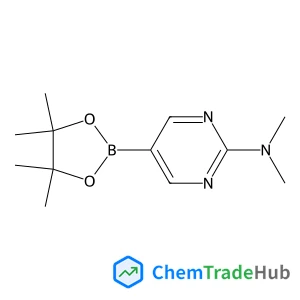
N,N-Dimethyl-5-(4,4,5,5-tetramethyl-1,3,2-dioxaborolan-2-yl)-2-pyrimidinamine
CAS Number:
1032759-30-0
Molecular Formula:
C12H20BN3O2
Yi-bo Hu, Xiao-yan Li
Nanoscale zero-valent iron (NZVI) is a highly reactive material for decontamination but it often suffers from problems such as agglomeration, aqueous corrosion, and poor mobility for field applications. In this study, a new modification technique was developed by coating the NZVI surface with a soluble Mg(OH)2 shell to form Mg(OH)2-coated NZVI (NZVI@Mg(OH)2) nanoparticles. The Mg(OH)2 shell significantly reduced the magnetic attraction between NZVI particles, preventing particle aggregation. Consequently, NZVI@Mg(OH)2 with an appropriate coating ratio (Mg/Fe, wt%) had an increased stability in suspension and considerably improved mobility in saturated porous media. According to the filtration tests, the Mg(OH)2 shell effectively decreased the attachment, blocking, and straining effects during the transport of NZVI particles through a sand column. With the Mg(OH)2 shell, the reactivity of NZVI was well preserved during the NZVI storage and transport. Encapsulation with 100 wt% Mg(OH)2 could protect the NZVI core from aqueous corrosion such as oxidation by H+ ions. When NZVI@Mg(OH)2 is used in field applications, the NZVI reactivity would be progressively released and fully recovered with the dissolution of the Mg(OH)2 shell in the background water. The test results showed that after the dissolution of the Mg(OH)2 shell, the NZVI exhibited a similar reactivity and capacity to bare NZVI for the reduction of Cr(VI). Overall, the novel Mg(OH)2 coating technique not only provides NZVI with a high mobility for transport and delivery but also protects the NZVI core from rapid corrosion and enables a controlled release of NZVI reactivity for environmental remediation.
Jian Xu, Hui-Lin Zhu, Jie Zhang, Wen-Yuan Liu, Jian-Guang Luo, Ke Pan, Wen-Yuan Cao, Qi-Rui Bi
DOI: 10.1039/C9QO00174C
Tao Guo, Xu-Ning Wei, Yu Liu, Pan-Ke Zhang, Yun-Hui Zhao
DOI: 10.1039/C9QO00198K
Guoli Shen, Ruhima Khan, Haiping Lv, Yong Yang, Xia Zhang, Yong Zhan, Yongyun Zhou
DOI: 10.1039/C9QO00041K
DOI: 10.1039/C6QO00636A
Weisai Zu, Shuai Liu, Xin Jia, Liang Xu
DOI: 10.1039/C8QO01313F
Bo-Sheng Zhang, Hui-Liang Hua, Lu-Yao Gao, Ce Liu, Yi-Feng Qiu, Ping-Xin Zhou, Zhao-Zhao Zhou, Jia-Hui Zhao, Yong-Min Liang
DOI: 10.1039/C7QO00164A
Shangbiao Feng, Jinlai Li, Feifei He, Tao Li, Huilin Li, Xiaolei Wang, Xingang Xie, Xuegong She
DOI: 10.1039/C9QO00006B
Wei Shi, Yunfan Yang, Yu Zhao, Yongqing Li
DOI: 10.1039/C9QO00230H
When considering alternatives to 1-(4-Chlorophenyl)-N-hydroxymethanimine (CAS: 3...
This compound should be stored in a cool, dry place away from direct sunlight. I...
3-(4-Bromophenyl)-5-(2-fluorophenyl)-1,2,4-oxadiazole is synthesized through a m...
5-Chloro-2-(4-chlorophenyl)-4-methyl-6-[3-(1-piperidinyl)propoxy]pyrimidine (CAS...
2-Chloro-4-(difluoromethoxy)pyridine is used in the pharmaceutical industry for ...
3-Chloro-6-methylpyridazine (CAS: 1121-79-5) is classified under the Globally Ha...
Several alternatives can be used in the synthesis of Methyl 4,5-dimethyl-2-nitro...
Alternatives to (2E,2'E)-3,3'-(1,4-Phenylene)bisacrylaldehyde include other acry...
3-Amino-5-chloropyridin-2-ol hydrochloride is an organic compound with the CAS n...
When handling 6,7-Difluoro-2,3-dihydro-4H-chromen-4-one, it is essential to wear...

Journal of Materials Chemistry A, B & C cover high quality studies across all fields of materials chemistry. The journals focus on those theoretical or experimental studies that report new understanding, applications, properties and synthesis of materials. The journals have a strong history of publishing quality reports of interest to interdisciplinary communities and providing an efficient and rigorous service through peer review and publication. The journals are led by an international team of Editors-in-Chief and Associate Editors who are all active researchers in their fields. Journal of Materials Chemistry A, B & C are separated by the intended application of the material studied. Broadly, applications in energy and sustainability are of interest to Journal of Materials Chemistry A, applications in biology and medicine are of interest to Journal of Materials Chemistry B, and applications in optical, magnetic and electronic devices are of interest to Journal of Materials Chemistry C. More than one Journal of Materials Chemistry journal may be suitable for certain fields and researchers are encouraged to submit their paper to the journal that they feel best fits for their particular article. Example topic areas within the scope of Journal of Materials Chemistry A are listed below. This list is neither exhaustive nor exclusive. Artificial photosynthesis Batteries Carbon dioxide conversion Catalysis Fuel cells Gas capture/separation/storage Green/sustainable materials Hydrogen generation Hydrogen storage Photocatalysis Photovoltaics Self-cleaning materials Self-healing materials Sensors Supercapacitors Thermoelectrics Water splitting Water treatment

![2-{[(1R,2S)-2-Aminocyclohexyl]amino}-4-{[3-(2H-1,2,3-triazol-2-yl)phenyl]amino}-5-pyrimidinecarboxamide structure](https://static.chemtradehub.com/structs/137/1370261-96-3-40df.webp "2-{[(1R,2S)-2-Aminocyclohexyl]amino}-4-{[3-(2H-1,2,3-triazol-2-yl)phenyl]amino}-5-pyrimidinecarboxamide structure")




