













How to determine optical gaps and voltage losses in organic photovoltaic materials
Literature Information
Publication Date
2018-02-02
DOI
10.1039/C7SE00601B
Impact Factor
6.367
Authors
K. Vandewal, J. Benduhn, V. C. Nikolis
View Original
Abstract
The best performing organic solar cells (OSC) efficiently absorb photons and convert them to free charge carriers, which are subsequently collected at the electrodes. However, the energy lost in this process is much larger than for inorganic and perovskite solar cells, currently limiting the power conversion efficiency of OSCs to values slightly below 14%. To quantify energy losses, the open-circuit voltage of the solar cell is often compared to its optical gap. The latter is, however, not obvious to determine for organic materials which have broad absorption and emission bands, and is often done erroneously. Nevertheless, a deeper understanding of the energy loss mechanisms depends crucially on an accurate determination of the energies of the excited states involved in the photo-conversion process. This perspective therefore aims to summarize how the optical gap can be precisely determined, and how it relates to energy losses in organic photovoltaic materials.
Related Literature
Construction of carbon nanotube based nanoarchitectures for selective impedimetric detection of cancer cells in whole blood
Wangxia Dan, Yu Fu, Shaoqin Liu
2014-07-21
Paper
DOI: 10.1039/C4AN00758A
Coumarin meets fluorescein: a Förster resonance energy transfer enhanced optical ammonia gas sensor
Marko Dorrestijn, Agathe Camerlo, Špela Korent Urek, Aleksandra Lobnik, Catherine E. Housecroft, Edwin C. Constable, Lukas J. Scherer
2014-06-24
Paper
DOI: 10.1039/C4AN00061G
A novel architecture based upon multi-walled carbon nanotubes and ionic liquid to improve the electroanalytical detection of ciprofibrate
Fernando Campanhã Vicentini, Amanda Elisa Ravanini, Tiago Almeida Silva, Bruno C. Janegitz, Valtencir Zucolotto, Orlando Fatibello-Filho
2014-05-15
Paper
DOI: 10.1039/C4AN00861H
Synthesis of water-soluble Ag2Se QDs as a novel resonance Rayleigh scattering sensor for highly sensitive and selective ConA detection
Lichun Zhang, Yurong Tang, Yi Lv
2014-05-16
Paper
DOI: 10.1039/C4AN00579A
Novel DFO-functionalized mesoporous silica for iron sensing. Part 2. Experimental detection of free iron concentration (pFe) in urine samples
Giancarla Alberti, Giovanni Emma, Roberta Colleoni, Maria Pesavento, Valeria Marina Nurchi, Raffaela Biesuz
2014-03-13
Paper
DOI: 10.1039/C3AN01488F
Diamond nanowires modified with poly[3-(pyrrolyl)carboxylic acid] for the immobilization of histidine-tagged peptides
Palaniappan Subramanian, Ievgen Mazurenko, Yannick Coffinier, Rabah Boukherroub, Sabine Szunerits
2014-06-11
Paper
DOI: 10.1039/C4AN00146J
A novel chromo- and fluorogenic dual sensor for Mg2+ and Zn2+ with cell imaging possibilities and DFT studies
Rabiul Alam, Tarun Mistri, Atul Katarkar, Keya Chaudhuri, Sushil Kumar Mandal, Anisur Rahman Khuda-Bukhsh, Kalyan K. Das, Mahammad Ali
2014-05-06
Paper
DOI: 10.1039/C3AN02347H
Quality assessment of recombinant proteins by infrared spectroscopy. Characterisation of a protein aggregation related band of the Ca2+-ATPase
Chenge Li, Saroj Kumar, Andreas Barth
2014-05-22
Paper
DOI: 10.1039/C4AN00483C
Flow analysis in Brazil: contributions over the last four decades
Alex D. Batista, Milton K. Sasaki, Fábio R. P. Rocha, Elias A. G. Zagatto
2014-05-01
Critical Review
DOI: 10.1039/C4AN00295D
Quantification of an exogenous cancer biomarker in urinalysis by Raman Spectroscopy
Guangyi Cao, Ghazal Hajisalem, Wei Li, Fraser Hof, Reuven Gordon
2014-08-19
Paper
DOI: 10.1039/C4AN01309C
You might also like
Compound Q&A
How should waste containing (6-Bromo-2-naphthyl)oxy](dimethyl)(2-methyl-2-propanyl)silane be handled?
Waste containing (6-Bromo-2-naphthyl)oxy](dimethyl)(2-methyl-2-propanyl)silane (...
100751-65-3[(6-Bromo-2-naphthyl...
Compound Q&A
How is 7-Fluoro-4-isoquinolinecarboxylic acid (CAS: 1841081-40-0) typically synthesized?
7-Fluoro-4-isoquinolinecarboxylic acid can be synthesized via a multi-step proce...
1841081-40-07-Fluoro-4-isoquinol...
Compound Q&A
What are the physical and chemical properties of 2,3,5,6-Tetrabromothieno[3,2-b]thiophene (CAS: 124638-53-5)?
2,3,5,6-Tetrabromothieno[3,2-b]thiophene is a crystalline compound with a high m...
124638-53-52,3,5,6-Tetrabromoth...
Compound Q&A
Is 1-[4-(Benzylamino)-7,8-dihydro-5H-pyrano[4,3-d]pyrimidin-2-yl]-2-methyl-1H-indole-4-carboxamide (CAS: 1542705-92-9) safe?
1-[4-(Benzylamino)-7,8-dihydro-5H-pyrano[4,3-d]pyrimidin-2-yl]-2-methyl-1H-indol...
1542705-92-91-[4-(Benzylamino)-7...
Compound Q&A
What is the market or research trend for imidazo[5,1-d]-1,2,3,5-tetrazine-8-carboxylic acid, 3,4-dihydro-3-methyl-4-oxo- (CAS: 113942-30-6)?
The market for imidazo[5,1-d]-1,2,3,5-tetrazine-8-carboxylic acid, 3,4-dihydro-3...
113942-30-6Imidazo[5,1-d]-1,2,3...
Compound Q&A
What is 3-(Triisopropylsilyl)propiolaldehyde (CAS: 163271-80-5)?
3-(Triisopropylsilyl)propiolaldehyde is a synthetic organic compound with the CA...
163271-80-53-(Triisopropylsilyl...
Compound Q&A
What regulatory guidelines apply to 6-Nitro-2H-1,4-benzoxazin-3(4H)-one (CAS: 81721-87-1)?
6-Nitro-2H-1,4-benzoxazin-3(4H)-one (CAS: 81721-87-1) is subject to various regu...
81721-87-16-Nitro-2H-1,4-benzo...
Compound Q&A
How should waste containing (3-Fluorophenyl)(4-{[(2-methyl-2-propanyl)oxy]carbonyl}-1-piperazinyl)acetic acid (CAS: 885272-91-3) be handled?
Waste containing (3-Fluorophenyl)(4-{[(2-methyl-2-propanyl)oxy]carbonyl}-1-piper...
885272-91-3(3-Fluorophenyl)(4-{...
Compound Q&A
What are the physical and chemical properties of N,N'-4,4'-Biphenyldiyldiisonicotinamide (CAS: 55119-40-9)?
N,N'-4,4'-Biphenyldiyldiisonicotinamide is a white crystalline solid with a mole...
55119-40-9N,N'-4,4'-Biphenyldi...
Compound Q&A
What industries use 6-Bromo-8-fluoro-2-quinazolinol (CAS: 1036756-15-6)?
6-Bromo-8-fluoro-2-quinazolinol is primarily used in the pharmaceutical industry...
1036756-15-66-Bromo-8-fluoro-2-q...
Source Journal
Recommended Compounds
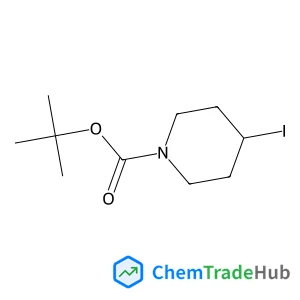
2-Methyl-2-propanyl 4-iodo-1-piperidinecarboxylate
CAS Number:
301673-14-3
Molecular Formula:
C10H18INO2

Oxalic acid compound with cyclohexylsulfamothioic O-acid (11)
CAS Number:
31895-22-4
Molecular Formula:
C7H13NO4S3


Recommended Suppliers







Disclaimer
This page provides academic journal information for reference and research purposes only. We are not affiliated with any journal publishers and do not handle publication submissions. For publication-related inquiries, please contact the respective journal publishers directly.
If you notice any inaccuracies in the information displayed, please contact us at support@chemtradehub.com. We will promptly review and address your concerns.