












Diamond nanowires modified with poly[3-(pyrrolyl)carboxylic acid] for the immobilization of histidine-tagged peptides
Literature Information
Publication Date
2014-06-11
DOI
10.1039/C4AN00146J
Impact Factor
4.616
Authors
Palaniappan Subramanian, Ievgen Mazurenko, Yannick Coffinier, Rabah Boukherroub, Sabine Szunerits
View Original
Abstract
Coating boron-doped diamond nanowires (BDD NWs) with a conducting polymer, poly[3-(pyrrolyl)carboxylic acid], has been reported. Polymer coating was achieved through electropolymerization of 3-(pyrrolyl)carboxylic acid at the electrode interface by amperometrically biasing the BDD NWs interface until a predefined charge has passed. The poly[3-(pyrrolyl)carboxylic acid] modified BDD NWs (PPA–BDD NWs) were characterized by scanning electron microscopy (SEM) and cyclic voltammetry (CV). Using a deposition charge of 11 mC cm−2 resulted in a thin polymer film deposition. The availability of the carboxylic groups of the polymer coated BDD NWs electrode was demonstrated through copper ion (Cu2+) chelation. The resulting complex was successfully used for the site-specific immobilization of histidine-tagged peptides. The binding process was followed by electrochemical impedance spectroscopy (EIS). The Cu2+-chelated PPA–BDD NWs interface showed peptide loading capability comparable to those of commercially available interfaces and can be easily regenerated several times using ethylenediaminetetraacetic acid (EDTA).
Recommended Journals
Related Literature
Dielectric spectroscopy of ion-pairing and hydration in aqueous tetra-n-alkylammonium halide solutions
Richard Buchner, Christian Hölzl, Jochen Stauber, Josef Barthel
2002-04-29
Paper
DOI: 10.1039/B110361J
Interaction between probe molecules and zeolites. Part II:Interpretation of the IR spectra of CO and N2 adsorbed in NaY and NaRbY
A. V. Larin, D. P. Vercauteren, C. Lamberti, S. Bordiga, A. Zecchina
2002-04-29
Paper
DOI: 10.1039/B107242K
Two ways of looking at Prigogine and Defay's equation
Luís P. N. Rebelo, Vesna Najdanovic-Visak, Zoran P. Visak, M. Nunes da Ponte, Jacobo Troncoso, Claudio A. Cerdeiriña, Luis Romaní
2002-04-25
Paper
DOI: 10.1039/B200292B
Fragmentations and reactions of three isotopically labelled dimethyl methylphosphonate ions produced by electrospray ionisation in an ion trap mass spectrometer
J. D. Barr, A. J. Bell, D. O. Konn, J. Murrell, C. M. Timperley, M. J. Waters, P. Watts
2002-05-03
Paper
DOI: 10.1039/B111192M
Rheo-optical study of colloidal crystals
Tsuneo Okubo, Hiroshi Kimura, Tohru Hatta, Takaharu Kawai
2002-04-22
Paper
DOI: 10.1039/B109963A
Active sites in sol–gel prepared silica-alumina for photoinduced non-oxidative methane coupling
Hisao Yoshida, Norimitsu Matsushita, Yuko Kato, Tadashi Hattori
2002-04-22
Paper
DOI: 10.1039/B111101A
EPR spectrum and formation properties of a cubic Rh+ centre in NaCl
H. Vrielinck, F. Callens, P. Matthys
2002-04-26
Paper
DOI: 10.1039/B110906P
The PFI-ZEKE photoelectron spectrum of m-fluorophenol and its aqueous complexes: Comparing intermolecular vibrations in rotational isomers
Keigo Yosida, Kazunari Suzuki, Shun-ichi Ishiuchi, Makoto Sakai, Masaaki Fujii, Caroline E. H. Dessent, Klaus Müller-Dethlefs
2002-05-14
Paper
DOI: 10.1039/B201107G
You might also like
Compound Q&A
How should waste containing (6-Bromo-2-naphthyl)oxy](dimethyl)(2-methyl-2-propanyl)silane be handled?
Waste containing (6-Bromo-2-naphthyl)oxy](dimethyl)(2-methyl-2-propanyl)silane (...
100751-65-3[(6-Bromo-2-naphthyl...
Compound Q&A
How is 7-Fluoro-4-isoquinolinecarboxylic acid (CAS: 1841081-40-0) typically synthesized?
7-Fluoro-4-isoquinolinecarboxylic acid can be synthesized via a multi-step proce...
1841081-40-07-Fluoro-4-isoquinol...
Compound Q&A
What are the physical and chemical properties of 2,3,5,6-Tetrabromothieno[3,2-b]thiophene (CAS: 124638-53-5)?
2,3,5,6-Tetrabromothieno[3,2-b]thiophene is a crystalline compound with a high m...
124638-53-52,3,5,6-Tetrabromoth...
Compound Q&A
Is 1-[4-(Benzylamino)-7,8-dihydro-5H-pyrano[4,3-d]pyrimidin-2-yl]-2-methyl-1H-indole-4-carboxamide (CAS: 1542705-92-9) safe?
1-[4-(Benzylamino)-7,8-dihydro-5H-pyrano[4,3-d]pyrimidin-2-yl]-2-methyl-1H-indol...
1542705-92-91-[4-(Benzylamino)-7...
Compound Q&A
What is the market or research trend for imidazo[5,1-d]-1,2,3,5-tetrazine-8-carboxylic acid, 3,4-dihydro-3-methyl-4-oxo- (CAS: 113942-30-6)?
The market for imidazo[5,1-d]-1,2,3,5-tetrazine-8-carboxylic acid, 3,4-dihydro-3...
113942-30-6Imidazo[5,1-d]-1,2,3...
Compound Q&A
What is 3-(Triisopropylsilyl)propiolaldehyde (CAS: 163271-80-5)?
3-(Triisopropylsilyl)propiolaldehyde is a synthetic organic compound with the CA...
163271-80-53-(Triisopropylsilyl...
Compound Q&A
What regulatory guidelines apply to 6-Nitro-2H-1,4-benzoxazin-3(4H)-one (CAS: 81721-87-1)?
6-Nitro-2H-1,4-benzoxazin-3(4H)-one (CAS: 81721-87-1) is subject to various regu...
81721-87-16-Nitro-2H-1,4-benzo...
Compound Q&A
How should waste containing (3-Fluorophenyl)(4-{[(2-methyl-2-propanyl)oxy]carbonyl}-1-piperazinyl)acetic acid (CAS: 885272-91-3) be handled?
Waste containing (3-Fluorophenyl)(4-{[(2-methyl-2-propanyl)oxy]carbonyl}-1-piper...
885272-91-3(3-Fluorophenyl)(4-{...
Compound Q&A
What are the physical and chemical properties of N,N'-4,4'-Biphenyldiyldiisonicotinamide (CAS: 55119-40-9)?
N,N'-4,4'-Biphenyldiyldiisonicotinamide is a white crystalline solid with a mole...
55119-40-9N,N'-4,4'-Biphenyldi...
Compound Q&A
What industries use 6-Bromo-8-fluoro-2-quinazolinol (CAS: 1036756-15-6)?
6-Bromo-8-fluoro-2-quinazolinol is primarily used in the pharmaceutical industry...
1036756-15-66-Bromo-8-fluoro-2-q...
Source Journal
Analyst

CiteScore:
7.8
Self-citation Rate:
5.6%
Articles per Year:
653
Analyst publishes analytical and bioanalytical research that reports premier fundamental discoveries and inventions, and the applications of those discoveries, unconfined by traditional discipline barriers.
Recommended Compounds
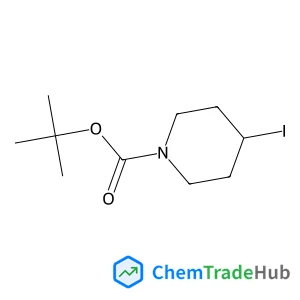
2-Methyl-2-propanyl 4-iodo-1-piperidinecarboxylate
CAS Number:
301673-14-3
Molecular Formula:
C10H18INO2
Recommended Suppliers




Disclaimer
This page provides academic journal information for reference and research purposes only. We are not affiliated with any journal publishers and do not handle publication submissions. For publication-related inquiries, please contact the respective journal publishers directly.
If you notice any inaccuracies in the information displayed, please contact us at support@chemtradehub.com. We will promptly review and address your concerns.