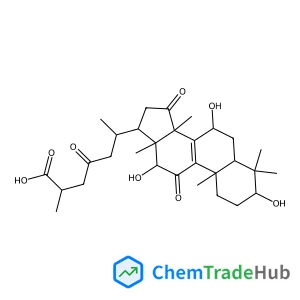
(3beta,7beta,12beta)-3,7,12-Trihydroxy-11,15,23-trioxolanost-8-en-26-oic acid
CAS Number:
98665-22-6
Molecular Formula:
C30H44O8
Maxime Colpaert, Sanjib Banerjee, Vincent Ladmiral, Taizo Ono, Bruno Améduri
The conventional radical homopolymerization of TrFE initiated by a ˙CF3 radical (generated in situ from perfluoro-3-ethyl-2,4-dimethyl-3-pentyl persistent radical, PPFR) is presented. Reactions were carried out at an increasing PPFR concentration (initial [TrFE]0 : [PPFR]0 molar ratios varying from 2.5 to 20.0 mol%) to influence the molar masses (Mn, ranging between 7700 and 38 100 g mol−1). PTrFE homopolymer yields were high (76–87%). The microstructures of such synthesized PTrFEs were characterized by 1H and 19F NMR spectroscopy. The generated PTrFE chains were exclusively terminated by CF3 end-groups, as revealed by MALDI-TOF spectroscopy and NMR analysis, indicating that the ˙CF3 radicals initiated the polymerization of TrFE. The addition of the ˙CF3 radicals onto TrFE was predominantly regioselective (66%) leading mainly to a CF3–CHF–CF2–PTrFE homopolymer. Furthermore, the CF3 end group could be used as an efficient label to determine the PTrFE molar masses by 19F NMR spectroscopy that also enabled us to assess the chain defects (14%). The thermal properties of these CF3–PTrFE–CF3 polymers revealed (i) a high thermal stability (their degradation under an oxidative atmosphere started from 362 °C and ranged even up to 428 °C for higher molar masses of PTrFEs) and (ii) a semi-crystalline behavior with a crystallinity rate averaging 36%.
Paul W. Percival, Khashayar Ghandi, Jean-Claude Brodovitch, Brenda Addison-Jones, Iain McKenzie
DOI: 10.1039/B005762M
Günter Förster, Annette Meister, Alfred Blume
DOI: 10.1039/B003278F
Udo Bakowsky, Willi Rettig, Gerd Bendas, Jan Vogel, Heike Bakowsky, Catalin Harnagea, Ulrich Rothe
DOI: 10.1039/B003727N
DOI: 10.1039/A902689D
Janko N. Herak, Krešimir Sanković, Eli O. Hole, Einar Sagstuen
DOI: 10.1039/B004639F
DOI: 10.1039/A902369K
J. M. Seddon, J. Robins, T. Gulik-Krzywicki, H. Delacroix
DOI: 10.1039/B004916F
When handling 4-(2-Furylmethyl)thiomorpholine 1,1-dioxide (CAS: 79206-94-3), it ...
When handling 4-Chloro-N-[2-(4-morpholinyl)ethyl]benzamide (CAS: 71320-77-9), it...
Waste containing this compound (CAS: 62921-74-8) should be handled according to ...
Waste containing (S)-Methyl 2-amino-3-cyclohexylpropanoate should be collected i...
This compound can be synthesized using a multi-step process involving the conjug...
There are several alternatives to (2E)-3-(3,4-Dichlorophenyl)acrylic acid in syn...
Ethyl 6-(2-nitrophenyl)imidazo[2,1-b][1,3]thiazole-3-carboxylate (CAS: 925437-84...
Waste containing 2-(1,3-Thiazol-2-yl)ethanamine (CAS: 18453-07-1) should be coll...
Methyl 5-iodo-2-methylbenzoate can be synthesized through the iodination of meth...
5-Chloro[1,2,4]triazolo[1,5-a]pyridine is commonly synthesized via the condensat...

Polymer Chemistry welcomes submissions in all areas of polymer science that have a strong focus on macromolecular chemistry. Manuscripts may cover a broad range of fields, yet no direct application focus is required.