


Fabrication of multifunctional fluorescent organic nanoparticles with AIE feature through photo-initiated RAFT polymerization
Literature Information
Publication Date
2017-11-13
DOI
10.1039/C7PY01563A
Impact Factor
5.582
Authors
Ruming Jiang, Meiying Liu, Qiang Huang, Hongye Huang, Qing Wan, Yuanqing Wen, Jianwen Tian, Qian-yong Cao, Xiaoyong Zhang
View Original
Abstract
Fluorescent organic nanoparticles (FONs) based on an aggregation-induced emission (AIE) dye have recently received increasing interest owing to their unique optical properties, water dispersibility and biocompatibility. However, fabrication of multifunctional AIE-active FONs through a facile controlled free radical polymerization method has not been reported thus far. In this work, a novel photo-initiated reversible addition–fragmentation chain-transfer (RAFT) polymerization has been developed for the fabrication of AIE-active FONs for the first time. During this procedure, a new tetraphenylethene based dye (named TPE-DETC) was conjugated to a chain transfer agent, which could serve as the fluorescence signal and catalyst for RAFT polymerization. Styrene (SE) and itaconic acid (IA) were selected as the monomers to construct the final fluorescent copolymers (TPE-SE-IA). Due to the amphiphilicity and AIE properties of TPE-DETC, the TPE-SE-IA copolymers tend to self-assemble and form FONs. The physicochemical properties, drug loading and release behavior of TPE-SE-IA FONs towards cisplatin (CDDP), their biocompatibility as well as cell uptake behavior have been investigated in detail. The results verified that TPE-SE-IA FONs possess strong fluorescence, high water dispersibility, distinguished biocompatibility and highly efficient drug loading capability, making them promising candidates for biomedical applications. More importantly, the in situ photo-initiated RAFT polymerization strategy is an ideal method to be used for the preparation of functional polymeric materials owing to its fascinating features, such as environmental friendliness, mild reaction conditions, being catalyst-free and cost effectiveness.
Recommended Journals

Nature

Journal of Heterocyclic Chemistry

European Journal of Wood and Wood Products

Pure and Applied Chemistry

Proceedings of the National Academy of Sciences of the United States of America

Israel Journal of Chemistry

Journal of Organometallic Chemistry

Molecular Pharmacology

Science Progress

Journal of Physics and Chemistry of Solids
Related Literature
Free electron transfer from several phenols to radical cations of non-polar solvents
Mahalaxmi R. Ganapathi, Ralf Hermann, Sergei Naumov, Ortwin Brede
2000-10-06
Paper
DOI: 10.1039/B005864P
Destructive adsorption of carbon tetrachloride on lanthanum and cerium oxides
Paper
DOI: 10.1039/A901847F
Interaction of thiophene with a molybdenum disulfide catalyst—an inelastic neutron scattering study
Paper
DOI: 10.1039/A902617G
Detection of muoniated organic free radicals in supercritical water
Paul W. Percival, Khashayar Ghandi, Jean-Claude Brodovitch, Brenda Addison-Jones, Iain McKenzie
2000-09-19
Paper
DOI: 10.1039/B005762M
Excess electrons in lithium–ethylamine solutions—density, electrical conductivity and EPR studies
Paper
DOI: 10.1039/A900683D
Already two water molecules change planar H-bonded structures of the adenine···thymine base pair to the stacked ones: a molecular dynamics simulations study
2000-10-13
Communication
DOI: 10.1039/B007167F
Friction and adhesion of mixed self-assembled monolayers studied by chemical force microscopy
Paper
DOI: 10.1039/A809994D
Synthesis of mesostructured aluminophosphates using cationic templating
2000-10-30
Paper
DOI: 10.1039/B004928J
You might also like
Compound Q&A
What precautions should be taken when handling 4-(2-Furylmethyl)thiomorpholine 1,1-dioxide (CAS: 79206-94-3)?
When handling 4-(2-Furylmethyl)thiomorpholine 1,1-dioxide (CAS: 79206-94-3), it ...
79206-94-34-(2-Furylmethyl)thi...
Compound Q&A
What precautions should be taken when handling 4-Chloro-N-[2-(4-morpholinyl)ethyl]benzamide (CAS: 71320-77-9)?
When handling 4-Chloro-N-[2-(4-morpholinyl)ethyl]benzamide (CAS: 71320-77-9), it...
71320-77-94-Chloro-N-[2-(4-mor...
Compound Q&A
How should waste containing 2-[2-(2-Methoxyethoxy)ethoxy]ethyl 4-methylbenzenesulfonate (CAS: 62921-74-8) be handled?
Waste containing this compound (CAS: 62921-74-8) should be handled according to ...
62921-74-82-[2-(2-Methoxyethox...
Compound Q&A
How should waste containing (S)-Methyl 2-amino-3-cyclohexylpropanoate be handled?
Waste containing (S)-Methyl 2-amino-3-cyclohexylpropanoate should be collected i...
40056-18-6(S)-Methyl 2-amino-3...
Compound Q&A
How is 5-({4-[(2S,4R)-4-Hydroxy-2-methyltetrahydro-2H-pyran-4-yl]-2-thienyl}sulfanyl)-1-methyl-1,3-dihydro-2H-indol-2-one (CAS: 166882-70-8) typically synthesized?
This compound can be synthesized using a multi-step process involving the conjug...
166882-70-85-({4-[(2S,4R)-4-Hyd...
Compound Q&A
Are there alternatives to (2E)-3-(3,4-Dichlorophenyl)acrylic acid (CAS: 7312-27-8) in synthesis?
There are several alternatives to (2E)-3-(3,4-Dichlorophenyl)acrylic acid in syn...
7312-27-8(2E)-3-(3,4-Dichloro...
Compound Q&A
How should Ethyl 6-(2-nitrophenyl)imidazo[2,1-b][1,3]thiazole-3-carboxylate (CAS: 925437-84-9) be stored?
Ethyl 6-(2-nitrophenyl)imidazo[2,1-b][1,3]thiazole-3-carboxylate (CAS: 925437-84...
925437-84-9Ethyl 6-(2-nitrophen...
Compound Q&A
How should waste containing 2-(1,3-Thiazol-2-yl)ethanamine (CAS: 18453-07-1) be handled?
Waste containing 2-(1,3-Thiazol-2-yl)ethanamine (CAS: 18453-07-1) should be coll...
18453-07-12-(1,3-Thiazol-2-yl)...
Compound Q&A
How is Methyl 5-iodo-2-methylbenzoate (CAS: 103440-54-6) typically synthesized?
Methyl 5-iodo-2-methylbenzoate can be synthesized through the iodination of meth...
103440-54-6Methyl 5-iodo-2-meth...
Compound Q&A
How is 5-Chloro[1,2,4]triazolo[1,5-a]pyridine (CAS: 1427399-34-5) typically synthesized?
5-Chloro[1,2,4]triazolo[1,5-a]pyridine is commonly synthesized via the condensat...
1427399-34-55-Chloro[1,2,4]triaz...
Source Journal
Polymer Chemistry

CiteScore:
8.6
Self-citation Rate:
7.3%
Articles per Year:
457
Polymer Chemistry welcomes submissions in all areas of polymer science that have a strong focus on macromolecular chemistry. Manuscripts may cover a broad range of fields, yet no direct application focus is required.
Recommended Compounds
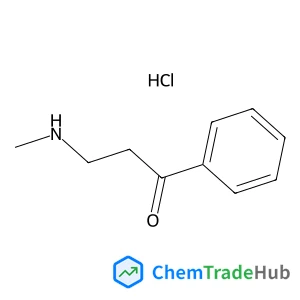
3-(Methylamino)-1-phenyl-1-propanone hydrochloride (1:1)
CAS Number:
2538-50-3
Molecular Formula:
C10H14ClNO
Recommended Suppliers



Disclaimer
This page provides academic journal information for reference and research purposes only. We are not affiliated with any journal publishers and do not handle publication submissions. For publication-related inquiries, please contact the respective journal publishers directly.
If you notice any inaccuracies in the information displayed, please contact us at support@chemtradehub.com. We will promptly review and address your concerns.