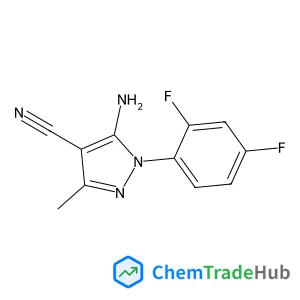
5-Amino-1-(2,4-difluorophenyl)-3-methyl-1H-pyrazole-4-carbonitrile
CAS Number:
1020057-92-4
Molecular Formula:
C11H8F2N4
Chisa Norioka, Kazuma Okita, Miho Mukada
Stimuli-responsive polymers that undergo a sol–gel transition in response to changes in environmental factors such as pH and temperature have attracted considerable attention for biomedical applications such as drug reservoirs for controlled release and scaffolds for tissue engineering. Although numerous stimuli-responsive polymers that undergo a sol–gel transition have been reported, the literature contains few accounts of biomolecularly stimuli-responsive polymers that undergo a sol–gel transition in response to a specific biomolecule. In previous studies, we designed biomolecule-responsive hydrogels that undergo changes in volume in response to a target biomolecule; the strategy involves using biomolecular complexes as dynamic cross-links in the gel networks. In the present study, we designed biotin-conjugated four-armed poly(ethylene glycol) (biotinylated Tetra-PEG) as biomolecular stimuli-responsive sol–gel transition polymers that underwent the phase transition from a sol to a gel state in response to avidin as a target biomolecule. When avidin that forms a biomolecular complex with biotin was added to a buffer solution containing biotinylated Tetra-PEG, the solution transformed to a gel state immediately. However, the addition of a buffer solution with free biotin to the resulting hydrogel induced its dissociation to a sol state. The sol–gel transition of a buffer solution with biotinylated Tetra-PEG was directly affected by polymer concentration and the biotin/avidin molar ratio. The phase diagram of the sol–gel transition of biotinylated Tetra-PEG in a buffer solution as a function of polymer concentration and the biotin/avidin molar ratio is presented.
Veronika Metlenko, WooChul Jung, Sean R. Bishop, Roger A. De Souza
DOI: 10.1039/C6CP05756J
Bhaswati Sengupta, Arusha Acharyya, Pratik Sen
DOI: 10.1039/C6CP05743H
H. B. Ramalingam, R. Hari Krishna, B. M. Nagabhushana, R. Chandramohan, C. Shivakumara, J. Thirumalai, Tiju Thomas
DOI: 10.1039/C6CP04633A
Alberto Privitera, Marcello Righetto, Dario Mosconi, Francesca Lorandi, Abdirisak A. Isse, Alessandro Moretto, Renato Bozio, Camilla Ferrante, Lorenzo Franco
DOI: 10.1039/C6CP05981C
Ross J. Ellis, Mrinal K. Bera, Benjamin Reinhart, Mark R. Antonio
DOI: 10.1039/C6CP06528G
Paulina Sierra-Rosales, Alvaro Muñoz-Castro, José Heráclito Zagal, Fernando Mendizábal
DOI: 10.1039/C6CP06156G
Hui Zhao, Changfeng Fang, Chengbu Liu
DOI: 10.1039/C6CP04826A
Gunnar Jeschke, Maxim Yulikov
DOI: 10.1039/C6CP05904J
Aurélien Bornet, Arthur Pinon, Lyndon Emsley
DOI: 10.1039/C6CP05587G
Lu Yan
DOI: 10.1039/C6CP06536H
Ethyl 4-chlorothieno[2,3-b]pyridine-5-carboxylate (CAS: 59713-58-5) can be synth...
5-Methyl-1H-indole-3-carbaldehyde (CAS: 52562-50-2) is subject to various regula...
(1,3-Dimethyl-2,4-dioxo-1,2,3,4-tetrahydro-5-pyrimidinyl)boronic acid is a white...
Waste containing Sulfocostunolide A (CAS: 1016983-51-9) should be handled with c...
When handling Murraxocin (CAS: 88478-44-8), ensure proper personal protective eq...
Formvar (CAS: 63148-64-1) is an alkyd resin characterized by a high molecular we...
(S)-4-benzyl-2-((benzyloxy)methyl)morpholine is generally safe when handled with...
Methyl 1-(5-bromo-2-pyrimidinyl)cyclopropanecarboxylate (CAS: 1447607-69-3) is p...
2-Methyl-1-phenyl-1-propanamine hydrochloride (CAS: 24290-47-9) is generally con...
3-(4-Bromophenyl)-2-methylpropanoic acid is synthesized through a multi-step pro...

Polymer Chemistry welcomes submissions in all areas of polymer science that have a strong focus on macromolecular chemistry. Manuscripts may cover a broad range of fields, yet no direct application focus is required.
![4-{1-[4-(4,4,5,5-Tetramethyl-1,3,2-dioxaborolan-2-yl)phenyl]cyclopropyl}morpholine structure](https://static.chemtradehub.com/structs/120/1206594-08-2-7afb.webp "4-{1-[4-(4,4,5,5-Tetramethyl-1,3,2-dioxaborolan-2-yl)phenyl]cyclopropyl}morpholine structure")