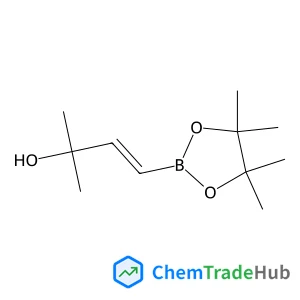
(E)-2-methyl-4-(4,4,5,5-tetramethyl-1,3,2-dioxaborolan-2-yl)but-3-en-2-ol
CAS Number:
581802-26-8
Molecular Formula:
C11H21BO3
J. Lacombe, C. Soulié-Ziakovic
Thymine-functionalized telechelic poly(propylene glycol) (PPG) chains of 460–4000 g mol−1 present a long-range ordered lamellar microphase separation due to thymine crystallization. This organization is lost if the difference of polarity between the H-bonding units and the chain is not sufficiently high to induce segregation, as with a poly(ethylene glycol) (PEG) chain. Moreover, the mesoscopic order is gradually lost with the longest PPG chains i.e. with the smallest volume fractions of supramolecular units limiting their clusterization/crystallization. Methylated thymine (MeThy) end-functionalized PPG presents the same lamellar mesoscopic organization, proving that Thy/Thy H-bonding self-association does not drive their crystallization. Infrared spectroscopy evidences that the amide functions linking MeThy motifs to PPG chains interact with each other through H-bonds, forming either a random or an aligned pattern, just like protein secondary structures. On cooling from the melt, disordered H-bonded amides align and pre-order the supramolecular units just prior to the disorder–order transition driven by the MeThy crystallization. The close packing, necessary to induce crystallization, is no longer possible with bulky neo-pentyl functionalized thymines (tBuCH2Thy), preventing mesoscopic organization. Hence, the pattern formed by H-bonded amide links plays a major role in the long-range organization of the telechelic supramolecular polymer in helping supramolecular units to crystallize. Indeed, replacing the amide by an ester link suppresses their crystallization and thus the mesoscopic order.
Joseph Hufton, John Harding, Thomas Smith
DOI: 10.1039/D0CP04067C
Trent R. Graham, Mateusz Dembowski, Hsiu-Wen Wang, Sebastian T. Mergelsberg, Emily T. Nienhuis, Jacob G. Reynolds, Calvin H. Delegard, Yihui Wei, Michelle Snyder, Ian I. Leavy, Steven R. Baum, Matthew S. Fountain, Kevin M. Rosso
DOI: 10.1039/D0CP04799F
Martin Hoener, Andras Bodi, Patrick Hemberger, Torsten Endres, Tina Kasper
DOI: 10.1039/D0CP04924G
Nishant Sharma, Rupayan Biswas, Upakarasamy Lourderaj
DOI: 10.1039/D0CP05567K
Masaya Hagai, Xiao-Gen Xiong
DOI: 10.1039/D0CP05229A
Miguel Lara-Moreno, Philippe Halvick, Thierry Stoecklin
DOI: 10.1039/D0CP05015F
Inna Ermilova, Jan Swenson
DOI: 10.1039/D0CP05111J
Gang Chen, Xinquan Wang, Yuting Shi, Jonathan S. Tinkham, Thomas M. Brenner, Dana C. Olson, Alan Sellinger, Thomas E. Furtak
DOI: 10.1039/D0CP03306E
Frederik Bader, Jean Christophe Tremblay, Beate Paulus
DOI: 10.1039/D0CP05031H
When considering alternatives to 1-(4-Chlorophenyl)-N-hydroxymethanimine (CAS: 3...
This compound should be stored in a cool, dry place away from direct sunlight. I...
3-(4-Bromophenyl)-5-(2-fluorophenyl)-1,2,4-oxadiazole is synthesized through a m...
5-Chloro-2-(4-chlorophenyl)-4-methyl-6-[3-(1-piperidinyl)propoxy]pyrimidine (CAS...
2-Chloro-4-(difluoromethoxy)pyridine is used in the pharmaceutical industry for ...
3-Chloro-6-methylpyridazine (CAS: 1121-79-5) is classified under the Globally Ha...
Several alternatives can be used in the synthesis of Methyl 4,5-dimethyl-2-nitro...
Alternatives to (2E,2'E)-3,3'-(1,4-Phenylene)bisacrylaldehyde include other acry...
3-Amino-5-chloropyridin-2-ol hydrochloride is an organic compound with the CAS n...
When handling 6,7-Difluoro-2,3-dihydro-4H-chromen-4-one, it is essential to wear...

Polymer Chemistry welcomes submissions in all areas of polymer science that have a strong focus on macromolecular chemistry. Manuscripts may cover a broad range of fields, yet no direct application focus is required.